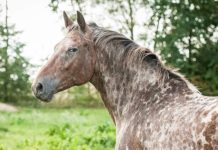
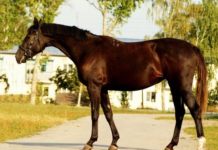
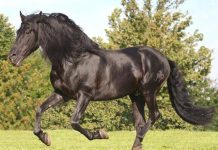
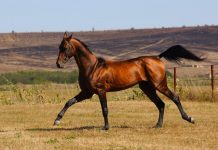
The Dales pony is visually a miniature frieze and a dream in terms of character. Intrepid, friendly, and always hardworking, it is the perfect horse for recreational riders and beginners.
So it is incomprehensible why the muscular pony is hardly widespread in Europe.
Breed description
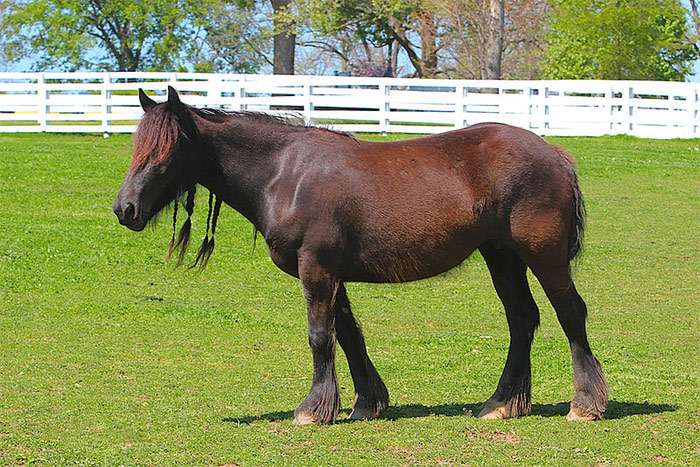
The Dales pony is a pony from the north of England, which was used primarily as a packhorse in the past.
The predominantly black and dark brown horses have a stable foundation and a calm mind.
Size: 135 – 147 cm
Weight: 300 – 450 kg
Origin: England
Lifespan: 25-30 years
Color: Black horses and dark browns
Suitable as: Leisure, Western
Origin and breed history
Dales Pony is one of the pony breeds originating from England, along with the Dartmoor, New Forest, Fell, and Exmoor Pony.
Origin
The Dales Pony is a cross of the Scottish Galloways, a now-extinct breed of horse, and the Pennine ponies native to northern England.
This in turn had Celtic ponies, which once came to England through the Romans and Dutch horses as ancestors.
The characteristic appearance of the Dales pony suggests that Frisians were also among the ancestors.
The need for a strong packhorse was only given by the lead industry in northern England.
The ponies had to move all kinds of materials from the coast and ports to the mines in Northumberland and Durham.
In the 17th century, the English focused on the breeding of Scottish Galloways and Pennine ponies in order to promote the breeding of robust, easy-to-feed, and sure-footed horses. The foundation stone for the Dales pony was thus laid.
Start of breeding
What was remarkable about the Dales Pony was its strength and ability to find its way easily in the rough regions of the north of England. The pony was able to carry over 200 kg.
Their pulling power was also more than remarkable: a Dales pony was able to pull a ton well.
It wasn’t long before the Dales pony was no longer just a workhorse. The English quickly recognized that the Dales pony was also an excellent riding horse. Soon they were used for herding sheep and looked just as good in the hunt as they did in front of a wagon.
Their agility and surefootedness were so impressive that the Dales pony was used in trotting races.
The perfect adaptation to the English weather eventually even led the British Army to use the Dales pony as a packhorse and artillery horse.
Some changes were made to the breed in the 18th and 19th centuries. Using it as a trotting horse, Norfolk and Yorkshire Roadsters were crossed to improve the trot.
By crossing the Clydesdales it was hoped that the qualities of the Dales pony as a pack and artellie horse could be improved even further. The crossbreeding of the Welsh Cobs was intended to improve the gaits in general.
20th century and present
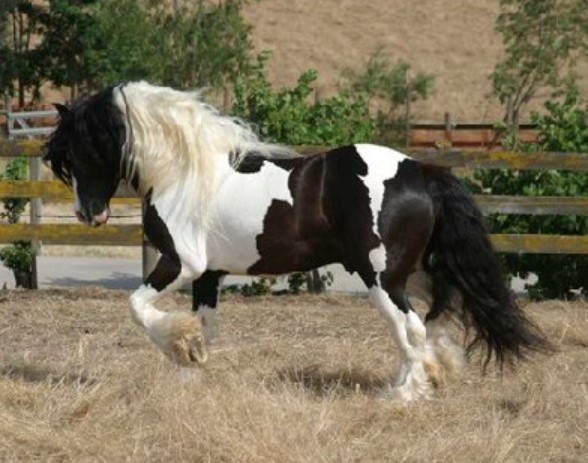
Through the crossbreeding of different breeds, some breeders were forced to set up the Dales Pony Society in 1916 in order to preserve the purity of the breed. The First and Second World Wars, however, almost meant the end of the Dales pony. Many horses perished in the war and only a few ponies ended up in the hands of breeders afterward.
In 1964, today’s Dales Pony Society was launched again and a studbook was opened again. The stock recovers so quickly that the studbook was closed in 1971 and pure breeding is guaranteed.
Despite its consistently positive properties, the distribution of the Dales pony outside the island is limited.
The appearance of the Dales pony
The external appearance of the Dales pony is strongly reminiscent of the slightly smaller fur pony. It’s not a coincidence. Both breeds are closely related and have similar genes.
Anatomy
The Dales pony is a small, compact, and stocky horse. With 135 to 147 cm, the height is clearly within the pony size. The breed association aims for a height of between 142 and 146 cm.
The Dales pony has a round and muscular group. The legs are short with strong joints. The shoulders are strong and sloping, the chest is rather deep.
While the legs and torso of the Dales pony are strong and almost reminiscent of a cold blood (apart from the size), the head and neck can almost be described as elegant in comparison. The neck is thin and long, but well-formed.
The head is small and clearly pony-type. Despite these very different appearances, the Dales pony looks absolutely harmonious in the overall picture.
Color and curtains
The strongest represented in the Dales pony is black horses and dark brown horses, which correspond to the desired type. Much less often you will encounter gray and gray horses as well as horses in a lighter shade of brown. Large badges like a blaze are not welcome.
Smaller badges such as star or snip as well as white shackles on the hind legs are permitted.
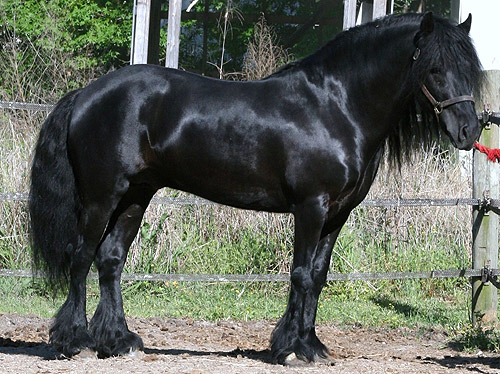
The hangings on the Dales pony are striking. The long hair is long and full, the dense tail should be worn floor-length. In addition to the curtain, the hair on the legs should be emphasized.
The Dales pony has heavy hangings on its legs called a feather.
Temperament and essence
The Dales Pony is the ideal horse for children and beginners. The stocky ponies are balanced, calm, and intelligent.
They are extremely friendly and very obedient.
At the same time, they are not lazy, but are always hardworking and have great perseverance.
Husbandry and nutrition
Attitude
The Dales pony is a sturdy horse that does not have high demands on keeping. Due to its thick coat, the Dales pony can be kept outside all year round.
Like every horse, the Dales pony attaches great importance to contact with fellow horses and species-appropriate feeding.
Nutrition
Like most pony breeds (such as the Icelandic horse and Haflinger), the Dales pony is easy to feed. This means that it is a good feed processor and needs little roughage.
With the nutrient and energy content of the German soils, it appears to be overwhelmed and can tend to become overweight if the physical activity is low.
In order to avoid obesity and the associated health risks, good feed conversion should be taken into account when feeding.
Education and care
Upbringing
Due to its balanced nature and uncomplicated character, the Dales Pony is easy to train and does not present its owner with any major challenges.
Despite its good nature, the Dales pony, like any horse, needs trust in people.
Nevertheless, the lovable pony is definitely suitable for beginners, as it easily forgives rider mistakes.
Due to its great endurance, it is absolutely recommended for recreational riders and is also suitable for driving.
Fearful riders and those returning to the sport also feel extremely comfortable on the Dales Pony.
Maintenance
The care of the Dales pony is relatively unproblematic. It should be brushed regularly and checked for injuries.
Only the mane and tail should be cared for more intensively. Of course, you are free to shorten your mane.
However, the long mane is a characteristic of the breed and should be retained.
If you don’t want to untangle and brush the mane several times a week, you have the option of braiding it into longer braids. Breeders of the Dales pony also often use this measure.
In addition to the mane, the tail needs a lot of care. You should read this out regularly. Once the strands are curled up, untangling the tail is an extremely time-consuming task.
Health and Typical Diseases
The Dales pony has never been a moderate breed in the past, which was beneficial to the health of the breed. Even today only healthy horses are bred.
Typical diseases are therefore not known. Despite its robustness, however, the Dales pony can get sick like any other horse and pony if incorrectly cared for, fed, and kept.
The life expectancy of the Dales ponies
Like most robust pony breeds, the Dales pony is long-lived and, with good care, often reaches an age of 30 years.
Buy Dales Pony horse breed
Have you decided to give a Dales pony a home? Are you interested in ponies? How about the American Miniature Horse, the Shetland Pony, or the Highland Pony?
Here you can find out where you can find what you are looking for and what you should consider when buying.
The Dales pony is not widespread and the current population is relatively small. For this reason, you will rarely come across sales advertisements from private sellers.
If you want to buy a Dales pony, you need to contact a breeder from Germany or England. Depending on whether the horses still have to be imported, you should therefore plan some time if you want to buy a Dales pony.
The cost of a Dales pony is difficult to estimate in advance. The price varies widely and is influenced by gender, suitability for breeding, state of health, level of training, whether the horse has papers that prove its purebred, and whether it was imported from England or even has to be imported.
Horses that come directly from England are significantly more expensive than Dales ponies raised in Germany.
Decision support
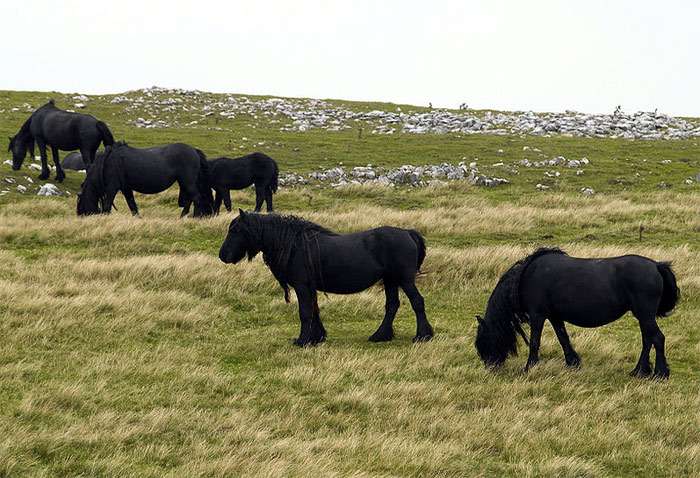
You won’t go wrong with the Dales Pony. Dales ponies are extremely versatile; they are suitable for both driving and riding and are the perfect horse for beginners and children.
Even insecure riders feel comfortable on the friendly and well-balanced ponies very quickly.
Despite its stocky and stable build, it is not the ultimate weight carrier. Tall and strong people should therefore rather refrain from buying them.
In addition to its handy size, the Dales Pony is really the perfect horse for the recreational rider who wants to have fun with his horse and enjoys the calm and fearless nature of the little pony.
In addition, the Dales pony doesn’t hold it against you if you don’t exercise and move it every day. Standing days without intensive work don’t bother the tough pony from the north of England.