A mini appaloosa is a mini pony that is particularly popular with children. It has numerous advantages, but it doesn’t meet everyone’s needs either.
Whether a mini Appaloosa fits into life and personal requirements can be found out from the breed portrait.
Breed description
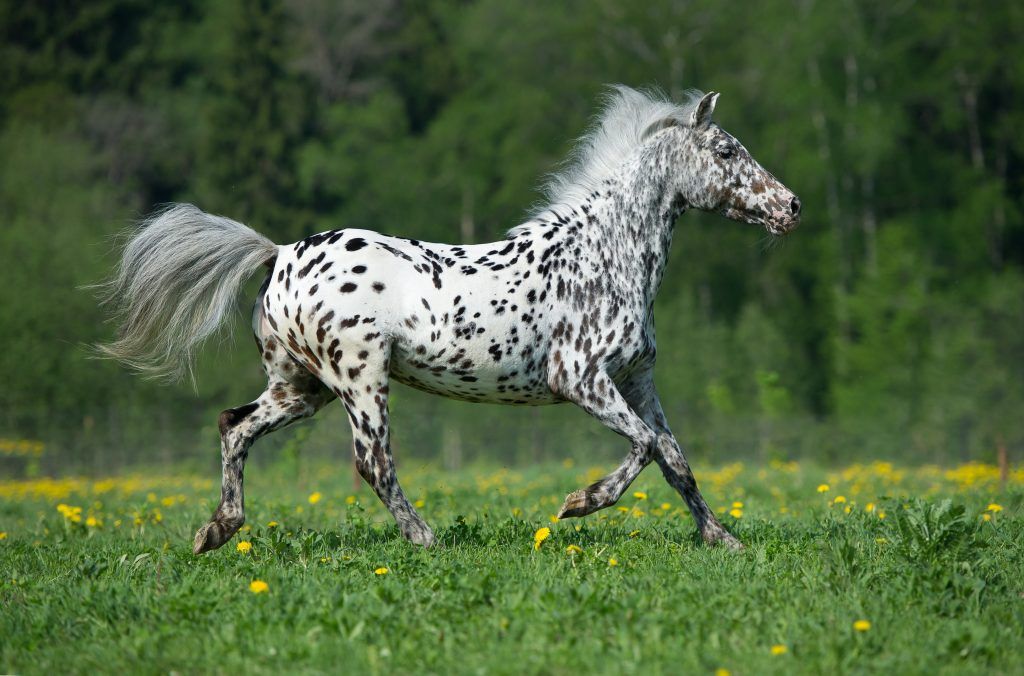
The mini Appaloosa is a horse breed that is one of the smallest specimens of this species.
Although it shares many similarities with the well-known and widespread Shetland Pony and is often confused with it, it is a separate breed. The pony breed is recognized and its own studbook is kept.
The mini horses have a rarity value and have special characteristics like no other mini pony so that they can be clearly identified as mini Appaloosa.
Size: 100-110 cm
Weight: 150-200 kg
Origin: Netherlands
Lifespan: 25-30 years
Color: Tigerscheke
Suitable as: Leisure, Western
Origin and breed history
The history of the mini Appaloosa goes back to the middle of the 18th century. At this time the Indians of the Nez Perce tribe started breeding the Appaloosa, which arose through crossings with Spanish horses and free-range horses in American nature.
This is where the Indians set in and pursued targeted breeding of the Appaloosa, which was based purely on piebald parent animals. Today the Appaloosa is known as the tiger pancake due to its special design.
The Indians found in the small horses an ideal mount that was strong and strong enough to pull and carry loads. This was due to the influence of the Spanish Legionnaires’ horses because they were built much more robustly than the American horse population.
With the decline of the Indians due to the occupation of the country, the Appaloosa race lost more and more of its importance and, like the Indians, became increasingly rare.
It was not until 1938 that breeding was resumed with the still small amounts of Appaloosas. Crossings with the quarter horse took place. The “Appaloosa Horse Club” from the state of Idaho, which still exists today, brought the breed back to life.
In the meantime, the Appaloosa horse is particularly popular as a workhorse in the USA and occasionally finds its way to Europe as a riding and carriage horse. So also to Holland.
Here the Appaloosa was bred to be a mini-pony at the end of the 19th century. At the time, mini-ponies were popular pets that kept the children entertained.
Before mini-ponies were particularly popular in royal families, but wealthy families also considered mini-ponies for their children’s leisure time.
With the Mini Appaloosa, a breed was created that could not be more versatile in use. Due to many of the characteristics that they have inherited from their big “Appalossa siblings” and the advantages that result from their small size, they are now mainly used as riding ponies for very small children and carriage horses.
By the way: only a tiger piebald can be a mini appaloosa. Other drawings are not permitted for breeding.
The appearance of the mini appaloosa
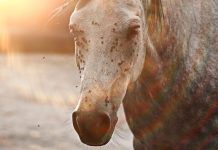
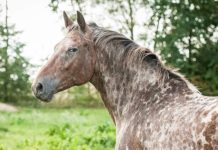
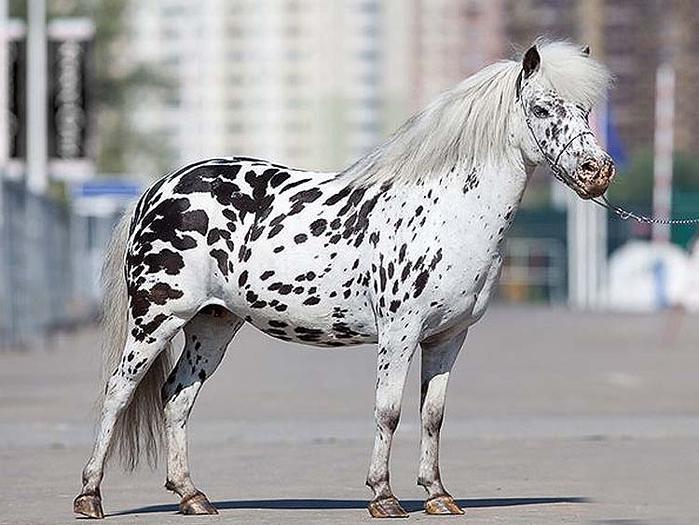
As already mentioned, the pure-bred mini Appaloosa has tiger spotting.
These are either closely spaced colors that are less spotted, but more like a line, as is the case with tigers, which is why this drawing is also called tiger spotting.
Another acceptable variant is stains. These differ from classic piebald horses in that they have irregular stain edges, which are often jagged and always irregular. The formation/shapes of spots with confused pigmentation disorders in human skin is/are comparable.
While one color of spotted tiger piebalds is basically white, line-like tiger piebalds usually have black or brown markings. Rare, but very special, is a fur in which an entire area of the body does not show any drawings, and these are only presented elsewhere.
So it can happen that the head, shoulder, chest, and middle back area completely resemble a black horse, and only from the croup on does, the entire hindquarters have the typical tiger spotting. This phenomenon can develop anywhere in the body.
The head of a mini Appaloosa is dominated by a broad, flat forehead. Compared to classic warmbloods, the eyes are further outwards.
The bridge of the nose is straight. The strong cheek area and the narrow bridge of the nose result in a slim profile downwards, whereby the nostril area, similar to Arabs, points slightly upwards and gives the head a distinctive look.
The physique of a Mini-Appaloosa is strong and shows itself in compact dimensions (square shape). The trunk appears with a deep-set center, surrounded by well-developed muscles.
The withers are moderately high and smoothly merge into the base of the neck. The neck starts well in the chest area, resulting in a wide neck. The croup is well-formed and sloping slightly backward.
The limbs are short according to the body size. The joints show a strong contour and already at first glance give an idea of a stable, robust frame.
The mane and tail hair of the Mini Appaloosa is noticeably thin and fringed. The hooves are normally shaped and differ from those of large horses only in their significantly smaller size.
Temperament and essence
Just like its big “brother”, the Mini-Appaloosa presents itself as a pony with a very easy-going and friendly character. In its essence, the Mini-Appaloosa is characterized by a lot of joie de vivre and willingness to learn.
He is brave, disciplined, and has a tremendous grasp of things. Breeding-related character traits are above all attachment and human orientation. It is not for nothing that the mini Appaloosa is often kept as a pet and playmate for children.
In addition, he is very reliable and can not be easily disturbed. Although he likes to romp, he can easily be converted into concentration mode. He is neither very jumpy, nor does the Mini-Appaloosa have a restless or nervous nature.
Husbandry and nutrition
Attitude
The mini appaloosa feeds on grasses, herbs, and leaves. He tends to be overweight. It is therefore important to ensure that your food ration is adapted to your physical performance.
If he stands in a lush meadow all day, no additional nutrition through oat feeding is usually necessary if he is not physically challenged accordingly.
If this is the case, however, additional energy-rich feeding should take place, for example, oats. Be careful when eating leaves.
Nutrition
There are numerous trees and shrubs that are poisonous. In the worst case, this can lead to a life-threatening situation, especially with the small mini Appaloosa.
Therefore: always check each run-out area beforehand for the possibility of poisonous plants being reached before the Mini-Appaloosa is allowed to dash off.
The good thing about such small ponies is that they take up little space. There does not have to be a large stable and no huge meadows/pastures are required for a little exercise in the open air.
If you own a piece of lawn, you don’t necessarily need a meadow, because your little friend will feel at home here too – especially if it gives them a family connection.
So you don’t have to provide professional accommodation for a Mini-Appaloosa, but it can move into a somewhat larger garden and maybe into a kind of garden shed, where it receives protection from wind and weather as well as a sheltered place to rest and sleep.
While other horse breeds are generally not loners or are not happy without social contact with their conspecifics, the Mini-Appaloosa has no problem with keeping it alone, although of course, it has no objection to a conspecific or at least playful friend.
But through its people-related nature, you can take the position of them very well if you also allow the Mini-Appaloosa to participate in your life. Leaving him to his own devices is not a good idea, as this attitude can quickly lead to the loneliness of the animal.
Education and care
Upbringing
The training of a Mini-Appaloosa is very easy, like hardly any other horse. The pedigree pony benefits here from its special docility, curiosity for new things, the willingness to work, and its thinking.
In combination with above-average intelligence, he has the ability to quickly combine commands, movements, or other actions. So he often already knows what is being asked of him before you convey it to him.
Thanks to his quick perception, he learns quickly and is easy to learn, as well as being guided by the hand, under the saddle, and when clamped. The only important thing here is that training tasks are made understandable for him and that mistakes are not added afterward, as the Mini-Appaloosa can otherwise quickly lose the fun of work.
With a mini Appaloosa, the question is less what it is suitable for, but rather where you would like to travel with it. Due to the immense learning ability and easy trainability, the all-around talent can become a successful jumping pony as well as a disciplined and fearless carriage horse.
His physique offers ideal conditions for western riding. And it is the ideal partner even for learning tricks. At riding and driving tournaments he convinces with strong nerves, which the Mini-Appaloosa has already achieved numerous profits with the help of a good upbringing and ideal training.
Maintenance
The maintenance is limited with a mini Appaloosa. Due to the small body size, there is a correspondingly small area for grooming. Nevertheless, it does not work without a care, because the Mini-Appaloosa also has certain requirements here, just like any other horse.
Grooming the fur, cleaning hooves, and combing the mane and tail are part of the daily ritual. The hooves have to be corrected regularly and dirt particles have to be removed from the nostrils. You will need a lot of accessories for this.
Health and Typical Diseases
Due to their origin and the crossbreeding, that has taken place, two genetic diseases can occur in the Mini-Appaloosa ponies. Otherwise, the mini Appaloosa is considered a sturdy and resilient pony.
Hyperkalemic Periodic Paralysis
Hyperkalemic periodic paralysis, or HYPP for short, is a disease of the muscles. This leads to sudden muscle weaknesses that occur periodically, i.e. at different times and at different intervals.
This disease is not life-threatening for the Mini-Appaloosa. Usually, the symptoms decrease with age. Drug treatment can help prevent seizures.
Polysaccharide Storage Myopathy
Polysaccharide storage myopathy, or PSSM for short, is a hereditary muscle disease that occurs primarily in horse breeds that are related to American ancestries, such as the quarter horse and the Appaloosa pony and consequently also the mini appaloosa.
This leads to a disruption of the carbohydrate metabolism, which leads to problems in the muscles. This can be, for example:
- Muscle stiffness and tremors
- Slackness
- Strong muscle tension mostly in the hindquarters
- Back stiffness
There is no cure for this disease and usually leads to unriddenness and inability to drive. If a mini appaloosa possesses the gene and it is recognized early, special countermeasures can be taken that prevent this disease from breaking out or at least greatly reduce the course of the disease in mini appaloosa.
The life expectancy of the mini appaloosa
With loving care, attentive handling, and animal species-appropriate keeping, Mini-Appaloosa is bursting with health and can easily reach an age of up to 30 years.
Buy Mini Appaloosa horse breed
Due to the possible inheritance of diseases, it is advisable to buy a mini Appaloosa from a breeder who is registered with the breed association.
This ensures that the parent animals are free from hereditary diseases, because only then will they be officially approved for breeding. This regulation is based on the fact that the spread of hereditary diseases is curbed and ideally dies out completely.
But there are also many other breeder sellers. Above all, here you will find a wide variety of offers, ranging from foals to performance horses with completed performance tests. Broodmares and stallions are also available if you want to become a (hobby) breeder of mini Appaloosa ponies yourself.
Even against buying it at a horse market, there are no concerns to be expressed. Because the Mini-Appaloosa Pony is very docile, friendly, and easy to get along with, even animals with bad experiences and acquired idiosyncrasies can be easily corrected. But here you should definitely pay more attention to health factors.
While breeders cannot afford to sell sick Mini-Appaloosa ponies because of their reputation, there are also dubious business people who are more interested in their profit than the animal in public horse markets.
Are you interested in ponies? How about the American Miniature Horse, the Shetland Pony, or the Highland Pony?
Decision support
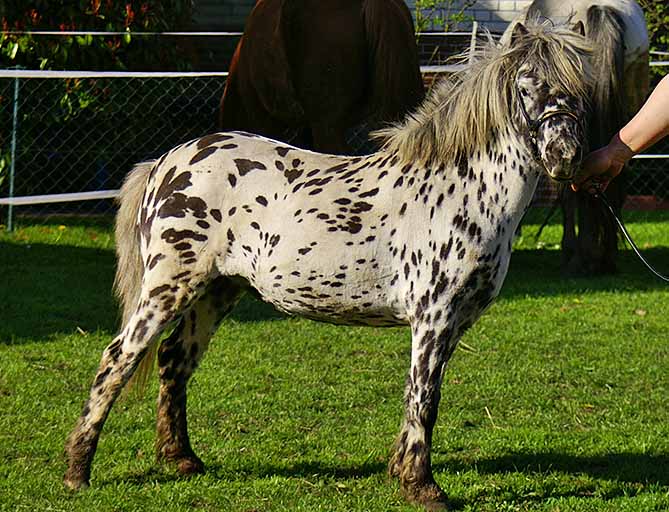
Mini Appaloosa ponies are ideal for fun, as play and riding companions for small children and as draft animals for carriages.
You do not need to have any idea or experience for keeping and handling it, because that is not much different from that of a larger dog.
The mini pony breed is especially ideal for beginners because your children cannot seriously injure themselves if they fall down.
Especially if you do not want to / cannot afford the immense costs of external accommodation but have a sufficiently large garden with lawn and space for a small shelter, you are making the right choice with a Mini-Appaloosa.