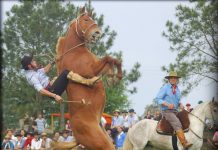
The Criollo comes from the rough and barren regions in South America and is an extremely sure-footed, persistent, and compact horse breed with a stable foundation.
The small horse comes in all imaginable colors and has incredible nerves. They are skillful, agile, and reliable – a dream for every rider.
Breed description
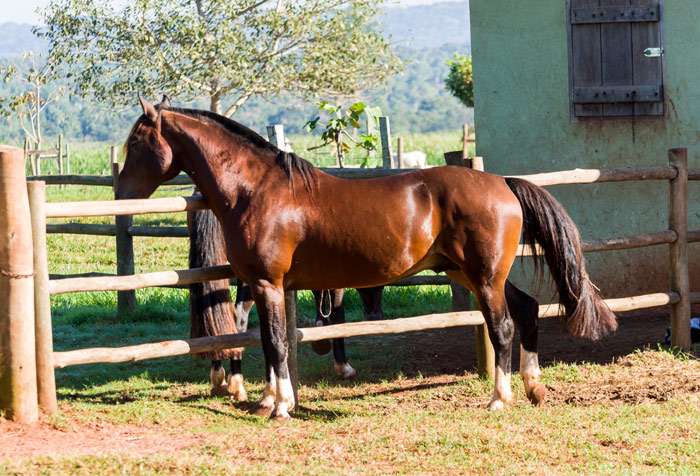
The Criollo originally comes from Argentina and is a compact small horse that comes in all imaginable colors and shades.
With its calm and pleasant character, the Criollo is the perfect leisure horse with a pleasant level of temperament.
Size: 142-152 cm
Weight: 400 – 550 kg
Origin: South America
Lifespan: 20 – 35 years
Color: All colors represented
Suitable as: Leisure time, jumping, tournament, western
Origin and breed history
Origin
Originally the Criollo comes from the horses of Spanish conquerors who brought them to South America in the 16th century. These Iberian horses were closely related to the Berber and Andalusian horses, and these impacts are still noticeable in the Criollo today.
The wild horses lived completely free and without any human influence in the rough regions of South America. This resulted in a natural selection process that only the toughest and toughest horses survived.
The rough climate and impassable terrain ensured that the compact small horses were extremely sure-footed and of great endurance.
Breeding today
The crossbreeding of other breeds almost threatened the Criollo with extinction in the 19th century. The Criollo should be refined by crossing thoroughbreds, while Percherons should make it even stronger.
Efforts that did not help improve the breed of the Criollos – on the contrary. Only to mention the commitment of numerous breeders, especially Dr. It is thanks to Emilio Solanet that the Criollo horse breed has been preserved in its original form.
Through Solanet’s efforts, the Criollo was included in the Argentine studbook in 1918, and the first breed standard was adopted in 1922.
In 1944, a breeding standard was finally passed throughout South America, in which a common standard for the Criollo was agreed.
In 1925 the Swiss Aimé Félix Tschiffely rode two Criollos from Solanet from Buenos Aires to Washington D.C. and thus gained a lot of media attention, which made the Criollo known beyond the borders of South America.
In 1994 the Criollo Zuchtverband Deutschland e.V. was founded, which is affiliated to the Bavarian Special Breed Association.
This breed association uses special performance tests to check whether a horse is suitable for breeding. In this way, the breed-typical characteristics should be preserved in the breed.
Purebred or a mixed breed?
Due to the import of numerous horses from South America, which later turned out to be slaughter horses, the Criollo does not necessarily enjoy the best reputation in Europe.
It is not always clear whether it is actually a Criollo or a hybrid.
Here you get a small overview of the different names.
Criollo
A distinction is made between Criollo Preparatorio and Criollo definitivo. The first is a Criollo that has been grown in one to three generations.
The Criollo definitivo is a horse that has been purebred in four generations. When buying such a horse, the ancestry of the horse is guaranteed, but such purebred horses are correspondingly expensive.
In South America, a Criollo definitely costs at least $18,000.
Mestizos
Mixed breeds from South America are called mestizos and are later sold as South American ranch horses. These hybrids can certainly have Criollo blood, but there is no proof of parentage.
While they are by and large criollotypical, the crossbreeding of other breeds is evident in many horses.
Mestizos are now quite popular in Germany, as they are often larger than the pure-bred Criollo and can easily be ridden by adults.
Mestizos are also significantly cheaper to buy than a pure-bred Criollo with papers.
Mestizos are now imported on a large scale by ship from South America.
Cruzado
Mares who have no pedigree, but clearly correspond to the type of Criollo are referred to as cruzado. Therefore, they were included in the studbook until 2006, provided that they were less than 149 cm tall.
If the mare is paired with a licensed Criollo stallion, the foal receives a pedigree certificate.
The appearance of the Criollo

Anatomy
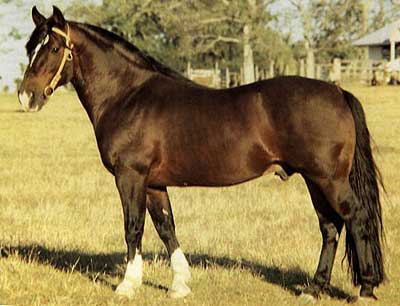
The Criollo is a compact small horse that can be divided into different types depending on the direction of breeding. There is no official set size for the Criollo, for example.
His height varies between 138 and 148 cm. The head is medium in size and compact with a kind eye. The profile of the head should be straight to slightly convex, with small ears and strong gaiters.
The neck is strong and short and merges into an equally strong, broad, and deeply set chest. The withers are barely pronounced, the back is long and straight.
The croup is round and well-muscled, as is the entire horse. What all horses have in common is that they have an extremely stable foundation with strong joints and hard hooves.
The typical pure-bred Criollo, as desired by the gauchos as a workhorse, is only 140 cm tall. Mixed breeds, on the other hand, can grow up to 150 cm.
Although strictly speaking they are not purebred, due to their size they are more popular in Germany than the purebred criollos.
Despite different types within the Criollo breed, certain characteristics are the same in all horses. For example, there must be no deviations in the head.
A finer head or a strong stature, which is at the expense of maneuverability, suggests foreign blood influences. Also hanging on the legs is an unmistakable sign of the influence of another horse breed.
Color
The Criollo comes in all possible color variants, allegedly the Gaucho knows around 600 different color names for his Criollo. 300 color names are secured for the Criollo.
The most common are fallows in all possible variations such as gray and yellow falcons. Just as common are browns with badges, foxes, and Overo piebalds.
Barbary gray horses (cabeza de moro) and foxes (rosillo) are also welcome. Blacks, gray horses, and browns without badges are much less common.
Some breed associations exclude the Tobiano drawing from breeding when piebald.
Temperament and essence
The Criollo is characterized by a friendly and pleasant nature. He is very people-oriented, cooperative, and has considerable nerve strength.
The Criollo neither tends to be frightened nor is it a walk-through. Even unknown situations do not disturb the little horse from South America.
It is clear to him that he sees his fulfillment in working with people. The Criollo is extremely motivated and extremely persistent.
In addition to their endurance, they are characterized by enormous agility and are predestined for work on cattle.
Husbandry and nutrition
Attitude
The Criollo is uncomplicated both in keeping and in nutrition. He is naturally used to cold and heat and can cope with both weather extremes.
Like every horse, however, he needs the possibility of a dry and clean shelter and does not want to stand in the wet for weeks. The Criollo does not need concentrated feed and is also satisfied with little roughage.
Nutrition
The good mineral feed should, however, be fed to meet the nutritional requirements. From his home, he only knows barren pastures, which should be taken into account when feeding.
The Criollo does not necessarily get too fatty feed in the form of lush grass meadows. Hay and straw are more suitable for him.
Education and care
Upbringing
The Criollo is a pleasant horse in terms of training. He does exactly what is asked of him, nothing more and nothing less. He is capable of learning and intelligent, but not stubborn, but rather turned towards people.
The training and education of small horses is a rewarding task with a little horse experience. With the Criollo, however, its willingness to work should not be underestimated.
He would like to work and please with people, these needs should be met.
Due to his pronounced surefootedness, in combination with his friendly and calm nature, he is perfect as a family horse and for trail rides.
His stamina also predestines him for long-distance rides. Certain lines also have a cow sense and have a good feel for working with cattle. Accordingly, the Criollo is now popular with western riders.
Circus lessons and clicker training are also conceivable due to his quick grasp.
Maintenance
The Criollo has steel-hard hooves and only rarely needs to be shod. It is not uncommon for a freshly imported Criollo to have an extremely short tail.
The Gauchos cut their horses’ tails as short as possible so that the workhorses do not get caught in bushes and bushes with them.
A measure that serves purely for convenience and less for optics. The lack of a tail is problematic for the horses, especially in summer.
They are not able to drive away annoying insects and are exposed to them without protection. A lot of stress for the horses. Horses that are imported in the summer months can be put on a fly sheet to make things easier or, alternatively, spend the time when insects are particularly active in the stable.
In summer, like any other horse, the Criollo should be checked regularly for ticks. Tick diseases such as Lyme disease have become more and more common in horses in recent years.
Health and Typical Diseases
The Criollo is extremely tough and robust. There are no diseases typical of the breed in this horse breed.
However, if the Criollo is not moved and fed according to its nature, it too, like any other horse, can be prone to obesity, metabolic diseases, or digestive problems.
Some imported horses may be prone to sweet itch, depending on the region they come from. Continental bred horses have no problems with sweet itch.
The life expectancy of the Criollo
The Criollo is a long-lived horse breed and can easily live to be 30 years old with good care. Quite a few criollos live to be more than 40 years old.
Buy Criollo horse breed
If you have decided to buy a horse and you want it to be a Criollo, some questions will likely arise. Should it be a thoroughbred Criollo or is a mestizo also conceivable?
The best thing to do is to contact a reputable breeder or breeders’ association and find out whether there are any horses available for sale.
If an import is also conceivable for you, you will find the right contact person at the breeding association. In addition to the purchase price, you have to factor in import costs.
For your Criollo, however, you have to take some money into your hand. A pure-bred Criollo, even if it was grown continentally, can cost at least $6000, and even more.
It is repeatedly advised against buying horses imported from South America. The stresses and strains on the ship or on the plane can be traumatic for many horses.
There are now numerous reputable breeders in Europe who breed pure-bred and type-appropriate criollos.
Decision support
The Criollo is the perfect horse for you if you are looking for a partner for western riding, endurance riding, trail riding, or just for long leisurely rides.
You will be impressed by his stamina and surefootedness, no matter how difficult the terrain is. However, you should be aware that the Criollo is not a weight carrier due to its size and foundation.
He is not the right breed for tall and heavy riders. With the Criollo, you get a horse that will not disappoint you in any situation and will always do what you ask of him.
His docility and friendliness are the great strengths of the compact small horse.