The American miniature horse is often viewed with suspicion by European horse lovers: Another newfangled, totally outbred horse breed that certainly doesn’t have much in common with a normal horse.
However, the American Miniature Horse is a real, sturdy miniature horse. It has been bred for a long time to be a good friend to humans.
The American Miniature Horse can do everything that a large horse can and can be used profitably in many disciplines and for many purposes in the leisure sector.
Breed description
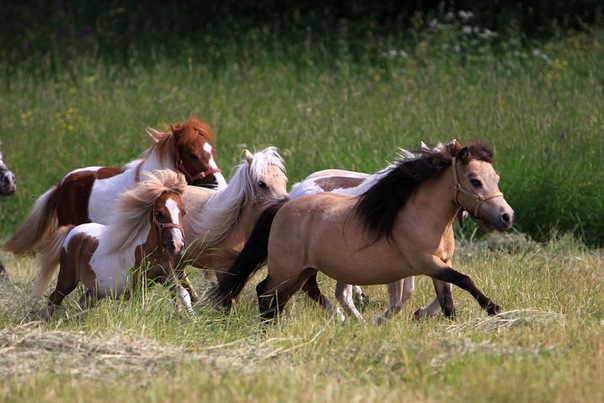
The American Miniature Horse is a mini version of the large horses that dominate the sport and recreational horse world. These are elegant large horses of noble blood, with perfect proportions and harmonious, expressive gaits.
According to the breeding goal, this is exactly how the American miniature horse should look and be built.
With him, every part of the body was simply “shrunk”, carefully keeping the correct proportions in mind, so that the American Miniature Horse reached roughly the size of a stately dog when fully grown.
Don’t be fooled by its tiny stature – the American Miniature Horse is small but mighty! A tiny, but rather magnificent horse, with a big heart, a lot of expression in a slender body, and a temperament that is as friendly as it is fiery.
A great horse for everyone who simply loves horses and not just “horses under the saddle”, which is why it is gaining more and more fans in both the USA and Europe.
Size: 85 – 115 cm
Weight: 20-30 kg
Origin: USA
Lifespan: 25-30 years
Color: All colors
Suitable as: Leisure time, therapy
Origin and breed history
Since the early days when humans first bred horses, horses have not only been bred larger, but smaller too. Today’s miniature horses in Europe and America are the result of centuries of breeding.
This is also the case with the American Miniature Horse: Its roots are originally in Europe, in the continent of the strong and healthy forest and mountain horses from which the heavy cold-blooded horses were also bred.
These prehistoric horses were smaller than the average large horse of today; ponies have preserved much more of their heritage in many breeds.
The ancestors of the American Miniature Horse were also ponies that were used in everyday life for people at that time in many areas of their daily work.
In the 17th century the ponies, which were kept at the European royal courts as riding horses for the aristocratic offspring, were sometimes bred even smaller.
They should be available as early as possible to instill moderation and responsibility in dealing with the animal to future leaders.
Due to the many wars of the 18th and 19th centuries, their numbers were thoroughly decimated until only a few miniature horses were left that were exported overseas (first mentioned in writing in 1888).
From these few specimens, a breed was set up in the USA, which further bred and developed the European miniature horse by crossing Shetland ponies, Hackney ponies, and Argentine falabellas.
Until the 1960s, however, these first representatives of the American Miniature Horses were largely unknown to the public; they were mainly used as mine horses in the Appalachian coal mines.
As the leisure activity with horses increased, such a cute little horse naturally did not stay hidden in the dusty mine for long.
In 1970 a breeding association for the American Miniature Horse was founded, which published the first studbook, and in 1978 the American Miniature Horse Association (AMHA) was established.
The AMHA established clear breed standards and did so much promotion for the small horses that the American Miniature Horse is now one of the breeds with the largest population in North America.
In Europe, recreational riding remained a matter of the wealthy upper class for a long time and only became really freer towards the end of the 19th century.
Useless mini horses “just for playing” were not at all popular for a long time and have now been completely forgotten. Until in the 1970s the run on the most exotic pets possible began and in 1976, in addition to exotic dogs, monitor lizards, and snakes, a few American Miniature Horses were (re-) imported and presented as an attraction at the Equitana in Essen.
The American Miniature Horses were also noticed in other European countries. In the “horse countries” of Denmark, France, Great Britain, and Belgium, the breeding of the American Miniature Horse has progressed very quickly.
In Germany, only a few breeders initially devoted themselves to the cute novelty.
That is why the American Miniature Horse was only officially recognized as a breed in 2003. At that time, the Bavarian Breeding Association for Small Horses and Special Horse Breeds published a German studbook, which is kept in coordination with the AMHA.
This association continues to coordinate German breeding, the American miniature horse is also increasingly being discovered in Germany – and not just as a children’s pony.
The appearance of the American Miniature Horse
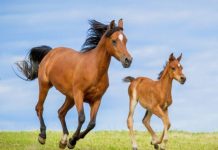
The American Miniature Horse looks like a horse, it is only a good deal smaller: According to the AMHA breed register, an American Miniature Horse may not be more than 34 inches (86.36 cm) high.
This size limit is strictly observed: the last hairs on the mane on the withers are measured.
Apart from the size of the American Miniature Horse, the similarity to the elegant, long-legged horse is in the foreground according to the breed name:
– The American miniature horse should have the same “slim” proportions as a large horse
– With a rather slender bone structure
– And a beautiful, very well balanced movement
The miniature version of a real horse and not a robust, compact, stubborn pony.
In the USA an American miniature horse in the Arabian type has been bred lately, which looks extremely filigree compared to a pony. And unfortunately, it is often very filigree; We will come to the breeding dangers of this breeding line later.
But this is just a special breeding line, the normal American miniature horse is simply a small, well-formed, healthy horse even according to the applicable breeding guidelines.
Temperament and essence
The American Miniature Horse was bred to be a good playmate for the children of the nobles. Therefore it should first show all instincts and all normal character traits of a normal, healthy horse.
In addition, it should be very people-oriented, friendly, reliable and sociable. The pony’s eagerness to work and curiosity are welcome to keep in its genes.
As a rule, an American miniature horse behaves in exactly the same way (and the results of the “breeding accidents” just mentioned suffer more from a physical point of view than from the nature of the horse). This makes an American Miniature Horse the ideal horse for beginners, as a riding horse for small children, and much more:
Husbandry and nutrition
Attitude
For some breeds, there is a heated argument among miniature horse breeders about whether breeding should be more in the direction of ponies (more original, more compact, more self-confident) or more in the direction of horses (lean, long-legged, tame).
Such disputes often lead to misunderstandings about the basic facts among the users of the respective breeds: The American miniature horse belongs genetically to the type of domestic horse, Equus caballus, like every pony and every large horse.
There are different breeds of these domestic horses, which are grouped according to all possible characteristics, including according to size into a pony, small horse, large horse.
Very few people are aware that the ponies, especially their robust breeds, are much closer to the actual original horse than our large horses, all of which were created through very intensive human breeding.
An American miniature horse is a real horse and wants to be kept like a horse.
Ideally, of course, in an open stall or in an active stall.
Stable housing is also possible – because of its small size, an American Miniature Horse could even be kept in a large garden.
A prerequisite, however, is that the American Miniature Horse always has a few buddies available that is roughly his size for every form of keeping.
An American miniature horse can only be recommended as a companion horse for a large horse under these conditions.
If an American miniature horse is to be used to handling large horses, you have to plan a longer period of careful acclimatization.
You have to proceed with the greatest care, because every playful, not necessarily malicious expression of displeasure by a large horse can very quickly cause serious injuries to your American miniature horse (which is why keeping in a herd group with large horses is not recommended).
The horses, which are so different, should only be brought together in an area with enough space so that they can get out of the way if necessary.
Because the large horses are often “more intolerant” than the relaxed minis and can even be quite aggressive towards the “little unknown horses from an unknown world”.
Another prerequisite for any form of husbandry is that you not only see your American Miniature Horse as a playmate but also give it a real task.
Nutrition

An American miniature horse tends to be easy to feed. This can often be observed in friendly, people very affectionate horses and means that they “eat everything you put in front of them”.
Please do not take it literally, because this is exactly where the difficulties lie: Not everything that a horse likes or barely ingests is also good for the horse.
Before buying any other horse, you have to deal very carefully with the subject of horse nutrition before buying an American Miniature Horse.
With the American miniature horse, there is also the fact that it should not simply be fed with the feed that our large horses are usually fed with – with its high proportion of concentrated feed, this is often not optimal even for these large horses.
Simply giving “a quarter of it” to an American Miniature Horse would be fatal. Because it needs as many vitamins and minerals as a large horse, it just has a much lower energy requirement.
It also applies to the American Miniature Horse, just a little more. A healthy combination of feeding and exercise is particularly important for miniature horses.
If this is not the case, horses get fat, and with horses as small as the American Miniature Horse, that happens very quickly.
This excess weight is just as harmful to the health of horses as it is to humans. If it has reached a level like the one in the videos, it may have already caused metabolic changes that can only be brought back to normal function very slowly.
Education and care
Upbringing
The upbringing of the American Miniature Horse is really simple: an American Miniature Horse usually approaches people all by itself.
All you really have to do is allow your American Miniature Horse to become friends with you. And of course, as a wise person to foresee everything that can happen to a tiny horse in the big, wide world.
If the tiny horse is completely wrong in believing that big things in the big world threaten it, you will need a lot of patience to convince the American Miniature Horse of the opposite.
If you spend a lot of time with your American miniature horse in the stable area and thus gain his trust, it shouldn’t be difficult for you.
The rider’s upbringing for the American Miniature Horse is more likely to come from the rider’s parents because the rider is still a little too young for an American Miniature Horse to be able to carry him.
An American miniature horse does not necessarily have to be trained under the rider, there are many other ways to keep it busy.
Maintenance
The coat of the American Miniature Horse is fine to shaggy and must be groomed regularly in both cases.
A good time for the American Miniature Horse; not only because of the pleasant massage but also because you are busy with it.
Otherwise, the American Miniature Horse needs all the horse care that a large horse gets: mane and tail hand-picked, brushed, and maybe even plaited in, inspect areas of skin that are not covered with fur and, if necessary, apply cream, clean ears and corners of eyes, scratch out hooves and greases, etc.
Health and Typical Diseases
It was mentioned above that robust pony breeds are much closer to the actual prehistoric horse than our large horses, all of which were created through human breeding.
This is usually very good for your health, ponies usually suffer less from “horse lifestyle diseases” such as muscle tension and bone sensitivity or food intolerance.
This also applies to an American miniature horse, if it has been carefully and not too much drawn to tiny size or “Arabian beauty” (which is not really beautiful).
With proper husbandry and good nutrition, you can do a lot to ensure that your American Miniature Horse stays healthy for a long time. This goes up to the application of various healing herbs in the context of feeding.
Life expectancy
The average life expectancy of an American Miniature Horse is quite considerable: a well-bred and well-kept American Miniature Horse can grow older than a large horse.
Some American Miniature Horses have already reached the stately age of 30 years.
The prejudice that miniature horses are susceptible to disease also has its reasons: It concerns the exaggerated breeding line of American Miniature Horses of the Arab type, which is often at the expense of health.
Buy American Miniature Horse breed
If you are interested in mini horses, you can ask the Bavarian Breeding Association for Special Horse Breeds, kleinpferde-und-spezialpferderassen.de, which breeders have American Miniature Horses in their product range.
However, they are often only bred with one or two mares on the side. Finding an American Miniature Horse in Germany could therefore be quite difficult.
However, a really large selection of American Miniature Horses can be found in the USA. On the website of the American Miniature Horse Association, you will also find a Breeders List, a list of American American Miniature Horse breeders.
There you could ask which of these ranches more often export American Miniature Horses to Germany.
Decision support

Have you come across the American Miniature Horse in search of a dog of a breed with a “reasonable size” and are now wondering whether it could be an alternative?
Then we can only advise against buying it – an American Miniature Horse is a horse and not a dog and wants to be kept like a horse.
If you already know what it means to keep a horse as a pet, an American Miniature Horse could be a great companion for you.
However, this is only under the following conditions:
– You want and can hold the American Miniature Horse like a “real horse”
– In an (active) stable or in an open stable
– With daily feed and in between also green meadows for grazing
– With as many adventures as possible every day
Then you have to make sure that you get an American Miniature Horse from a good breed, in which care is taken to ensure that the American Miniature Horse remains a complete, natural horse.
The mini-Arabs, which are currently in vogue in the USA, are extreme breeds of the American miniature horse, which you should better avoid.
Their heads are often so narrow that the eyes bulge out. Breathing is difficult because the chest is too tight.
The too delicate and fine bone structure often shows misalignments and can withstand little. Mares often have to be delivered by caesarean section because the foals can no longer fit through the birth canal.