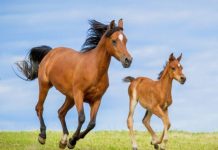
The Partbred thoroughbred horse is an ideal combination of stylish elegance, endurance, and robustness. It is conditionally suitable for beginners and inexperienced horse enthusiasts.
Before buying, check the breed portrait to find out whether a Partbred is the ideal purchase decision for you.
Breed description

A partbred is a cross between warm-blooded horses, primarily Trakehner, and thoroughbred Arabs, whereby the proportion of thoroughbred Arabs must be at least 12.5 percent.
The result is the Partbred horse breed as a half-blood that brings together the positive characteristics of warm and thoroughbred horses in one horse.
A studbook for this horse breed has only been in existence for some time, for which previously a maximum of one position in the preliminary book of Arab breeding associations was given.
Here they are referred to exclusively from Arab half-blood, while the breeding association for Shagyi Arabs, Anglo-Arabs, and Ara-ber e.v. (ZSAA for short) this horse breed is run as the Arabian Partbred.
Within Germany, the Partbred horse is listed in the studbooks “German noble blood” and “Arabian Partbred – Type: Special”. The former allows, in addition to the breeds of ZSAA, also crosses with the “German Riding Horse”.
With the Arabic Partbred Typ Spezial, all riding horses, special horses, gaited horses, and riding pony breeds can be registered.
With a stick size above the pony gauge, the classic Partbred is one of the small horses.
Special types, such as the Partbred Shetland pony, are mini ponies with a stick size of up to 112 centimeters.
Origin and breed history
The Partbred horse breed has not officially been around for long. Initial breeding attempts can be traced back to the 1990s, with their first occurrence in North America and Europe.
It was not until 2000 that a Partbred stallion was licensed for the first time.
To date, the breeding takes place mainly in North America and Europe, although other continents have now also found interest in the breeding or horse breed.
It is not known exactly where and when and by whom the idea of cross-breeding came about. The first breeds, however, allowed thoroughbreds to be crossed with horses without specific breed specifications.
It was only with the breeding goal of combining the characteristics of warm and thoroughbred horses that the selection of suitable mare and stallion lines was restricted.
The result should be a larger-framed horse with the Partbred, which is significantly more robust and balanced than the thoroughbred, but has the high endurance that a warmblood in this form lacks.
In addition, the thoroughbred influence usually gives a more distinctive, noble look and makes the often chunkier-looking warm-blooded animals appear more delicate, elegant.
The first breeding lines of the Partbred crosses are ideal for long rides and hunting.
In the meantime, an exceptionally good jumping ability has been discovered at the Partbred, so that they have also been successfully used in multi-purpose and jumping tournaments for several years.
Today, the expansion of the breeding conditions is planned in order to make the Partbred even more performance-oriented in the direction of sportiness, so that in the future the Partbred horse breed will probably be seen much more often at dressage and jumping competitions or even at the Olympic Games.
The goal is to achieve this and that with a “new generation” of Partbreds, who are supposed to carry more and more thoroughbred blood, until perhaps one day the Arabs will become high-performance athletes.
The appearance of the partbred
When it comes to the appearance of the Partbred horses, it depends on how much whole blood there is and which breed prevails more in a cross.
The Partbred Welsh Pony can only have minor optical details, while the Trakehner-Thoroughbred Arab mix, for example, can be recognized much more than this.
The more whole blood there is in a partbred, the more distinctive the head, among other things, with the convex curve of the bridge of the nose being typical of the thoroughbred Arab, as well as the relatively wide, flat forehead and the relatively small, narrow mouth area.
Since the Arabian is between 140 and 160 centimeters tall, a partbred that is significantly larger, but can be immensely smaller due to the mix with mini ponies, is generally not to be expected.
The mix of robust warm-blooded animals with strong joints usually results in stronger joints in a Partbred than the Arabs have. The legs and especially the cannon bones in the Partbred are mostly much slimmer than in the warmblood.
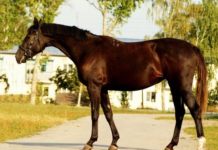
The neck usually benefits the most from half-blooded breeding. The Partbred shows this well-formed, graceful and muscular. The withers are usually flatter than in Arabs and the back is not so strongly arched, which makes it much better for resting saddles.
There is also a good belt width. The croup becomes rounder with increasing whole blood content and the tail set is high.
If the Partbred comes more like the Arabian thoroughbred, the shoulders are sloping and the leaves are relatively long.
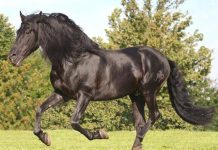
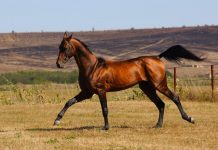
This allows a thoroughbred-dominating partbred to have an enormous amount of swing at the gallop, which is his preferred gait, while the trot is less or not practiced at all. The hooves are quite small and narrow in circumference.
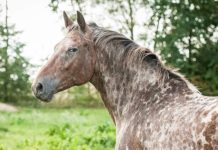
The fur is slightly longer than that of warm-blooded animals. Anything is possible as color, from black and gray to foxes and browns, to badges and piebalds / pintos.
Temperament and essence
Also with regard to the essence and character, no general statement can be made, as is shown exactly with a Partbred. The different possible influences by the warm blood cross do not allow a general answer to it.
Only the tendency due to the Arabian thoroughbred can be mentioned here. A better assessment of character and nature can be made if the blood percentage and the warm-blooded breed are known, under which the most diverse character traits and types of nature can be found.
The typical thoroughbred Arab is known for his fiery nature, which is definitely lower in a Partbred. The full-blooded temperament is also more restrained in the Partbred. But a partbred is always very willing to learn and willing to perform.
He can be stubborn and it is not uncommon for him to be slightly nervous. He is much more confident in people than the thoroughbred Arab, but it takes time, which is why patience is required.
In addition, a partbred can be resentful. He remembers bad experiences for a long time and reacts accordingly. Once trust has been created, it becomes man’s best friend.
If it does not happen, this can result in a certain jumpiness and restlessness, which is much less due to the warm-blooded influence of the higher calmness.
Otherwise, Partbred thoroughbred horses show themselves to be immensely enjoyable at work and prove to be not particularly fearful horses.
Husbandry and nutrition

Attitude
Due to the fiery temperament of the thoroughbred Arab, sufficient exercise is also essential for the Partbred in order to make the horse happy and keep it healthy.
Depending on which bloodline is more strongly represented, Partbreds sometimes bitch with other members of their own species. Wallach in particular can show a stronger dominance, so keeping them in the meadow and in the direct vicinity of the stable can be associated with restlessness.
It is important to ensure that the risk of injury is kept as low as possible when “stinking”. If necessary, they may need to be disassembled and/or separated in the pasture.
But as already mentioned, the proportion of blood and the nature of the warm blood side play an essential role. If the warmblood dominates, a Partbred can also be very undemanding in terms of posture and prove to be a frugal, very peaceful, and agreeable horse. But in any case, he needs a lot of space and exercise in order to be able to run.
Nutrition
If the partbred is classified as jittery and restless, this usually also affects the stomach and/or the digestive system. Overfeeding should be avoided in any case, because Partbreds are more prone to overweight and colic.
Too much high-carbohydrate feed is also not beneficial. When it comes to nutrition, attention should always be paid to a diet rich in vitamins and digestible.
Competitive horses should be given concentrated feed when they are under high stress in order to quickly replenish their energy and protein stores after a workout.
Flaxseed and wheat bran offer the partbred a change in the menu and optimize the digestive functions.
Education and care
Upbringing
The more thoroughbred there is in a Partbred, the more tenacious and stubborn it can be when it comes to upbringing.
If the parent on the warmblood side is known to be a very calm and relaxed guy, this usually also has a positive effect on the upbringing.
Thoroughbred beings do not shy away from confrontation and like to assert themselves. A “hard”, consistent hand is required here. If the partbred is “cracked”, as horse connoisseurs call it, the partbred proves to be a very docile and willing horse.
He has a very good perception and high intelligence. In combination with the trust between the partbred and the rider/guide, the upbringing becomes almost child’s play and a lot of fun.
A little sensitivity in the upbringing is still required because a Partbred can also turn out to be a sensitive being who could react fearfully if the crackdown is too tough.
Fear is never good in a horse because it makes it unpredictable – no matter what breed!
Crossing with thoroughbred Arabs gives the Partbred elegance, which is mainly reflected in its shiny fur. Daily grooming and regular showering in summer should be in order to maintain the elegant, well-groomed overall appearance.
Particular attention should be paid to hoof care. They are relatively small and can break quickly, especially if you do a lot of work on hard ground. Generous greasing and hoof corrections at short intervals are recommended for optimal care.
If the tail and mane are kept natural and not trimmed in tournament style, it is essential to comb the mane and sort the tail every day so that no knots and tangles form.
After a demanding workout, the tendons and ligaments on the tubular legs thank when they are rubbed with rubbing alcohol or something similar with a cooling effect.
Health and Typical Diseases
The thoroughbred Arab is considered to be a very resilient horse with excellent, robust health. Typical, breed-specific diseases are not known from this side.
However, typical illnesses can arise from the other parent. That depends on which warm-blooded breed it is so that no general information can be given in this regard as to whether such a breed can occur or not.
It is advisable to find out about the warm blood part of the Partbred breed in order to be able to get an exact picture of whether there is a risk of hereditary diseases due to the parental horse breed.
If it is a partbred that consists of 50 percent whole blood and 50 percent warm blood, the risk of typical racial diseases is very low.
Life expectancy
Due to the influence of the warm-blooded animals, this noble horse breed has a significantly higher life expectancy than that of the thoroughbred Arabs. In this case, the average life expectancy is around 17 to 18 years, while warm-blooded animals often exceed the age of 21.
This of course depends on how optimally the horses were kept and cared for and how much stress they were put into. Competition horses that move from tournament to tournament and are in tough training in between usually have a significantly shorter life expectancy.
This is between seven and nine years of age for warm-blooded animals. If you take care of a partbred attentively and lovingly, offer him enough exercise without constantly challenging him to perform at the highest level, he can easily reach an age of 19/20 years and more.
Buy Partbred horse breed
Buying a Partbred involves a certain amount of risk if you have no experience or knowledge of buying a horse.
Because a lot depends on the warmblood parent in a Partbred, it is advisable to always seek the help and support of a licensed breeder.
They lose a good reputation if you sell prospective buyers a horse that is unsuitable for them. A serious breeder is always concerned that “his” offspring are doing well with the new owner and that the owner will enjoy the horse for a long time.
Alternatively, there are sellers who are recommended by trustworthy rider friends. In any case, you should refrain from buying at public horse markets.
Decision support

If you want to benefit from the advantages of a warmblood, such as serenity, sociability, and robust physique, but also want a little pep and elegance, a Partbred is a good purchase decision.
However, you should be aware that he loves the distance and should be able to run a lot.
If you lack horse and/or riding experience, a partbred that has 12.5 percent whole blood is recommended.
But ultimately, temperament and essence only reveal themselves when you face a partbred. After all, upbringing is also relevant to whether a Partbred is suitable for beginners or not.