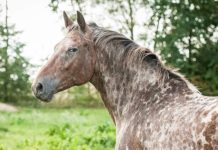
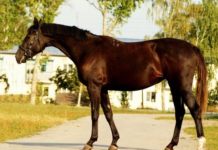
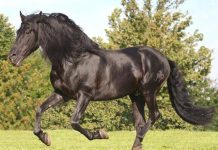
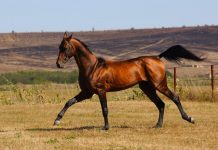
Small, robust, and smart: this is how the Huzule, a pony breed from the Eastern Carpathians, presents itself.
The pretty, resilient ponies go back to the wild horse in their origins and were used by the farmers as work and load horses.
You can find out everything you need to know about the small, Ukrainian Hutsul horses and whether such a horse suits you here.
Breed description

The Hutsul is a breed of pony that originated in the Hutsulei, a region of the Eastern Carpathians in Romania. The region, or the mountain farmers of this region, from which the pony breed originates, was also the inspiration for the name of the breed, the Hutsuls.
The Huzule is small and very robust, the maximum height of this horse breed is 145 cm.
The Hutsul was bred semi-wild by the mountain farmers of the same name – the Hutsuls – and was highly valued as a draft and load horse.
Size: 135-145 cm
Weight: 380-450 kg
Origin: Eastern Carpathians
Lifespan: 25-30 years
Color: All colors except gray and wild horse badges
Suitable as: Leisure time, draft horse
Origin and breed history
The pony comes from the Hutsule region, north of the Bistritz river, in the eastern Carpathians. They were bred by the mountain farmers who settled there well into the 19th century.
The Hutsul grew up semi-wild in herds. Characteristic wild horse badges such as black pastern stripes, the eel line, or the back cross indicate that this old and almost original horse breed is closely related to the Tarpan.
When the demand for versatile, small, and powerful horses for the army and cavalry steadily increased, the Hutsuls began to be bred in a targeted manner.
For a long time, it was possible to distinguish between three different types of Hutsuls.
Tarpan type
Bystrzec type
Przewalsky type
The tarpan type wore the characteristic badges of the tarpan. Even today there are quite a few ponies that have eel stripes or fetlock stripes.
The Bystrzec-type of the Huzule clearly emerged from a mating between the Tarpan and the Konik, another pony breed from Eastern Europe.
In the Przewalsky type, the crossbreeding of different Tartars and Mongolian horses was clearly visible.
The breeding of the Hutsuls
Around 1870, some of the beautiful and strong Huzule ponies ended up in the Imperial and Royal State Stud in Radautz. This stud was located in the northeast of the country, in what is now Romania.
The aim was to breed horses for the Austro-Hungarian armed forces that could operate reliably in rough terrain. In addition, the Hutsul was crossed with Koniks, Arabs, and English thoroughbred horses.
As a result, the breed became larger overall, but gradually lost its original type, hardness, and toughness.
During the First World War, the stock of breeding horses was evacuated to Lower Austria for safety.
After the war, the horses that were leftover were taken to different countries, namely Hungary, Romania, Czechoslovakia, and Poland. State studs of this breed of horse can still be found here today.
The first studbook was opened in 1924. From this point on, the Hutsuls were also bred pure again in order to preserve the original characteristics of this beautiful pony breed.
The Hutsul today

Seven stallion lines had established themselves over time: Prislop, Hroby, Polan, Gurgul, Ousor, Pietrosu, and Goral.
All Hutsuls that are recognized and registered in a studbook go back to these seven stallion lines.
Hroby
The stallion Hroby was born in 1895 and was a grazing stallion from Luczina. He was 130 cm high at the withers. He was used as a breeding stallion from 1901 to 1905. Very good and noble riding horses come from this line.
Goral
Goral was born in 1899. In 1905 it was imported from Zabie to Huzulei. His height at the withers was 139 cm, his chest a proud 173 cm. Very good distance and leisure horses come from him.
Gurgul
Gurgul was born in 1924 and was of unknown ancestry. He came from Czechoslovakia and was used as a breeding stallion in Topalcianky.
His height at the withers was 136 cm, his chest was 172 cm. Heavy horses, suitable for forestry and agriculture, come from his line.
Polan
Polan came from Hutsulei and was also born in 1924. Very good driving horses come from him.
Ousor
Ousor, born in 1929, came from Luszina in Bukowina in Romania. His appearance was somewhere between the Hroby and Gurgul lines. Very good work and load horses came from him.
Pietrosu
Pietrosu was born in 1930 and comes from Bukovina. Pietrosu was mainly bred in Austria and Romania. His offspring are excellent all-rounders.
Prislop
Not too much is known about Prilop. He is descended from Goral III and was born after 1930. Prislop came from Romania.
It is still bred as a pure breed today. The Romanian state stud Lucina, the Hungarian stud Aggtelek, the Polish stud Gladyszów and the Slovakian state stud Topolcianky deny the majority of the breeding.
Some smaller stud farms in Germany and Austria have also committed themselves to breed Huzulas.
The appearance of the Hutsul
The Hutsul is rather small in size. The height of the stick ranges from 132 cm to a maximum of 145 cm for stallions. The expressive head has a slightly concave profile.
The ears should not be too long and the nostrils should be large and wide. The expressive eyes look lively.
The neck is set in the middle and is short to medium in length. The physique is rectangular, this is typical of the Hutsul. The croup is sloping and short. The tail is carried low.
In the case of six-year-old Hutsuls, the chest circumference must be 30 cm higher than the height of the stick. The legs are strong and have large and pronounced hooves.
The Hutsul comes in all colors, except mold.
The main colors, however, are brown, fallow, or Isabelle, which mostly resemble the characteristic wild horse badges such as the eel line, the black pastern stripes, the indicated zebra stripes, and the back cross.
Temperament and essence
The Huzule is a robust, undemanding and undemanding horse. It has a friendly and balanced character.
However, due to his very rough demeanor in his homeland, the Hutsul has also become a self-confident horse that can react very stubbornly from time to time.
Because of this attitude, the Hutsuls have developed a very good sense of danger. It can happen that the Hutsul refuses to serve you if he fears for his safety. The Huzul is therefore rather unsuitable as a pure children’s horse.
His strong nerves, his perseverance, his surefootedness, and his courage make the Huzul an ideal leisure horse as well as his willingness to learn, his intelligence and his good-natured nature.
Husbandry and nutrition
Attitude
The Huzule is an absolutely undemanding horse. It can stand outdoors all year round without any problems.
When it comes to occupation, things are different: the Hutsul has to be moved several hours a day, and he even needs daily exercise.
The Huzul is not suitable as a horse that mostly only stands on the pasture and is ridden sporadically.
Nutrition
When it comes to food, the Huzule does not have any great demands.
However, you should definitely consider a high-quality, balanced feed.
Education and care
Upbringing
The upbringing of the Hutsul is relatively easy due to his eagerness to learn and his cleverness.
However, you should already have some experience in training a horse. Buying a fully trained horse is therefore suitable for beginners.
Maintenance
Like any other horse, the Hucul needs care.
Grooming is important for the health of your horse and strengthens the bond between humans and animals.
Health and Typical Diseases
The Huzule is a strong, robust, and healthy horse. There are no typical diseases in this breed of horse.
A weak point in this breed of horse is the legs.
Misalignments occur very often in the Hutsuls. The so-called cow hocks – one can also call it “knock knees” – occurs particularly frequently and is tolerated in a mild form.
The cow hacking occurs particularly often in pony breeds, to which the Hutsuls belong.
The misalignment of the legs can cause the joints to wear out more quickly. You should pay attention to this with your Hucul.
Life expectancy
The life expectancy of this robust and healthy horse breed is average
The robust and resilient Huzule has an average life expectancy of up to 30 years or more.
Buy Huzule horse breed
The number of Hutsuls in Germany is growing steadily. You can purchase a Huzule from one of the breeders of this pony breed here in Germany or Austria.
You can find a lot of offers online at horse markets and classifieds.
Before buying, insist on the so-called purchase examination, which means that a veterinarian carefully examines the horse of your choice before buying it.
It is also advisable that you be present during this examination.
Interesting facts about the Hutsuls
The Hutsuls are mainly bred in Eastern Europe with quite large populations. As a result, he falls under the “less common horse breeds”.
Since 2001 the Hutsul have been listed in Austria as a horse breed that is worth preserving but is threatened with extinction.
Decision support

The Huzule is a robust, healthy, and resilient horse. It can be kept outdoors all year round without any problems. This pony breed is also very undemanding and frugal.
The characteristic of the Hutsul is their surefootedness, their longevity, and docility. The Huzule is ideal as a family horse or as a leisure horse.
But these small, agile, powerful ponies can also be used as carriage horses.
If you are looking for a small leisure horse with a maximum height of 145 cm and a sociable character and strong nerves, a courageous and easy-to-ride horse, you should consider buying a Huzule.
This old and strong horse breed is unfortunately not so well known outside of Eastern Europe, but it finds more and more fans every year – and rightly so.
What is a Hutsul?
The Hutsul is a pony breed and comes from the “Huzulei”, an area in the Eastern Carpathians north of the Bistritz river, where the Hutsuls have settled as mountain farmers.