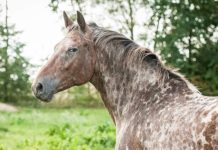
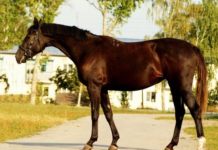
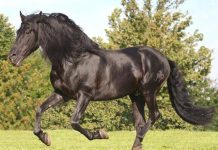
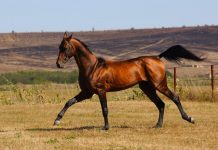
The Akhal-Teke thoroughbred is the oldest pure-bred horse breed in the world. Its origin goes back to over 2000 years according to various sources. These noble, fast, light-footed, resilient and strongly people-oriented horses were the most important weapons of war of the nomadic tribes of Central Asia.
Akhal-Teke Horse Breed

He is also known as “the greyhound among horses”: the Akhal-Teke. It is not only because of its unusual and elegant appearance that it inspires many people, its robust and spirited temperament also ensures that the Turkmen desert horse has many fans in the meantime.
“I first saw an Akhal Teke over fifteen years ago at the Swiss National Knee Circus, who presented three of these unique thoroughbreds in his horse show. At the time, however, it was not easy to get hold of these horses. With a lot of luck, I bought my first Akhal Teke stallion a short time later. He had been imported from Russia to Switzerland shortly before as a four-year-old and I was immediately impressed by his noble character and expressive gaits. Thanks to contacts within Europe, I was able to expand my breeding quickly, ”says Buss.
The main breeding area of Akhal Teke is in Central Asia and extends over several countries from Turkmenistan to Kazakhstan and southern Russia, where this oldest and thoroughbred horse breed in the world has been bred for around 3000 years. The Turkmen nomadic tribe of the Tekke gave this breed its current name. The horses came to Eastern Central Europe via Russia in the 18th century and had a formative influence on Trakehner studs and English thoroughbred breeding.
For Hans-Jurg Buss, the historical background of this breed is particularly fascinating: “The Akhal Teke is a piece of human cultural heritage. Early on, the nomads of Central Asia bred the Akhal Teke especially for use as war horses and prey. He had to be extremely persistent, tough, willing to perform, quick to react, reliable, and undemanding. These character traits have remained with him to this day, ”says the breeder.
Therefore, the Akhal Teke can also be used in a wide variety of equestrian sports. In his homeland in Turkmenistan, he is mainly used for horse races. Outside of his breeding areas, he is known for his extreme hardness on long distances, his speed, and his jumping ability. For this reason, it is used here in the country mainly in versatility and endurance riding.
“As pure thoroughbreds, the Akhal Teke is very persistent, long-legged, and agile,” says Buss. His son Jacopo Buss, today an international three-star eventing rider and member of the Swiss elite eventing team, became vice-champion of Switzerland as a junior with one of his Akhal Teke stallions.
But also in dressage, some Akhal Teke was able to celebrate successes, above all the famous 1960 Olympic champion “Absent” under the Russian dressage rider Sergei Filatov. Absent was the only horse to win Olympic medals at three Olympic Games (Rome, Mexico, and Tokyo) and was even voted “Sport Horse of the Century” by Western European horse journalists in 1968. As great-grandfather, “Absent” can also be found in the dam line of Buss ‘licensed stallion“ Mazan ”.
The Akhal-Teke is considered to be a particularly persistent, frugal, and spirited horse. As a desert horse, it has learned to get along with little and to achieve a lot even over long distances, which has resulted in a unique endurance horse.
The Akhal-Teke is extremely sure-footed and can cover long distances through tough conditions in a short time with his expansive movements. His robust and nervous nature combined with his strong will make the desert horse breed today a popular sport and leisure horse around the world. The Akhal-Teke does not only shine when it comes to endurance rides: there have also been several successful horses of his kind in show jumping and dressage.
Because the Akhal-Teke is not only persistent but also extremely willing to perform – he wants to be promoted, is curious and demanding. If a person responds to him, a close bond can develop between the loyal Akhal-Teke and his person. Provided he is treated accordingly. If he is badly treated or neglected, the Akhal-Teke clearly shows what does not suit him.
Although the Akhal-Teke belongs to the warm-blooded animals, it looks more like a thoroughbred. It was precisely this elegant appearance, combined with his spirited nature, that ensured that the Akhal-Teke was often crossed with stronger European horse breeds in order to refine them.
The Akhal-Teke is often referred to as the “most beautiful horse in the world” because of its unusual fur, which often has a metallic shimmer and makes it appear golden with certain color embossing.
History of the Akhal-Teke

Exactly where and when the story of the Akhal Teke began is unknown. What is certain, however, is that the Akhal-Teke is one of the oldest horse breeds in the world and was bred in Turkmenistan over 3,000 years ago. Here the spirited animals lived in herds in the wild steppe and were only looked after by shepherds on their horses. The elegant horse breed quickly caught on in China and is said to have been very popular over 2,000 years ago.
The number of pure-bred Akhal-Teke sank through many wars and was only brought back to a stable number by crossing thoroughbred Arabs. It was not until 1917 that a studbook was created, which was kept in Russia. Although the studbook is in Russia, Turkmenistan still has the right to keep the studbook. English Thoroughbreds were briefly crossed into the Akhal-Teke breed around 1920. Not even 20 years later, the mating of Akhal Tekkins with English thoroughbreds was again declared improper. Today the elegant horse breed can be found almost all over the world.
Turkmenistan still seems very proud of the breeding of the elegant desert horses and so it happens that the Akhal-Teke adorns the country’s coat of arms.
“The Akhal-Teke is the unique result of breeding efforts by Central Asian steppe peoples over millennia. In the eventful cultural history of the Orient – Central Asia and the Middle East – the better horse often enough decided over the victory or destruction of entire cultures and peoples The “Akhal” oasis from the Turkmen tribe of the “Teke” is the world cultural heritage “Akhal-Teke”, which has been handed down to us from this development that has lasted for thousands of years “. (Quote from the Association of Friends of Akhal-Teke Horses Switzerland.)
The famous stallion Bykephalus of Alexander the Great was, according to history, a predecessor of the Akhal-Teke breed. With the stallion, Beverly Turk, one of the three founding stallions of the English thoroughbred breed was very likely also an Akhal-Teke.
In this tradition, the Akhal-Teke breeders were selected in their original homeland Turkmenistan and the former Soviet Union in the past century, primarily based on their racing performance over short and medium distances. Accordingly, Akhal-Teke generally has an unbelievably expansive gallop and a strong step out of the hindquarters.
Horse races with thoroughbred Akhal-Teke horses are nowadays social highlights in Russia, Turkmenistan, and Kazakhstan, comparable to the races of the English thoroughbreds in England and the USA.
It is, therefore, all the more astonishing that the greatest sporting success of an Akhal-Teke rider stunned the world in the field of dressage, of all places. Because none of the classic equestrian sports is further away from racing than dressage.
And yet: In 1960, the then eight-year-old Akhal-Teke stallion Absent became Olympic dressage champion at the 17th Games in Rome under his rider Sergej Filatov. And this was with a rating of 84.2%, which was never achieved until then.
The black stallion Absent conquered the hearts of the western dressage world almost out of nowhere with his incredible movement potential and charismatic expression. Never before has a rider or horse from the Soviet Union been so successful on the international stage.
Rome 1960: that was also the time of the height of the Cold War. Most of the dressage riders were then still male and often started as officers of their respective nations. So also the main opponents of Absent / Filatov: the German Josef Neckermann with Asbach and the Swiss Gustav Fischer.
But the expressive absence put all western horses in the shade. Josef Neckermann himself later wrote in his memoir “Im stark Trab” in 1992: “Absent was probably without exaggeration the most beautiful horse of these games. The couple presented the lessons with great elegance, showed … the best piaffes and passages … “.
And Rome 1960 was not a flash in the pan. This was followed by several successes in Western European tournaments and in particular the two bronze medals (individual and team) in dressage at the Olympic Games in Tokyo in 1964 and the silver medal in Mexico in 1968. This made Absent the only horse so far to win a medal at three Olympic Games. In 1968 the stallion was voted “Sport Horse of the Century” by western horse journalists.
For many, this seems a long time ago, more or less from “another” time. But for those dressage riders and horse lovers who have seen Absent alive, he will remain in an indelible memory. However, horse breeding in the former Soviet Union did not know how to sustainably develop this incredible success. It is true that Absent was used in breeding after completing his sports career. But according to the self-image of the Akhal-Teke breed, this never resulted in a specialized dressage direction.
In this context, the fate of the stallion Abakan, one of Absent’s most promising sons, is particularly tragic. Abakan was led by Dr. Elena Petushkova, the first female dressage world champion (double gold in dressage singles and the team at the World Championships in Aachen 1970), trained for four years as the successor of her Trakehner stallion Pepel and prepared for the 1980 Olympic Games in Moscow. But just six weeks before the games started, Abakan died young due to a tragic accident. After Abakan’s death, Petushkova remained without a comparable horse for several years.
Since the successes of Filatov and Petushkova and the other two dressage medals at the Olympic Games in Moscow in 1980, Russian riders and horses no longer play an essential role at the international level.
In contrast, horse breeding in Western Europe, especially in the horse highlands of Germany, has made targeted and commercially-driven advances. The specialized dressage and show jumping lines in Germany, the Netherlands, and France that have emerged over the past 40 years now dominate the classic equestrian disciplines. The Russian Akhal-Teke breed had nothing to counter this. Not genetically, but financially and mentally.
Anyone who talks about sport horses today thinks of Hanoverian, Oldenburg, or Dutch dressage horses, of Selle Français or Holsteiner, show jumpers or Irish eventers, all more or less refined with English thoroughbred, or then of Arabian endurance horses. Akhal-Teke blood was hardly used in these breeds.
Akhal-Teke Horse Nowaday

For many Akhal-Teke breeders today, especially in Western Europe and the USA, Absent has become more of a mortgage than a reference. Because the Akhal-Teke found today in the “West” often only rudimentarily show the absent movement qualities, although there are definitely some horses with outstanding movement and jumping ability among the small population. As in other breeds, not all Akhal-Teke is at the top level, breeding luck, and breeding ambition as well as solid dressage and jumping training play a central role, as with other breeds. Many local breeders and owners, therefore, take the path of least resistance and try to market the Akhal-Teke primarily as a “distance horse” due to its undoubted robustness and endurance.
But every soulful rider who has ever sat on one of these sensitive thoroughbreds and has experienced their rideability and especially their gallop and light-footed jumping ability as well as their incredibly human-related character will fundamentally rethink their previous idea of riding and horses.