





Do you love Garfield? Then the Exotic Shorthair is exactly the right cat for you. After all, the cozy, lazy but very amiable TV cat with the short, stocky legs and the large, short-nosed head of the exotic shorthair cat was modeled on.
The Persian Cat for the Lazy

In the USA, the exotic shorthair, which emerged from the mating between a Persian cat and a British or American shorthair cat, is called with a wink “the lazy man’s Persian”, i.e. the Persian cat for lazy people. Because the Exotic Shorthair has all the positive characteristics of the Persian cat but is – thanks to the short coat – a lot easier to care for than its long-haired relatives.
Apart from the fur, there are actually no significant differences between it and the Persian cat. In some national cat associations, the Shorthair is therefore listed as a Persian cat. To this day, she shares the same standard with her. The Fédération Internationale Féline (FiFe) recognized the Exotic Shorthair in 1983 as a short-haired variant of the Persian cat.
History of the Exotic Shorthair
Scientists suspect the ancestors of the Persian cats already in antiquity. There is no doubt that Persians are among the oldest pedigree cats at all. However, according to recent genetic studies, it is controversial whether they actually come from the Persian city of Khorassan, from where the Italian world traveler Pietro Della Valle is said to have brought them to Europe. The French Nicolas Claude Fabri de Peiresc is said to have brought the first long-haired cats from Asia Minor back home with him in the middle of the 17th century, but whether these cats, which were soon referred to as Persians, are actually the ancestors of the cat breed known today, could not be proven. A study published in 2014 by the University of Missouri (USA) showed that today’s Persian breed was rather a chance breed from specimens of the Russian domestic cat.
The noble longhair cats achieved worldwide fame in 1871 when the British Queen Victoria bought two blue specimens of the breed at an exhibition in London. The British also led the breed of Persian cats for a long time. The short-haired variant of the Persians, on the other hand, originated in the USA in the 1950s. Breeders of the American Shorthair crossed the popular but caring-intensive Persians with their short-haired cats in order to satisfy the desire for a Persian cat with a short and therefore easy-care coat. The experiment succeeded: The offspring from Persians and Shorthaires were just as sociable and friendly as the long-haired Persians – just with a short fur dress. Many Persian breeders started breeding the short-haired Exotic and continued to spread the Exotic Shorthair. In 1967 it was recognized as a separate breed in the USA.
Appearance
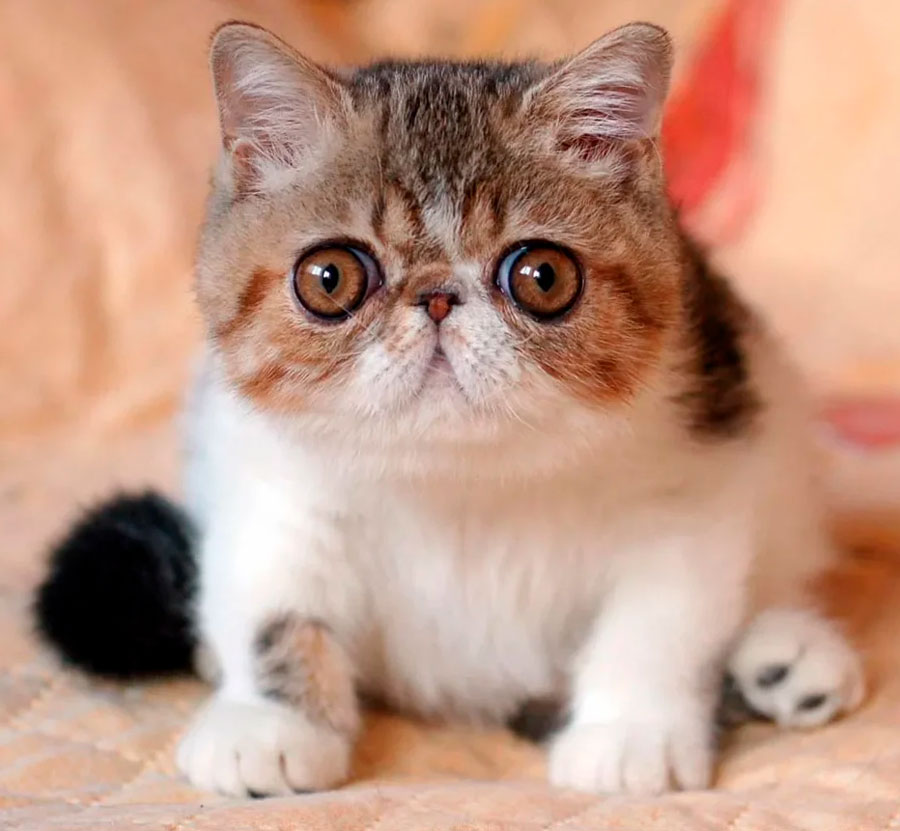
Today the Exotic Shorthair is available in all known Persian colors. In addition to the most common colors of white, black, blue, red, cream, chocolate, and lilac, they are available in chinchilla, colorpoint dress and tabby patterns, tabby, brindle and spotted. Under her thick fur, she wears a thick undercoat that lets her top hair stick out from the body, giving her a plush teddy bear look.
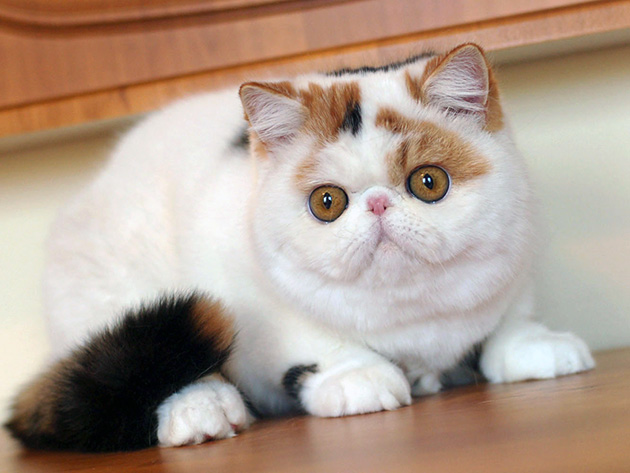
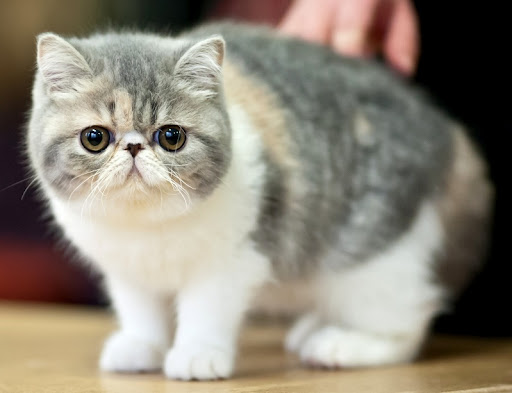
In general, the Exotic Shorthair – just like the related comic figure Garfield – gives a very cozy impression. The medium to a large cat is quite stocky and stands on low, thick legs that end in large and round paws and perfectly complete the teddy bear look. Adult exotic shorthair males can weigh in at a proud nine kilograms. The weight of the female cats is four to seven kilograms. In keeping with their stocky body, the cat breed has a large, powerful head with a distinct stop that is typical of Persian cats. The massive, round skull, the flat face, and the short, wide nose give it an unmistakable appearance.
Attention Torture Breeding!
In the past, excessive breeding unfortunately repeatedly resulted in extremely flat noses, which hindered free-breathing and which led to inflammation and discomfort in the eye, nose, and throat area. When buying an Exotic Shorthair, you should therefore definitely turn to a reputable and responsible breeder who puts the breed’s health, its amiable nature, and a natural appearance at the top of the list.
Exotic Shorthair Temperament
Proud, Cozy, and Charming!
The Exotic Shorthair does not need an exaggerated flat nose to be distinctive – because its unique character takes on that. She is a proud personality of her own who – despite her independence – is exceptionally people-centered. She loves the quiet life with her people and never seems averse to a cozy nap on the sofa – she has that in common with the lazy but lovable series hero Garfield. Her relaxed and balanced manner has a wonderfully calming effect on her people, which she knows how to wrap around her fat paw with great charm. Although she is less prone to pranks than Garfield, she knows how to make her people smile and to get her way through in a lovable way.
Attitude and Care
Thanks to her calm demeanor, she is also suitable for a purely domestic position, whereby – like almost every cat – she also likes to move around in nature. Their forays never take them too far from their home, after all, the full food bowl and the wonderfully cozy cat blanket are waiting there again. Again and again, she seeks to be close to her people. She is a very sociable and well-tolerated cat who does not allow herself to be disturbed by bright, loud children. In contrast to many other cat breeds, she feels just as comfortable in turbulent everyday family life as in a quiet single household.
Its Motto: Together You are Less Alone
The Exotic Shorthair, on the other hand, resolutely rejects long solitude and boredom. Accordingly, she is open-minded towards a playmate in the form of a second cat. Even with dogs, the social, self-confident cat gets along well after the usual acclimatization period.
In keeping with its frugal nature, the Exotic has few demands on its posture. The short coat is also very easy to care for. In addition to the twice-yearly coat change, it only needs to be combed once or twice a week.
Nutrition
She also proves to be undemanding in terms of her diet. To avoid obesity or other health problems, however, you should always resort to a species-appropriate diet consisting of high-quality cat food.
Health and Breeding
A problem with the Exotic Shorthair cat breed is – as is known in Persian breeds – in the excessively short bred nose, which can lead to a number of serious health problems. Breathing disorders, tears in the eyes, problems with eating, and other pains are unfortunately not uncommon among the so-called “pekefaced” representatives. Another problem is the widespread inbreeding in the Exotic Shorthair breed, which can lead to further breed-typical diseases and a shortened life expectancy.
Good Reasons to Buy From a Reputable Exotic Shorthair Breeder
If you are interested in an exotic shorthair, you should definitely contact a reputable breeder and only buy kittens from a healthy pedigree. Make sure that no ancestor appears twice in the family tree to rule out inbreeding. The breeder should also have his breeding animals tested for common hereditary diseases and his kittens vaccinated, dewormed, and chipped. An Exotic Shorthair that is free from breeding exaggerations has a long life expectancy of 15 years and more. Of course, a purebred, responsibly bred Exotic Shorthair has a price of around 1,000 dollars – but you will also save a lot of veterinary costs.
Alternatively, you can of course also take a look around a nearby animal shelter, where many adult cats, including Persians, Exotic Shorthairs, or mixed breeds, are waiting for a new home and a second chance. Ask at the animal shelter where the cat came from and whether inbreeding or serious hereditary diseases can be ruled out. You will usually be met by the keepers in the home in a friendly manner and willingly and openly answer your questions about the animal.
Is the Exotic Shorthair the Right Cat For You?
Before you go to the next animal shelter or breeder, you should of course be convinced that the Exotic Shorthair suits you. You are not doing yourself or the cat a favor if you notice after a few months that living together is not working as expected and you have to give up your new fur friend. Buying a pet should be considered carefully. The following questions will help you in your considerations:
- Do I have enough time to look after a cat?
- Are all family members free from cat hair allergies?
- Can I keep a pet in my rented apartment/house?
- Who will take care of the cat when I have to travel?
- Do I want a pure indoor cat or would I prefer an outdoor cat?
- Does the cat have enough room to move around in the apartment?
- Who in the family takes care of food, care, visits the vet, and cleans the litter box?
- Can I afford the cat financially? You should not only consider the acquisition costs, but also the costs of accessories, cat toys, food, and visits to the vet.
Have you been able to clarify all questions and do all family members agree to buy the cat? You are not “afraid” of big cats, enjoy the company, and also long for a calm pole in your everyday life? Then the Exotic Shorthair is guaranteed to enrich you and your family with its infectious coziness and poise. And if you’re still looking for a name for your new roommate: How about “Garfield”?















