





Short- and long-haired cats are a common image in the cat world. But cats with curly fur or even without a coat are less known! One of the rare cat breeds whose representatives have a striking coat structure is the Cornish Rex.
History of the Breed
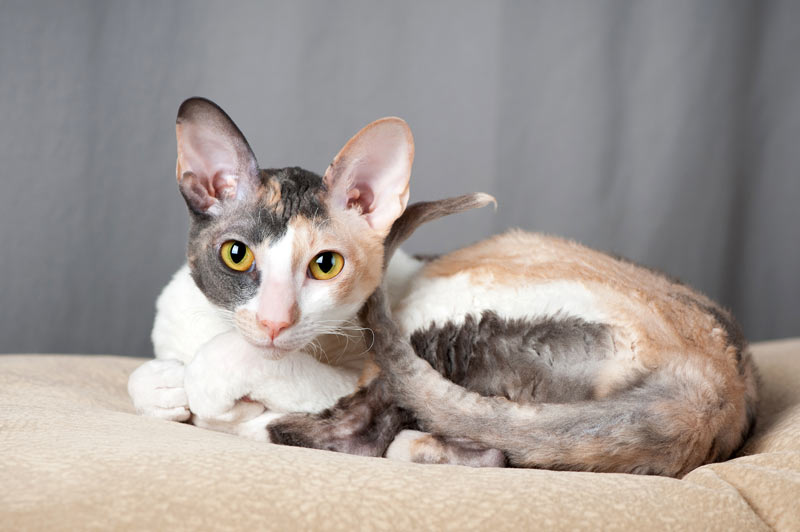
Cornish Rex cats may look different from many popular cat breeds. But they come from small backgrounds, their origins are completely modest: The first cat with curly hair was born on a farm in Cornwall in the 1950s. “Kallibunker”, a cream-colored tomcat with ruffled fur, differed from its siblings not only in terms of the texture of its fur. Slender, delicate, with a narrow head and large ears as well as a long tail, the tomcat caused a sensation in the breeding community in England. Its properties were most likely caused by a spontaneous mutation. In order to preserve these genes and to establish a new breed of cats, Kallibunker was back-crossed with his mother. The curly kittens that resulted from this pairing were crossed with Burma cats, Siamese cats, and British shorthair cats. The gene that was responsible for the extremely soft coat is inherited in a recessive manner. That means in plain language: It is inherited in a covert way. Carriers of the gene mutation do not necessarily show the famous, soft fur of the Cornish Rex cat. You can pass this on to your offspring: If both parents are carriers of the gene and the kittens receive one of the recessive genes from each parent, the mutation also continues in the appearance of the kittens, in the so-called phenotype.
The Devon Rex cat breed is similar in appearance to the Cornish Rex. In contrast to the Cornwell cats, the curly coat of the Devon Rex is based on a different mutation. The Devon Rex consists of an undercoat and shortened guard hair, which leads to a wavy, soft texture. This peculiarity is caused by a mutation in the “LPAR6” gene. This leads to a disruption of the protein structure of the hair and an altered coat structure.
Appearance
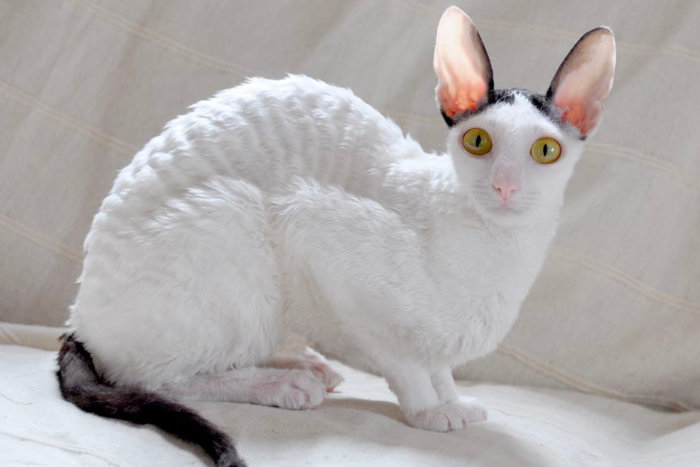
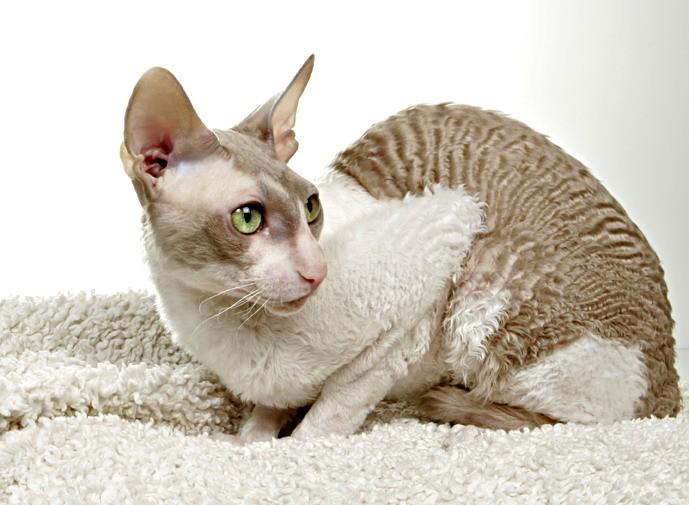
The fur of the Cornish Rex is reminiscent of that of a mole – and it is the standout feature of the cat breed. In the 1950s, this interesting coat structure appeared through a chance mutation on a farm in Cornwall, England, and has been systematically developed since then. The curly hair of the Cornish Rex cat was caused by a random mutation, which, however, is different from the mutation that causes the curls in the Devon Rex cat breed. The term “Rex” describes this unusual fur structure, but it is mainly used in rabbit breeding.
The reason for the wavy structure of the Cornish Rex’s fur: It consists only of an undercoat. The coat of the Cornish Rex cat is therefore extremely soft, comparable to the fur of a rabbit or silk. Even the mustache hair is frizzled! However, the extremely fine fur of the Cornish Rex also ensures that it is extremely sensitive to cold temperatures. This breed is only conditionally suitable for keeping outside the house – and there, too, it prefers warm resting places.
All coat colors are allowed on the Cornish Rex, including these:
- Monochrome: According to the breed standard, the animals may be monochrome, any color may be combined with white. Black, chocolate, orange, and the respective dilutions blue, lilac and cream are welcome.
- Tabby: According to the breed standard, Cornish Rex may be “tabby”. Different tabby drawings include “classic”, mackerel, whacked (“mackerel”), “spotted” and “ticked”. With the “ticked” color of the fur, each individual hair is banded several times.
- Two-tone: Any coat color of the Cornish Rex cat can be combined with white.
- Tri-colored: Tri-colored animals, also called “tortoiseshell”, are always female due to their genetic makeup.
Cornish Rex cats are medium in size and slender. Cats weigh up to 4 kilograms, cats up to 5 kilograms. The cats have a muscular yet slim build. Particularly noticeable are the slender legs, which are reminiscent of members of oriental cat breeds. The tail and head are also long and particularly slender. In contrast, the ears of the Cornish Rex are conspicuous. These are particularly large and have a broad approach. Oval, medium-sized eyes glow with the desire to explore and reveal that behind the plush appearance of the Cornish Rex, a spirited and exploratory cat is hiding.
Temperament
The Cornish Rex has retained the original character of a farm cat. She is spirited and eager to move. Some owners report that the cats retain the naivety of a young cat even at an advanced age. They love to jump, climb and even fetch! Some Cornish Rex can also be taught tricks. It’s not for nothing that friends call the Cornish Rex cat “a dog in a cat’s body”! As an intelligent animal, she explores everything with outstanding curiosity and especially likes to play with her human. But extensive cuddling and cuddling sessions are exactly what you want! Cornish Rex cats are considered to be people-friendly, they fully join their human family. As sociable animals, they are reluctant to be alone. Here it might make sense to get a second cat.
At the same time, a Cornish Rex knows exactly what it wants and likes to assert its own head – against other cats and people! A well-thought-out upbringing is essential here so that your little mole cat doesn’t dance around on your head soon. Fortunately, however, parenting can be combined with fun and games. Have you heard of clicker and target training? Intelligent animals like the Cornish Rex love to be intelligent! This is all the more important because the Cornish Rex cat is particularly suitable for keeping as an indoor cat due to its fine coat. So that the clever animals don’t get bored or have foolish thoughts, they should offer your indoor cat plenty of activity!
Cornish Rex Allergy
Contrary to popular belief, the short, soft fur does not make the Cornish Rex hyperallergic cats, which are also suitable for those allergic to cat hair. A so-called “cat hair allergy” actually has nothing to do with the amount of hair that a cat has or loses, but has its origin in the saliva composition of the respective cat. Cornish Rex cats lose their fur just like other cats; like most cat breeds, their saliva contains the allergy-causing glycoprotein Fel d 1. The lack of guard hairs on the fur does not make the Cornish Rex better tolerated by those allergic to cat hair than other cat breeds.
Care and Attitude
Caring for a Cornish Rex is no different from keeping other cats in a species-appropriate manner. Their soft fur does not require exceptional care, but it makes the animals sensitive to drafts and cold. A Cornish Rex cat is therefore only partially suitable as an outdoor cat. The intelligent, spirited cats still want to be used to their full capacity – especially if you keep them in the apartment, you should offer your Cornish Rex a variety of climbing, hiding, and playing options, such as playhouses or tunnels. The clever cats love challenges. So give them plenty of opportunities to let off steam so they don’t get stupid thoughts! For this purpose, you can offer your cat a multi-level scratching post and other scratching furniture, for example.
Cornish Rex Diet
Like other cat breeds, Cornish Rex cats benefit from a species-appropriate, wholesome diet. As carnivores, cats depend on plenty of healthy protein. They can only utilize carbohydrates to a limited extent. The ideal food for the Cornish Rex cat is based on the composition of the mouse: Scientific findings show that the cat’s sensitive taste buds actually prefer food that, with 26 grams of protein, 9 grams of fat, and 8 grams of carbohydrates, corresponds to the composition of their natural prey. This composition is perfect for feeding a cat appropriately. Cat food should therefore have the highest possible meat content. As desert animals, cats rarely go to the water bowl, they mainly take the liquid they need with their food. The ideal cat food should have an as high moisture content as possible – moist food suits the cat’s natural diet better than dry food.
Are you looking for the best food for your Cornish Rex? Discover our dry or wet cat food, as well as grain-free food, BARF, organic, or diet food.
Apart from the species-appropriate diet, you should show your Cornish Rex to a trusted veterinarian just like all other cats once a year. Apart from any necessary vaccinations, he can take a close look at your fur nose, listen to your heart and lungs and clarify any questions.
Cat Breed
The Cornish Rex is one of the lesser-known breeds of cats. One of the reasons for this is that the characteristic fur of cats is recessive, hidden, and inherited. Nevertheless, there are also breeders in Germany and Europe who breed a Cornish Rex with a solid character with a special, curly coat.
Breeding is hard work: professional breeders are members of one of the numerous cat breeding associations. Your animals have papers, but this is not the only difference to so-called “multipliers” who offer “pedigree cats without papers at a reasonable price” in the classifieds section of the newspaper. A responsible breeder ensures that his animals meet the breeding standard of the breed, but first and foremost the animal itself always comes first – and this also includes a species-appropriate diet, care by the veterinarian, and mating with understanding, with knowledge of possible genetic peculiarities and risks. A responsible breeder mates his animals carefully. Of course, his animals are dewormed and vaccinated and are regularly presented to the vet. He accompanies the cat’s mother through pregnancy and childbirth. He looks after his kittens around the clock, offers them the best possible food and the necessary health care. This often includes basic immunization against common infectious diseases and, if necessary, deworming. He does not get the kitten until he is 12 weeks old at the earliest. Because he knows: In the first three months, kittens learn everything that is important to cats from their parents and siblings. Only kittens that are allowed to spend this important time in the family can grow into well-socialized, mentally and physically healthy animals. All of this does not apply to unprofessional breeders who offer their animals at low prices. Here the supposed bargain is often at the expense of the animal’s health. Therefore only trust a professional, responsible breeder when buying your Cornish Rex.
Cornish Rex Price

Pedigree cats also have their price: A Cornish Rex often costs $800 or more. Those who cannot afford this should take a look at the local animal shelter. Because papers do not protect against the trials and tribulations of life – and so many pedigree cats find themselves in the care of animal rights activists. Maybe you will find your dream cat in animal welfare?
We wish you and your Cornish Rex a wonderful time to get to know each other!















