





When the first European settlers traveled to America, four-legged passengers were also aboard their ships. At that time, cat companions were valued primarily for their hunting skills. After all, they kept rats and mice at bay during long voyages at sea. They were also popular on land, as they ensured that the settlers’ granaries were free from vermin. According to current knowledge, the four-legged friends of the first North American settlers are also the ancestors of a now known and popular breed called the “American Shorthair”, which is often also referred to as the “American Shorthair”.
Like the first American colonists to come from Europe, the ancestors of the American Shorthair cat were straightforward. Although the American Shorthair is mostly a family member these days, it has retained its excellent hunting skills. The active animals are nevertheless good-natured. Just like European and British Shorthair cats, they display a balanced temperament, which makes them perfect companions for families with children. Although the American Shorthair does not attract as much attention as oriental cat breeds, the animals enjoy spending time with their humans – regardless of whether it is about extensive play with catfishing rods and Co. or cozy pats.
Story

Even if the American Shorthair is considered to be the “originally American” breed, small cats of their kind were probably not represented before the first colonies in what is now the USA. The ancestors of the American Shorthair were the companions of the first Europeans to move to America. The cats were highly respected, hard-working animals. After all, they had to keep the mice and rat plague in check in the settlers’ ships and later in villages and on farms! Cats are said to have been represented onboard the Mayflower – the famous sailing ship with which the so-called Pilgrim Fathers traveled to America from Plymouth in 1620. So it’s no wonder that the American Shorthair is a down-to-earth, uncomplicated breed! Systematic breeding was not established until the beginning of the 20th century.
At the beginning of the 19th century, the American Shorthair bloodlines were extremely thinned by cat breeds imported into the USA, so in 1906 a group of breeders began with a specific breeding program. The breed originally called “Domestic Shorthair” was renamed “American Shorthair” in order to emphasize its American origin and to differentiate it from other domestic cat breeds, some of which do not belong to any breed. Nevertheless, in the opinion of many breeders, the American Shorthair was neglected at breeding shows until the 1960s – probably also because of its similarity to “normal” domestic cats and its simplicity.
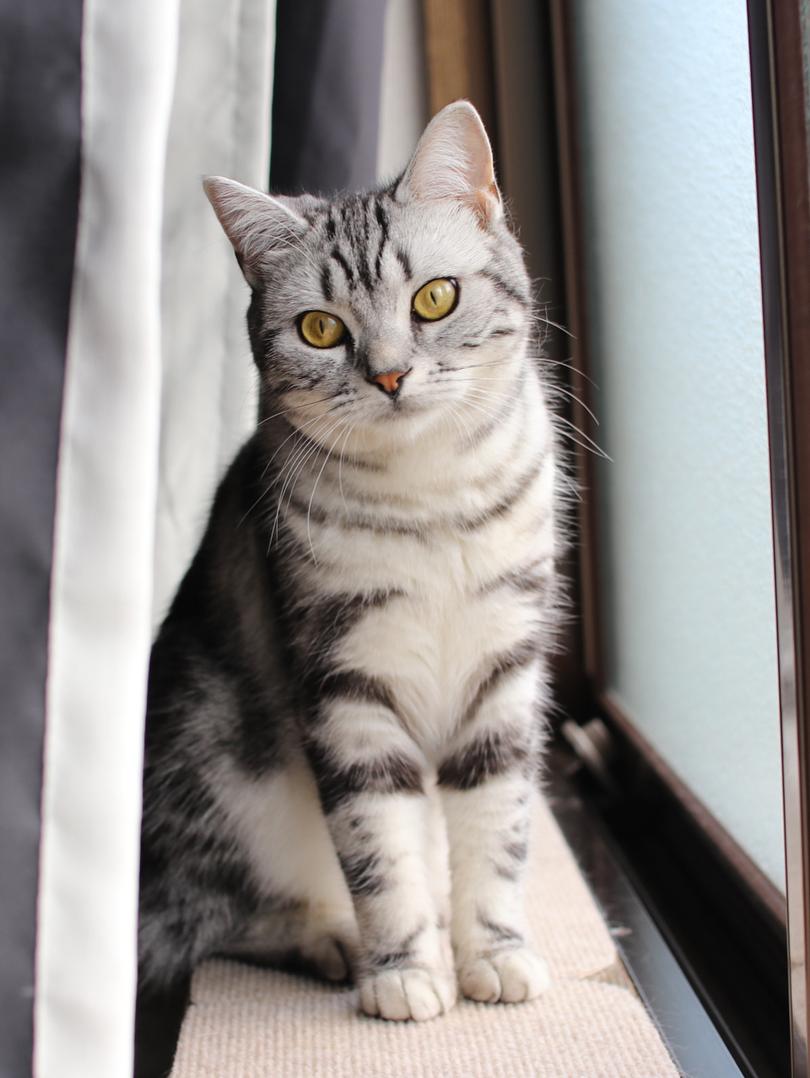
Nevertheless, like many other cat breeds, breeding an American shorthair cat requires a precisely defined breed standard. This relates to body structure, hair length, and color, but also to the character of the uncomplicated animals. Even if most breed associations recognize all coat colors, the “silver tabby” is particularly popular. Just like British Shorthair cats of the same color, American Shorthair of the color silver tabby resembles the well-known cat from the Whiskas advertisement almost down to the hair!
American Shorthair Cat Breed
The American Shorthair is a healthy, active, and athletic cat. The medium-sized cat is strong and well-muscled, but still supple – its broad chest sits on medium-length legs supported by round paws. The medium-length tail also has a broad base. The American shorthair cat stands out because of its often bright yellow, attentive, and slightly slanted eyes. These sit over a massive, angular muzzle that perfectly matches their concave profile with a slight nose stop. Their ears are medium-sized and erect, the distance between them is small.
The coat of the American Shorthair is short, length and texture are comparable to that of the European Shorthair. Which colors are allowed in breeding depends on the respective organization. Most breed clubs still accept all colors. The Cat Fanciers Association, for example, allows the following colors:
- White: American Shorthair of the color white can have blue or gold eyes – but unevenly colored eyes are also allowed.
- Black: The black coat of the American Shorthair should be colored throughout and free from gray tints. The color of the eyes is often gold, the nose and pads of the paws are black.
- Blue: The thinning of the coat color black shows up as “blue”. Often the nose and pads of the paws are also blue, the eyes shine gold.
- Red: A red color without any white component is preferred.
- Cream: The dilution of the color red is called “cream”. The almost beige color is preferred without white.
- Two-colored: Two-colored cats are also allowed in American Shorthair breeding. These often have a white base color with black, blue, red, or beige spots.
- Chinchilla: If the hair itself is two-colored, is white and only the tip is colored black, the color of the cat is called “chinchilla”. There are also so-called “red chinchillas”, in which the individual hair has a red tip instead of a black tip. Many cats of this color have a frame around the eyes and nose. American Shorthair of the color chinchilla often has bright green eyes. As a variant of this color, there are also blue and cream-colored chinchilla colors.
- Shaded: As with the color chinchilla, American short-haired cats of the color “shaded” also have banded, two-tone hair. The individual hair here, however, has a higher proportion of black than in the chinchilla color. This color also occurs with a red-colored tip – it is called “red shaded”.
- Smoke: American Shorthair of the color “Smoke” have like the color shades Chinchilla and Shaded a banding of the individual hair. In the case of smoke, however, the black component predominates, only the lowest part of the hair is white. Often the white partial coloration is only noticeable when the fur is divided. The color smoke also occurs as “blue smoke” and “red smoke”, instead of black, the individual hair is colored blue or red. Some cats even have banding with black, red, and blue! The animals appear three-colored, but a close examination of the individual hair reveals a white undercoat.
- Tabby: Tabby cats are called “tabby” by the American Shorthair. “Tabby” is not always “tabby”! The Mackerel Tabby coloring shows a tight, well-defined mark, often with an eel line and stripes on the legs and tail. The ticked tabby often has only one mark on the head, neck, legs, and tail. A “patched tabby” is a tabby American Shorthair with cream-colored or red spots.
- Calico: Who doesn’t know them, the three-colored “lucky cats”? In English usage and so also in American shorthair breeding, these cats are called “Calico”. White represents the predominant part of the coat color, this is supplemented by spots of black, red, their dilution, and, if necessary, tabby markings.
American Shorthair Temperament

Like their looks, the American Shorthair’s character is straightforward. The cats have retained the characteristics of their ancestors who conquered the American continent together with human settlers. They are good mouse hunters, but not very aggressive, relaxed, and people-oriented. American shorthair cats like to play with their humans, but they also like to relax with extended pats. Their uncomplicated, less dominant nature makes them perfect family cats. As tolerant housemates, they often get along with other animals, such as dogs. An American Shorthair is very adaptable, so the cats are just as suitable for being kept in an apartment as they are for controlled or unlimited free-run!
Health and Care
As a short-haired cat, the American Shorthair cat has no special requirements for special care. Especially during the coat change period, it is advisable to brush the animals about once a week – otherwise, they do most of the care on their own and rarely need help. Cat grass and malt paste can ease the natural removal of swallowed hair.
In addition, the American shorthair cat is particularly robust and healthy. Usually, the annual veterinary check-up is enough to ensure that your cat stays healthy and happy.
However, many American Shorthair lovers report that the breed is susceptible to the disease HCM. This so-called “hypertrophic cardiomyopathy” leads to an enlargement of the heart muscle. When you visit the vet, your cat’s heart will be monitored during the routine examination – if he hears heart murmurs, an echocardiogram is usually performed to confirm the suspicion or to give the all-clear. HCM is considered to be inheritable – that is why it is particularly important to remove American Shorthair cats with HCM from breeding. HCM is not curable. However, your vet can advise you on how you can make the life of an HCM cat worthwhile with the right diet and selected medication!
American Shorthair Diet
American Shorthair tends to gain weight, especially with a more relaxed lifestyle or after being castrated. The best antidote is a healthy, species-appropriate diet. As carnivores, cats depend on high-quality cat food with lots of healthy protein and few carbohydrates. This gives you everything you need to stay healthy, without any side waste that pollutes the drainage organs and often leads to weight gain. Most high-quality ready-made food products offer your cat exactly that. Make sure that the food you choose for your American Shorthair cat contains plenty of healthy meat – this is indicated by the fact that meat is at the top of the list of ingredients, sorted by quantity. Herbal products should only be available in small quantities, ideally sugar not at all.
Raw feeding and self-cooking are good, albeit more labor-intensive, alternatives. Here you know exactly what is contained in the feed and what is not! Thorough training on cat food will ensure that your cat is getting everything it needs.
The best medicine against weight gain is also regular play with people. Offer your catfishing rods, balls, and play mice and try to encourage them to move. If you have space for a large scratching post, your cat can do some physical activity here. Intelligence toys are also very popular with curious four-legged friends!
Breed
American Shorthair is an integral part of the North American breeding scene these days! European lovers of this breed of cats often have to look a little longer for a breeder.
As with all pedigree cats: only professional breeding is good breeding. The work and the passion that the breeder puts into his animals and their offspring are decisive for the success of the breeding and the physical and mental health of the animals. It is important to a responsible breeder that the mother cat can recover after each birth. This reduces the number of litters per year and the profit of the breed – but healthy, balanced dams are worth it to him. It is mated with knowledge of possible hereditary diseases and the compatibility of the parent animals. He also has his cats monitored by a veterinarian while they are pregnant. After the kittens are born, they are also examined by a veterinarian and receive everything they need to grow up until they move to their new home: good food, vaccinations, deworming and social contact with siblings, fellow cats and the human family should be a matter of course. He does not give up his kittens before the 12th week, because the imprinting phase of the first three months is particularly important for developing a balanced, healthy psyche. This is the only way to make your American Shorthair the uncomplicated cat you want!
The breeder you trust should also be a member of a cat breeding association. Only the umbrella organizations can issue papers that make your cat a real American Shorthair. Especially when you just want to give a home to a cat lover, this piece of paper may seem superfluous. But cat protection associations make sense. They check the rearing conditions of the kittens, the breed affiliation of the parents, and make sure that your furry friend is really an American Shorthair. All of this, of course, costs money. Therefore, breeding is rarely a business, but in most cases an expensive hobby. Cats from a professional breed are therefore often more expensive than those from a “multiplier” who offers pedigree cats without papers at a special price. Here the bargain often comes at a high price: inbreeding, short rearing times, and a lack of health care mean that your cat may not be as healthy and uncomplicated as it would like it to be. Therefore only trust a professional breeder. Alternatively, many pedigree cats can be found in the animal shelter and are happy to be able to move into a good, new home!
If you have fallen in love with the uncomplicated American Shorthair cat, there is only one thing to do: Go to the breeder. We wish you and your American Shorthair a wonderful time!















