





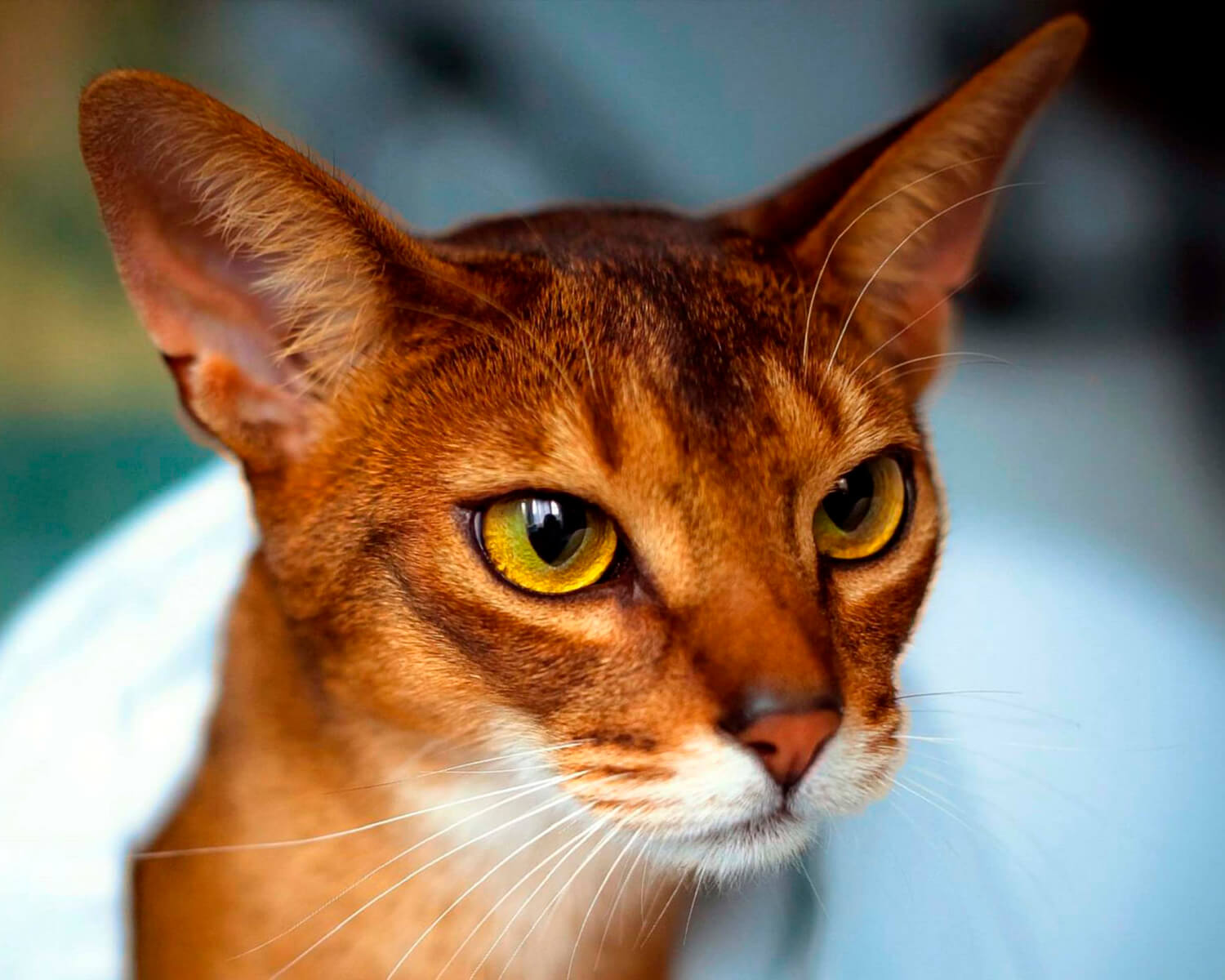
The Abyssinians’ large eyes and attentive ears reveal a lot about the character of this breed of cats: Abyssinians are people-oriented and curious.
Abyssinian Cat Breed
The name “Abyssinian” is misleading – because this breed of cats does not come from the old “Abyssinia”, today’s Ethiopia, as its name suggests. The claim that Abyssinian cats were the descendants of animals worshiped in Pharaonic Egypt is also wrong. The Abyssinians come from a completely different area, the jungles of Southeast Asia. It was exposed through modern genetics: a mutation of the tabby gene, which only occurs in this breed, does not appear at all in Egypt and East Africa. However, wild cats that live on the coast of the Indian Ocean between Singapore and Sri Lanka have the conspicuous mutation and the resulting coloration. Further information can be found in old cat pictures from the 19th century. For example, a cat that resembles today’s Abyssinian appeared in an English cat journal and was referred to there as an “Asian cat”. Presumably, the conspicuously “ticked”, wild-colored cats were brought to the Middle East and Africa by British traders and from there came to England with British troops who left East Africa in 1868.
It was there in the 19th century that the systematic breeding of the breed began, which attracted attention with its eye-catching coloration known as “agouti”. An “Abyssinian cat” was already part of the cat show at Crystal Palace in 1871. Only a short time later, in 1882, the breed was officially recognized. Harrison Fair, then president of the English national cat club, personally set the breed standard – the Abyssinian is one of the oldest cat breeds. The breed came to the USA shortly afterward, where it was officially recognized by the Cat Fanciers ’Association (CFA) in 1911. The first animals were registered in Germany in 1933.
The two world wars caused the number of Abyssinian cats to dwindle sharply. The small litter size of the Abyssinians makes things even more difficult: a litter usually consists of one to four animals, on average two kittens are born. A cat leukosis epidemic in the 1960s contributed to the further decline in the breed. Even if the Abyssinian population is now considered certain, it is not nearly as well known as other cat breeds.
Abyssinian Cat Breed Information
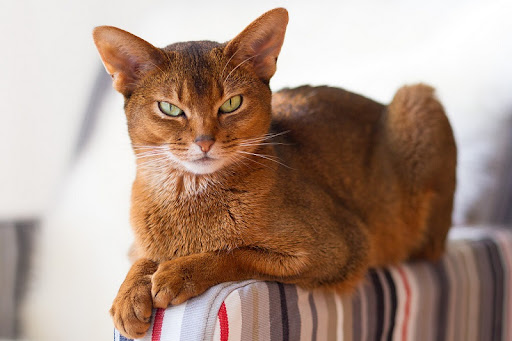
The Abyssinian is often referred to as the mini puma. No wonder, the slim, long-legged cats look athletic and lively! The Abyssinians are one of the lighter breeds of cats: female cats weigh up to 4 kilograms, male cats up to 5 kilograms.
The open-minded, curious character of the animals is reflected in their face: large, almond-shaped eyes shine in amber, green or light brown. The dark border is particularly striking. The big ears reveal that Abyssinian cats are good listeners who are thoroughly interested in their surroundings and their human family! The cat’s ears are set wide apart and have a wide base. The head of the Abyssinians themselves is wedge-shaped, but has a gentle contour without an aggressive stop and sits on a slender, graceful neck. Long legs with oval paws and a slender tail complement the image of an active, agile cat. The coat of the Abyssinians is extremely fine and soft due to the low undercoat. The animals still have a well-developed ruff, but the coat is a little shorter in the shoulder area.
Abyssinian cats show a particularly noticeable color, which gives their fur a similarity to that of a wild rabbit. The so-called “agouti effect” is caused by the banding of each individual hair, the so-called “ticking”. Each hair is banded two to four times, the ends of the hair always showing the darkest color sleep. However, not all body hair is “ticked”, but primarily the head, back, tail, and the outside of the legs. The abdomen, chest, and the inside of the legs are uniformly colored in the respective basic color. This eye-catching color scheme is complemented by an eel stripe on the back, and there is often a “sole stripe” on the hind legs that run down to the heel.
“Ticking” is an integral part of the Abyssinian breeding standard. The color appears from the sixth week of life but is not fully developed until around two years of age. Then the fur of the cats appears uniformly patterned, similar to that of a wild hare. The colors of the Abyssinian cat are also unique. According to breed clubs, only colors are accepted that are based on the color pigment “eumelanin” – this ensures strong light absorption and thus supports dark pigmentation. The colors blue, sorrel, fawn, and wild colors appear inbreeding.
- Wild colors: This original color of the Abyssinians resembles a warm brown. The basic color is a dark apricot to orange with black ticking. All other colors are derived from the wild coloring, which is sometimes referred to as “ruddy”, “usual”, “tawny” or “lièvre”.
- Blue: The color term “blue” does not refer to the color blue, but rather describes different intense shades in the shades of blue-gray. In fact, “blue” is the dilution of the wild color, caused by the mutation of a gene that is responsible for the color intensity.
- Blue Abyssinians have blue-gray fur, the individual hairs show dark steel-blue-gray bands.
- Sorrel: Abyssinians with a warm, cinnamon-red color and chocolate-brown ticking are referred to as “sorell”, and depending on the language used, also as cinnamon or red. “Sorell” is not to be confused with the actual red color: Sorrel was created through mutations in the gene that is responsible for the black color of the coat.
- Fawn: “Fawn” is the diluted form of “Sorell”. Abyssinian cats in “fawn” have a light cream-colored basic color with a warm, also cream-colored ticking. The nasal mirror is pink.
Other colors such as chocolate and the diluted form lilac appear but have not yet been recognized by all-breed clubs.
By the way: Since the 50s, long-haired Abyssinians have appeared in litter again and again, mainly in England. These cats became the progenitors of the “Somali”, a variant of the Abyssinians with half-long fur. The Somali and Abyssinians share a breeding standard.
Abyssinian Temperament
The Abyssinian is an oriental through and through. She is attentive, playful, and active. Curiously, she follows her human step and step and watches every move he makes. Abyssinians are considered to be particularly intelligent. That is why they want to be challenged and encouraged. Foraging games, clicker training, and even small tricks – the curious Abyssinian cat is up for everything! This is especially true when it comes to games with people. Abyssinians are very sociable animals, they fully join their human family and are reluctant to be alone. However, only one other cat is a fully-fledged companion, which is why the Abyssinian should ideally not be kept as an individual cat. When living together with conspecifics, it is often more dominant; early socialization in adolescence often makes living together easier. Littermates are also a good team – when you visit the breeder of your choice, think about whether you can give two cute kittens a home! Your cats will thank you. The active Abyssinian cats are only suitable to a limited extent for keeping them in the home. A secured garden or a cat-safe balcony with lots of climbing opportunities are more likely to accommodate your urge to move.
In contrast to most oriental cat breeds, the Abyssinian convinces with a calm, almost soft voice!
Care

Even if the Abyssinian cat is not considered overbred, it has a certain preposition for hereditary diseases. This includes “Feline Neonatal Isoerythrolysis”, also known as “fading kitten syndrome”. The cause is a blood group incompatibility between mother cats and their kittens when a male of blood group A is mated with a cat of blood group B. After birth, the kittens ingest antibodies against blood group B with their breast milk – this leads to excessive excretion of the blood pigment hemoglobin and acute anemia. An acute FNI is unfortunately always fatal. It can only be avoided through well-thought-out mating.
Abyssinians can also be affected by retinal atrophy (“progressive retinal atrophy”). Night blindness is often the first symptom that the retina of the eye is destroyed by local metabolic disorders in the tissue. In the recessive hereditary disease, visual disturbances occur from the age of two. The onset of the disease is possible up to the age of six. For breeding animals, a regular examination by an appropriately trained veterinarian is therefore mandatory so that they do not pass the serious disease on to their offspring. An examination by a specialist veterinarian should take place annually up to the age of six, the development of DNA tests is still being worked on.
A deficiency in the pyruvate kinase enzyme in red blood cells is also known. This leads to anemia due to a shortened lifespan of the red blood cells. Blood transfusions can save lives, but there is no therapy for pyruvate kinase deficiency itself. Since the disease is inherited in a recessive manner, carrier animals do not necessarily become ill themselves. However, the enzyme deficiency becomes apparent when two gene carriers are paired. Your offspring are deficient in the vital pyruvate kinase enzyme.
Apart from that, Abyssinians are very uncomplicated, easy-care cats. Their short coats do not require any special care and, like other cat breeds, they should see the vet for an annual check-up. Especially when your Abyssinian is outdoors, it should be vaccinated against certain infectious diseases. Indoor cats also benefit from immunization against known diseases.
Abyssinian Diet
Good cat food is the best guarantee for a long and healthy cat life. As carnivores, our cats are dependent on healthy protein, and the best source is plenty of fresh meat. They can only utilize a very small percentage of vegetable carbohydrates.
Can you find the best diet for your Abyssinian? Discover our dry or wet cat food, grain-free, organic, BARF, or diet food.
Breed
The occurrence of hereditary diseases makes it clear how important professional, well-thought-out breeding is. Do not buy your cat from unprofessional “breeders” who offer “pedigree cats without papers for a small price”. The bargain price often has a catch: the health of the cat.
An ambitious, committed breeder attaches great importance to seamless health care for his parents and kittens. As a member of a cat breeding association, he mates carefully in order to avoid hereditary diseases such as retinal atrophy and pyruvate kinase deficiency. He works around the clock for his animals. Breeding is therefore money- and time-consuming hobby – unfortunately, this is also reflected in the purchase price of cats from responsible breeding. But with the sales contract, you not only acquire your cat’s papers, you also buy a little bit of the breeder’s know-how. He grants his mother cats a certain period of grace after each litter so that they can then take care of their kittens with fresh energy. He raises these in his own household for at least twelve weeks – during this time the kittens learn everything important for a successful cat life. For an Abyssinian cat with papers, you have to put it on the table from $ 800 upwards. Adult animals that have been withdrawn from breeding are often available at a friendship price. As an alternative, of course, there is a visit to animal welfare. Many cats are waiting for a good new home here – including many pedigree animals!
Regardless of whether you choose a cat from the breeder or from the animal shelter: We wish you and your Abyssinian cat an exciting time together!















