The French dog breed Briard belongs to the herding dogs and cattle dogs in the FCI standard no. 113 in group 1. There he is one of the shepherd dogs in section 1 and is declared as a herding dog.
Briard Dog Breed Information
Size: Males: 62-69 cm, females: 56-64 cm
Weight: Males: 27-41 kg, females: 23-34 kg
FCI group: 1: herding dogs and cattle dogs
Section: 1: German Shepherds
Country of origin: France
Colors: black, grey, white, black-tan, black-grey, tan
Life expectancy: 10-12 years
Suitable as: shepherd, guard, family, therapy, and rescue dog
Sports: agility, drift ball
Character: Intelligent, Obedient, Loyal, Fearless, Caring
Exercise requirements: rather high
Low drool potential
The thickness of hair low
Maintenance effort: high
Coat Structure: Twisted, long, dry, and light undercoat
Child friendly: yes
Family dog: rather yes
Social: yes
Origin and breed history
The Briard was created as a cross between the French water dog Barbet and the Berger de Picardie, the Picard. Some sources name the Beauceron as an origin in addition to the Barbet. The Briard is the typical farm and farm dog in the northern French plains. His job in France was to guard and protect sheep.
The breed was first mentioned as Chien de Berger de Brie in 1758 by George-Louis Leclerc de Buffon. Until then, he is also known as Chien de Berger français de Plaine, French Lowland Sheepdog. The description of a long-haired herding dog already exists in 1387 in a hunting textbook by Count Gaston Phoebus de Foix. The Briard has been recognized as a separate breed since 1896 and the breed standards were established in 1897.
The French army used the Briard during the world wars as a medical service dog and as a reporting and patrol dog. To this day, the breed is found among police, rescue, and therapy dogs.
Where does the breed come from?
The breed’s original sources date back to the 12th century. At that time, a dog with a funny appearance, thick coat and excellent shepherding qualities was described. This can apply to both the ancestors and the Briards themselves. It is believed that the modern dogs of this breed descended from the Persian dog. The Briards’ closest relatives are the dogs of the Beauceron herding breed, although there are few that bind them apart from their purpose and size.
From the very beginning, the breed was actively used for sheep breeding. There was no information anywhere that the breed was artificially bred, so researchers assume that the Briards once lived in the wild. This confirms their organizational ability, the ability to collect animals in a herd, as living in a herd implies precisely this behavior.
As late as the late 19th century the breed did not have a standard, but once it was established dogs became regular exhibitors at the international level. At the same time, representatives of this breed invaded the Russian Empire to continue breeding. But for some reason selection work with Briards did not become popular.
Dogs of this breed were actively used for front service during the war. This is where their excellent sense of smell and obedience came into play. They were looking for injured soldiers and shelling with ammunition.
Today, Briar is not a shepherd, but an intelligent and good-natured member of the family. The pet of such a breed has Napoleon, Henry Lafayette.
Purebred representatives are quite tall. The growth of the dogs varies between 58 and 69 cm. Earlier the auricle was laid, then they stood and had a triangular shape. Nowadays many European countries have banned this procedure and dog ears hang loose on the head. They are thick and completely covered with a wool coat.
Like other breeds of livestock, the weight of Briards is not limited to the standard, males range from 30-45 kg, females – 25-30 kg.
Briard’s coat is chic, the top layer is tough and coarse. The fur covers the dog’s body and forms soft curls. In some places the hair is lengthened, for example, in the shoulder area, its length reaches 15 cm. The undercoat is short and dense throughout the body. The muzzles of dogs are also abundantly covered with hair, their eyebrows “cover” their eyes. However, the norm does not allow excessive overgrowth, which completely hides the eyes.
The deeper and richer the color, the better. If the dog is two-tone, then for the sake of symmetry, a smooth transition from one tone to another is required. Not allowed for normal spotted dogs and pure white wool. Only single white hairs or a small white spot in the sternum area are allowed.
Briard’s eyes are wide-set, black or dark brown. The look is always read the stupid question.
The muzzle is neat, with a black square lobe and large nostrils.
The lips are tight-fitting and pigmented black. Bite like “scissors”.
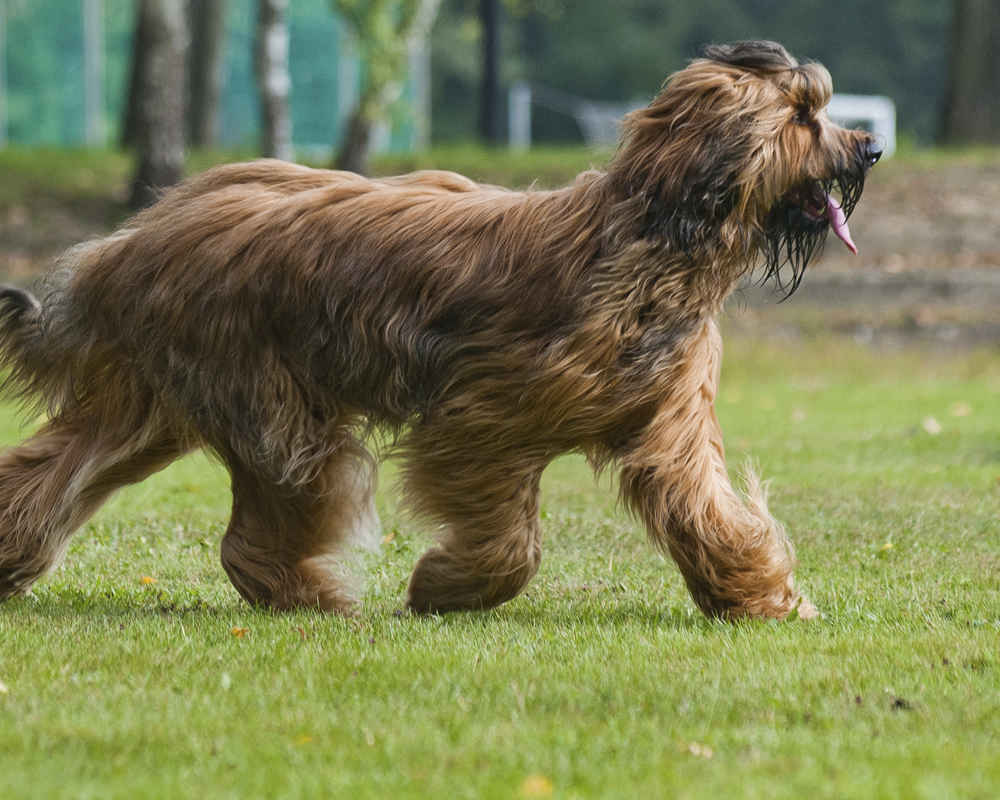
Many owners are characterized by a soft, feline gait in their pets. In fact, the movements of the Briards are light and gliding. At the same time, they are very mobile and can change trajectory at lightning speed, turn around or stop running.
Nature and temperament of the Briard
The Briard is characterized by many positive qualities. He is:
- clingy
- faithful
- intelligent
- fond of children
- patiently
- spirited
- eager to learn
- friendly
- good-natured
- adaptable
Typical of the herding dog is its special protective instinct. He is very alert and keen to keep his pack together at all times. For him, the pack also includes his family and cats as well as other pets. Despite the age of the breed and the numerous breeds associated with it, the dogs were able to retain their character. When a briard encounters a flock of sheep, it remembers its original task and wants to guard it.
The friendly dog loves to romp and play, occasionally getting a little cocky but never malicious. Briards don’t like to be alone. Ideally, they should always be in contact with a family member. The Briard gets along with other dogs and pets as long as they don’t pose a threat to his pack. This also means that he is not always friendly to strange dogs. He tends to be suspicious of strangers and initially ignores them.
Dogs are curious, friendly, very loyal. Their decorative appearance is deceptive, they need physical labor and emotional stress. Otherwise, the dog will become sluggish, apathetic.
If Briard lives in an apartment, then he needs long active walks. This is a great companion, but not for TV sharing. The pet will be happy to accompany the owner on a run, while swimming nearby with a bicycle. Without physical training, the animal can become embittered.
Briards cannot exist fully without human intercourse, and dogs are separated very harshly. They are so well socialized that it is difficult to embarrass them when going to new, even crowded, places. They are happy to meet with the guests and are always happy to participate in new games and fun.
On the Briard paddock – the interest and concern. Pets always follow company so no one gets left behind or lost. This is the behavior of many German Shepherds. Dogs belonging to this breed are excellent travelers who calmly tolerate movement on any transport and at the same time behave approximately.
In the blood of the Briards, the dogs, despite their cheerfulness, do not stop monitoring the movements of households and other members of the company. If a dog is shy or aggressive for no apparent reason, it will be disqualified for such deficiencies.
Do not forget that these dogs belong to service dogs, so you do not have to raise the pet in children’s hands. They communicate perfectly with children, but Briar needs a serious owner who deserves the respect of a pet. This is important as the growing dog will try to show leadership qualities and move up the hierarchy. This cannot be allowed.
Briards are highly intelligent and inquisitive dogs that are easy to train. But just in case rough treatment and corporal punishment are not used. Pet does not obey blindly and unconditionally, he thinks about how to do it.
If the dog has been trained, he will be left alone, for example in front of the pharmacy or shop door. Most Briards have an even-tempered mind, but there are members of the breed who are too high-spirited and require special endurance training courses. There are also phlegmatic Briards, but this is such a rarity.
If you need a pet to compete in, Briar is ideal. With a lightning-fast reaction, agility, flexibility, and stamina, he is able to complete training of any kind. He is able to pass a dog test and lobbies for many government requirements, including towing. In addition, the Briards are frequently awarded championship titles for external beauty.
Is the Briard a family dog?
The Briard is the ideal family dog and does not like to be left alone. He gets along with children, other dogs in his pack, and other pets.
The appearance of the Briard
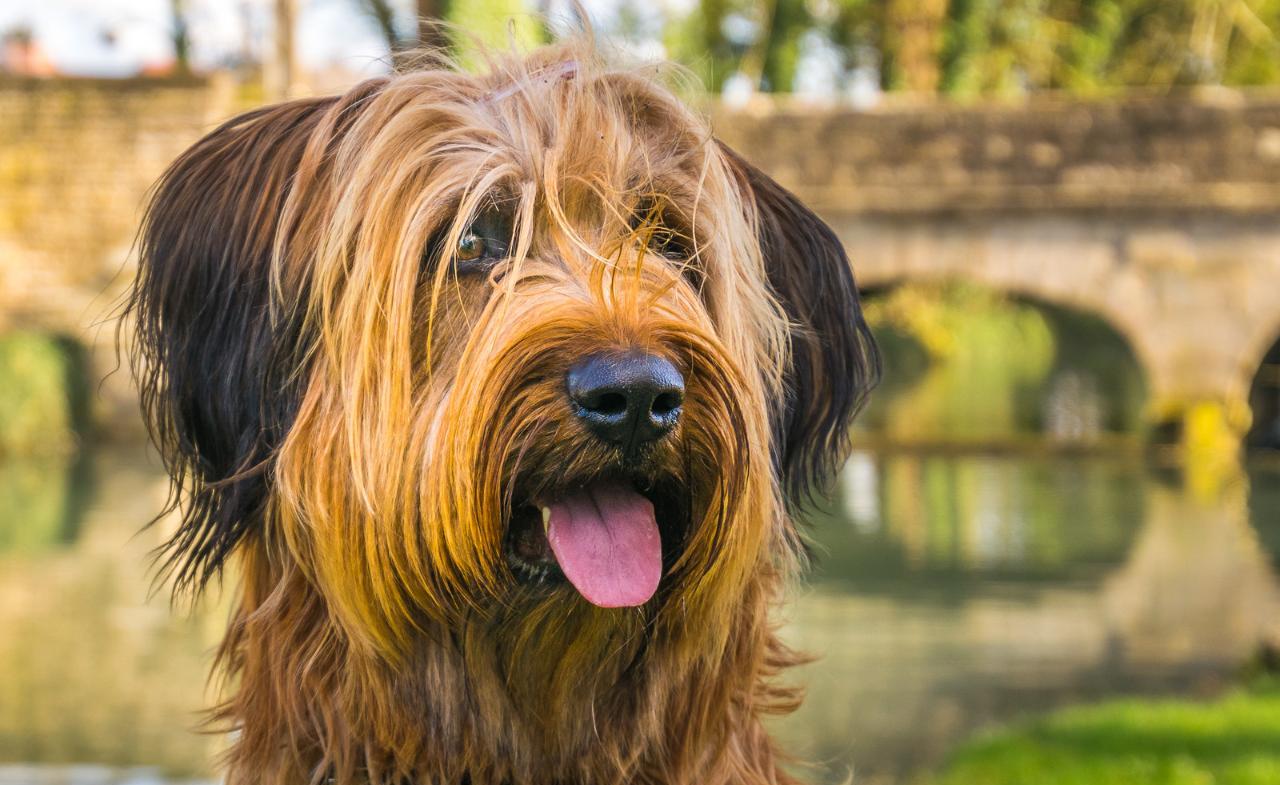
Visually, the Briard is a strikingly beautiful dog. At first glance, he appears as a large tuft of fur. The dense, slightly wavy fur is long-haired and forms fine strands. It is very dry and goat-like with a little undercoat. On the head, the dog has a distinctive mustache and goatee as well as bushy eyebrows. His head hair tends to grow over his eyes. The colors of the fur are:
- Black
- Fauve (Medium Brown Blonde)
- Fauve with black tips (charcoal plating)
- Gray
- Blue (deep dark grey)
Light-coated Briards may have a black mask. The lop ears are short, set high, and also covered with long fur. The Briard has dark, wide-open eyes and an alert gaze.
His build is well proportioned and muscular with a straight back and straight, strong legs. In its movements, the Briard looks very elegant with its springy gait. The tail joins the back straight and with a pronounced flag of fur. It reaches to the hock and when moving usually forms a straight line with the back. It is slightly curved at the top.
A distinctive feature of the breed is the double wolf claws or dewclaws. They are located above the paws on the hind legs. These are two closely spaced claws. They have no ground contact and no function. Rather, they are a relic of ancient times. Originally, all vertebrates had five limbs on their hands and feet. Since many animals do not need the thumb or big toe, it has degenerated. The fifth segment is only still present in dog breeds with a wolf’s claw.
Height and weight:
Female 56 to 64 cm; 22 to 34 kg
Male 62 to 68 cm; 27 to 40 kg
Breeding and husbandry of the Briard – This is important to note
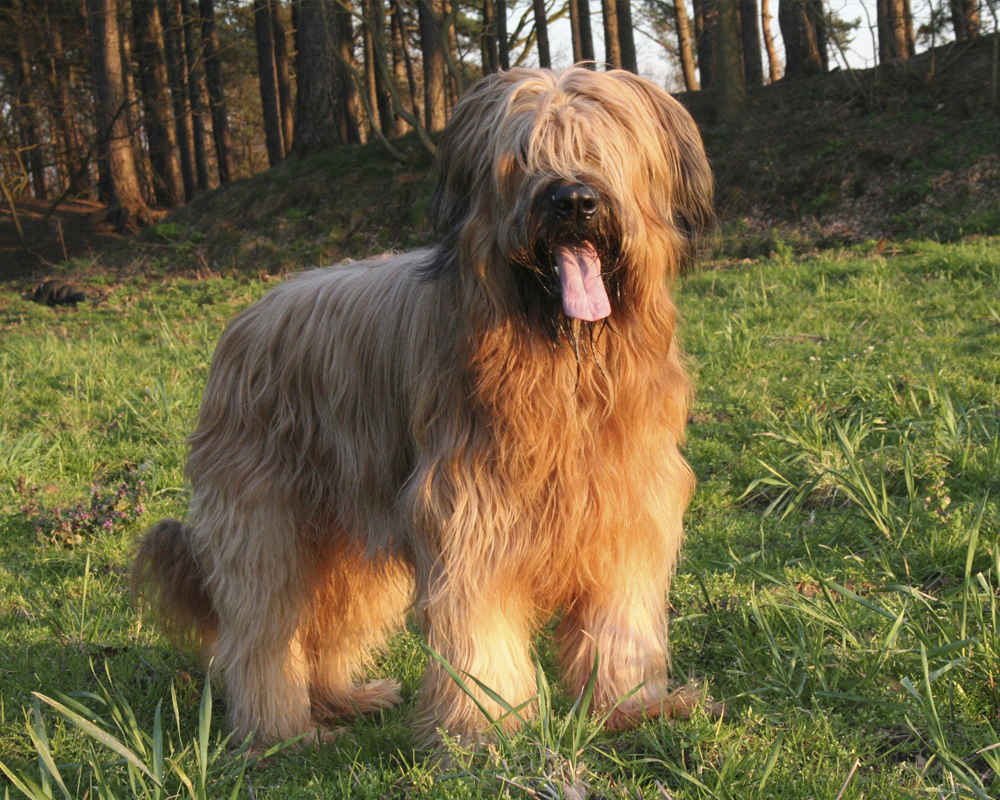
The Berger de Brie is not a city apartment dog. He loves to exercise outside and should therefore have his place in a house with a garden. A rural setting is ideal. Since the animal is very affectionate, a family member should be with him at all times. If it is unavoidable to leave the dog alone for hours, this must be trained slowly and in small steps. Although Briards are originally herding and livestock guardian dogs, they are not suitable for being kept in a kennel. Since they guard and protect the family, their place is in the home. The family dog needs to be close to its people. If he is well brought up, he accompanies him everywhere without attracting negative attention.
The upbringing takes place with patience, love and empathy as well as the right dose of consistency. In a good mutual trust relationship, the willing dog is easy to train. The intensive bond with the dog is an important first step in training. At the same time, the breed is prone to a certain stubbornness. Loving consistency is therefore an important prerequisite for harmonious coexistence. Briards are sensitive and don’t like rough handling. Loud insults or even hits do not correspond to animal welfare. They damage the dog and make training almost impossible.
Like most herding dogs, the Berger de Brie needs tasks to keep busy and balanced. If he is bored, he will look for his own occupation. This is then not always in the interests of the owner. Daily extensive walks, educational games and dog sports are absolutely necessary for the species-appropriate keeping of this breed. Briards complete training as therapy or rescue dogs with flying colours. There are thus many opportunities for an intensive study of the committed Frenchman.
Due to its stubbornness, the Briard is not considered a beginner dog. Experience in dog training is recommended for people who want to live with this friendly, spirited and somewhat idiosyncratic fellow. Attending a dog school is advisable even as a puppy. There the dog learns socialization among conspecifics. Its owner learns which tasks he has to fulfill for pleasant coexistence.
How much does a Briard cost?
A Briard is rarely a gift. This tends to happen in absolute emergencies, for example when an older animal loses its owner. Adult animals usually cost $800 or more.
Diet of the Briard
Measured against its size, a Briard eats rather little. Therefore, a balanced feed is all the more important. Because the breed is very lively and agile, it needs a lot of protein. Minerals and vitamins make up a small part of the feed requirement. About 70 percent of the feed should consist of high-quality meat. About ten percent grain is enough. Vegetables should be included in the feed composition with a share of 20 percent. In principle, dry and wet food are suitable for feeding. If the dog is to be fed with raw meat, i.e. bared, feed additives are necessary. These are offered by pet shops and special shops for BARF food.
Feeding dogs only dry food is easy and uncomplicated, especially for their owners. Nevertheless, it should be borne in mind that this form does not correspond to the natural dog diet. In practice, a mixture of dry and wet food has proven to be beneficial for the dog. Feeding with fresh ingredients is ideal. When selecting the vegetable portion in particular, however, it is important to ensure that the varieties are dog-friendly. The following foods can be toxic to dogs:
- Chocolate and foods containing cocoa
- Grapes and Raisins
- avocado
- stone fruit
- raw potatoes
- tomatoes
- eggplants
- rhubarb
- leeks and onions
- legumes
- raw pork
- sugar
- nuts and chestnuts
- raw elderberries
Dog treats such as dried meat, cooked meatballs or boiled ham are suitable as a small reward for in between meals. Rawhide chews and similar products are good for the teeth and keep the dog busy.
Puppies require a different diet than adult dogs. In the early days, puppies should be fed the same food as the breeder. With growth, there is a slow adaptation to later feeding.
Dogs need adequate amounts of drinking water at all times. Water bowls should be placed in the house and garden. While puppies need food several times a day, feeding once or twice a day is sufficient for an adult dog. After feeding, Briards need rest to avoid gastric torsion.
The most common mistakes in dog feeding
Be honest: how much do you know about your dog’s natural eating habits? Little? Then it’s high time to change that, because your behavior at the feeding bowl plays a central role in your dog’s life.
We all really only want the best for our dogs. And yet we often do exactly the wrong thing because we have succumbed to mistakes, false conclusions and outdated ideas when it comes to dog feeding. You will certainly feel caught with one or the other mistake.
Obesity, begging or even aggressive behavior are typical consequences of incorrect feeding techniques. We show you the most common mistakes, their consequences and how to do it right.
Mistake #1: The dog can’t eat in peace
What do we humans do?
We want to make sure that our dog is eating well, so we monitor him when he eats.
We think it’s nice when the dog is always with us and we feed it while the usual family hustle and bustle takes place around it.
We think it’s important that our dog recognizes us as the leader of the pack and occasionally take away the half-full bowl from him to demonstrate our position of power. If the dog doesn’t accept that, he gets in trouble.
What does this mean for our dog?
The dog must be afraid of losing its food (its prey) because someone is constantly approaching it, a higher-ranking member of the pack is watching it in a supposedly menacing manner, or it has even had the experience that its bowl is actually often taken away from it.
How does the dog react?
He will either:
try to wolf down his meal as quickly as possible to get as much as possible in his stomach before someone interrupts him, or
no longer dare to eat because our proximity signals to him that we claim the delicious meal for ourselves, right
defend their food aggressively. With threatening gestures, growls, or, in an emergency, by snapping. For him a completely legitimate way of canine communication, with which he secures his status and his prey, especially with children (who, for him, represent peers in the pack).
In any case, such disturbances when eating means stress and uncertainty for the dog. The whole thing puts a strain on the social structures in the family pack.
how are you doing right?
Feed your dog in a quiet place where he will not be watched or disturbed while he is eating. Not even from the family cat.
If you have several dogs, eating together in a pack will only work if the social structure is stable. Unsafe, sensitive animals may need to be fed individually.
If you want to take the bowl away before your dog has finished eating it, call him to another room first.
Mistake No. 2: According to the motto “Love goes through the stomach”, we use food as a form of attention
What do we humans do?
We are happy when our faithful dog soul looks at us with big eyes or is happy when we come home. So let’s make him happy with a treat.
We also want to treat our dog to something and spoil him with something particularly tasty in between. After all, when we enjoy our Sunday roast, we want it to feel good.
We want to motivate our dog to do a command like “sit!” to follow. So we show him the treat in our hand and give it to him as soon as he sits.
The dog annoys us by pacing, nudging, barking, or otherwise trying to get our attention when we’re not available. So we give him a chew or a treat to calm him down.
We have less time for our dog than we would like and often have to leave him alone. So that he isn’t so sad and doesn’t get so bored, he gets something to eat or chew on.
What does this mean for the dog?
Imagine a child asking you “Do you have time for me?” and you answer “Here you have a lollipop, my darling!”. Over time, food becomes a substitute for love and affection for that child. At some point the child will only say “I want a lollipop now!” when they are bored, lonely, sad or want to do something for you. He will probably overeat because food is comfort. And if you can always have lollipops, why eat vegetables? You can certainly picture it in your mind: Such a child, or such a shaped dog, becomes fat!
“If love goes through the stomach, what becomes of love once it’s through the stomach?”
dr Eckhart von Hirschhausen
How does our dog react?
If we fob it off with food more often, the dog will beg more and more obtrusively because it has learned that its begging behavior is rewarded. Instead of asking us to play or cuddle, he only cares about food and we as feeders are pretty much interchangeable. So instead of strengthening our relationship with the dog, we weaken it with the treats in between.
If we use treats as a bribe in training, our dog will probably soon not do anything without the proverbial carrot in front of his nose. Confident specimens will no longer obey orders, even with a treat in front of them, because they have come to believe that they are entitled to the food without giving anything in return.
Last but not least, our dog will eat more than is good for him if he is hand-fed frequently, because food from the boss’ hand has a particularly high social status (a bit like the puppy licking mom’s mouth directly). allowed).
how are you doing right?
Show your dog you love them in other ways. Instead of feeding him, play, frolic, cuddle, or brush him if he likes it. Your attention is a great reward for your dog!
When training, use food as a reward, not a bribe. The difference? You only conjure up the treat once your dog has completed the command. At first every time and later only every now and then. This “gamble” increases the excitement and incentive for your dog to do what you want him to do.
Reward your dog for good performance by giving him high-pitched praise, cuddling, or playing with him. This spurs most dogs on even more than a food reward.
Use food toys, such as food balls, to keep your dog occupied when you’re short on time. He eats then too, but much more slowly and he has to do something for his food.
Lastly, and most importantly, subtract food rewards and treats from his daily food allowance to keep him from consuming too many calories! Your best bet is to reward him with his usual complete food so you don’t upset his nutrient supply.
Mistake #3: We want to offer our dog variety
What do we humans do?
A varied diet is important to us, which is why we change the type of food more often.
If our dog gets diarrhea from the new food, we think “So he can’t tolerate that.” and switch to the next feed.
We feel sorry for our dog because he has to eat the same ready-made food day in and day out. That’s why we treat him to something special every now and then.
We know how happy our dog is about a piece of sausage or cheese. That’s why he’s sometimes allowed to have something off the table.
We put leftovers that we don’t want to throw away in the dog’s bowl.
How does our dog react?
If we often give our four-legged friend something special – from the table, from our hand or the leftover fillet from the plate – we may be breeding a fussy eater who “expects only the best of everything”. But, as we know from our own experience, what tastes particularly good is rarely healthy on its own.
If we keep putting something new in the dog’s bowl, there is a fairly high probability that our dog will develop diarrhea or constipation more often because its intestinal flora does not have time to adapt to the constantly changing food. We also know this from ourselves, for example when we suddenly have to do without our dark German bread abroad or are confronted with spicy dishes.
Since leftovers from the table and special treats usually end up in the dog in addition to the usual food ration and are often high in fat, it will probably also become fat.
how are you doing right?
Throw out the idea that a lot of variety is healthy for your dog. It stems from the misconception that processed food is something like a microwave lasagna (not a balanced meal, anyway). But the opposite is true: high-quality complete dog food contains all the nutrients, minerals, vitamins, etc. that your dog needs in exactly the right proportions. Anything you change will in no way make your dog’s diet more balanced.
Get rid of the belief that your dog suffers from the “drowsiness” in the food bowl. You can train him to eagerly await new taste experiences, but he doesn’t naturally feel the same need for variety as we do. We have this urge because as (with all due respect) “omnivores” we have to make sure we eat more vitamins from fruit, the next day more protein from meat and on the third day more fiber. The predatory dog provides everything it needs from its prey – or even its balanced complete food. There is no need for variety.
Go slowly when making feed changes. Mix in a little more of the new food each day for a week to give your dog time to get used to the new food.
What can we learn from the feeding behavior of wolves?
There is still a little wolf somewhere in each of our domesticated dogs. It is therefore worth taking a look at the feeding behavior in the wolf pack:
Wolves hunt together and pack large prey. To do that, they have to work together as a team.
This is exactly why our dogs are social creatures who want to cooperate with us. They feel most comfortable when they know exactly where they are in our pack and access to food has enormous symbolic importance for them as it is closely related to social status.
But be careful: Most dogs don’t like to share their food with other dogs because – unlike wolves – they don’t need their help when hunting! Even if we can learn a lot from the eating behavior of wolves, it is not so easy to transfer it to dogs (thanks to thousands of years of adaptation of dogs to us humans).
After a successful hunt, wolves fill their bellies as much as possible. Who knows when there will be something again? The Stone Age man in us sees it the same way.
So don’t expect your dog to eat just enough food “until he’s full.” The vast majority of specimens eat as much as they can fit in and such a dog’s stomach is extremely stretchy, as every dog owner knows whose protégé has already pounced on a feed bag unnoticed. It is up to us to use common sense and ration the amount of food. Don’t worry, the fact that your dog is begging for food most of the time doesn’t mean he’s hungry. A fully fed dog is seldom really hungry, and healthy dogs can easily survive a day of fasting (although they won’t be thrilled).
Wolves eat together in packs, strictly adhering to the hierarchy of the group. High-ranking animals eat first and get the best prey pieces. They are allowed to take the prey of lower-ranking animals, but usually don’t do it because they don’t have to. If there are differences of opinion about the order of eating, these are resolved through ritualized behaviors so that no pack member is seriously injured in an argument. After all, this would have fatal consequences for the group’s hunting success.
Your dog will attach tremendous importance to your behavior around food. Your body language as well as which of you gets something first and how delicious it smells. Keep that in mind the next time you fill your dog’s bowl before you sit down to eat (because he’ll calm down). Or the next time you offer him a treat without him having to make an effort.
Paying attention to a strict hierarchy when it comes to dog feeding often strikes us as strange. Rarely do we think about the social implications of slipping a treat or watching a dog eat. What we don’t see so closely, however, can mean constant social insecurity and ultimately stress for our dog.
Health – life expectancy & common diseases
The Briard has so far been spared from being a fashion dog. Overbreeding is therefore not to be feared as much as with widespread dog breeds. The life expectancy of this large dog is about twelve years. In good health, he can live up to 14 years.
A disease typical of the breed is hip dysplasia (HD), which is common in all large dogs. For this reason, the dog should not run on stairs as often as possible, especially during the growth phase. Running on the bike in puppy age should also be avoided at all costs.
Briards are also prone to eye disorders such as congenital stationary night blindness (CNSB). This retinal disease, like the retinal diseases PRA and CEA, can lead to complete blindness in the dog. There may also be an MDR1 defect. This leads to intolerance to various medications. Regular veterinary check-ups are a good idea to rule out your dog getting sick.
Since the Briard is not greedy by nature, it does not tend to become overweight if it is fed appropriately for its species.
With their long, dense fur, Briards are very robust and insensitive to cold and wet conditions. As with all dogs, activity should be limited on warm summer days. A cool spot in the shade is ideal. Since the breed loves to get in the water, a small paddling pool is helpful for cooling off.
When is a Briard fully grown?
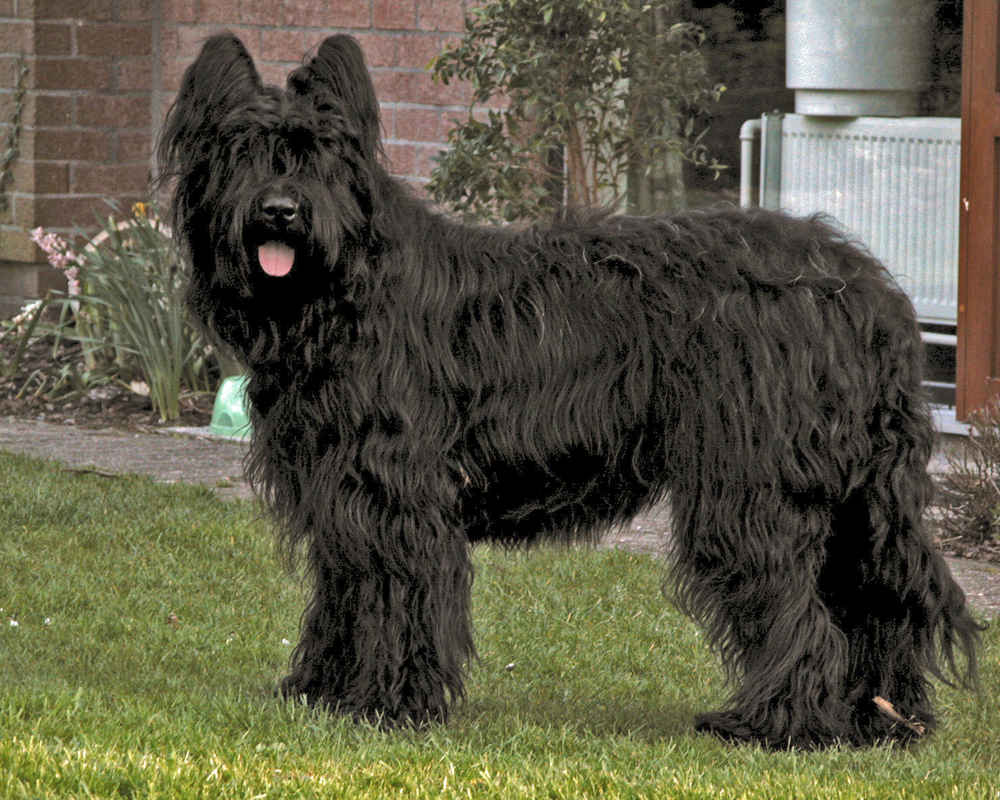
A Briard is fully grown after about ten to twelve months.
Care of the Briard
With its long coat, the Briard is a high-maintenance dog. There is disagreement about the frequency of combing. Since the fur is very dry and somewhat harder, it does not tend to become matted as much. Nevertheless, it makes sense to comb the fur regularly at least every two to three days. Dirt and plant parts get caught in the long hair, which are removed by combing. Due to the size of the dog, grooming takes about an hour.
Grooming is just as stressful for the dog as it is for the owner. Therefore, many long-haired dogs try to avoid her. It is easier if the animal is already used to it when it is a puppy. A fixed care ritual is helpful. If the dog is always combed at the same time and in the same place, it will be easier for him to get used to it. Unnecessary pain from small tangles can be avoided if the hair is carefully combed through from the tips with a wide-toothed comb. If one hand holds the hair in tufts at the base, combing does not pull on the skin. The very hairy areas behind the ears, on the chest, on the face and between the toes require special attention. A few strokes in between help to relax. If the dog gets a reward after grooming, the procedure receives a positive reinforcement.
The Briard must not be washed with shampoo. The shampoo would make his fur soft and prone to matting.
If the hair grows too far into the eyes, it will affect the dog’s vision. This makes it difficult for him to communicate with other dogs. Eye infections can also be the result of excessive hair growth. It makes sense for the dog to have short hair around the eye area so that the eyes are clearly visible. If you don’t want to cut your hair, you should put it in a ponytail. Like most long-haired dogs, the Briard sheds minimally.
Briard’s wool is her pride and of course it takes some effort from the owners to keep her looking beautiful and well-groomed. But here you can note a clear plus – the representatives of this breed lack seasonal molting , which means that there is no wool in the house.
Briards require grooming regularly. They should be combed daily. This process can take up to 2 hours. Only in this case the wool does not tangle, it becomes smooth and shiny, and it remains clean for a long time. If the dog does not participate in the exhibits, the coat can be trimmed a little. This simplifies the care of the appearance of the pet. It is required to visit a professional groomer with your pet at least once in 2 to 2.5 months.
Bathing requires regular – 1 time in 4-5 weeks or more often if the dog gets dirty. But this applies to apartment dogs: it is enough to wash captured Briards several times a year. Another feature of Briards is that when wet, the wool emits a sheepy smell.
Caring for your dog’s ears, eyes and paws is important. Check these parts and clean them of dirt and dust. This is a good way to prevent the development of an infectious disease in an animal.
But the most important are the obligatory long walks in the fresh air. They need to be done twice a day and should last 1.5 to 2 hours. It’s important to keep the briar busy with exercise, outdoor play, and jogging.
Can you shear the Briard?
In principle, it is possible to shear the Briard. Nevertheless, his long fur should be preserved. It protects him from cold and also insulates him from heat. If Briards are clipped too short, they can develop skin eczema.
Briard – activities, and training
Training and activities are especially important for this agile and hard-working dog. This includes long daily walks and games. The Briard also likes to be challenged cognitively. Therefore intelligence games belong to his preferred occupations. Catch-and-seek games and dog frisbee are some examples. Adult animals are suitable for running on a bicycle. Some owners use their dogs as draft animals in front of a sulky.
The Briard can be enthusiastic about all known dog sports. These include:
- dog dancing
- agility
- protection dog training
- mantrailing
- tracking work
- territories
- obedience
- hoopers
- distance training
Good to know: special features of the Briard
Because of its attractive appearance, intelligence and endurance, the Briard is a popular film dog. The film dog Michael, for example, portrayed the family dog Buck in the American series “A Terribly Nice Family”. A Briard also plays a part in the film “Kiss Kiss Bang Bang”. The dog Dex of the Geiss family also gained notoriety. He can be seen in many episodes of the series “The Geissens – a terribly glamorous family”.
In one of the most successful melodramas of the 19th century, a Berger de Brie played the title role in “The Hound of Aubry”.
How to feed Briard
It is worth considering that coming into the house of a large dog is a lot to eat such a four-legged friend. Therefore, this aspect requires special attention. Like most breeds, Briards can be fed natural foods or prepared rations. Only for them compound feed is not suitable, as it can undermine the health of a pet.
Briard needs a balanced meal. The basis of the diet is meat. Other ingredients are greens (carrots, pumpkins, zucchini), greens, cereals (millet, buckwheat, oatmeal, oatmeal). It is not recommended to give potatoes to a pet, it is also desirable to remove rice, bread and other pastries, all pastries, from the menu.
The amount of food depends on the dog’s body weight and activity level. Briards are distinguished by excellent digestion, so stomach discomfort is practically absent. It should be borne in mind that in hot periods the dogs move less. Therefore, it is advisable to reduce the amount of protein feed by enriching the ration with vitamin E and yeast. Additionally, you can add a small amount of peanut butter.
If the owner decides to feed the dog production food, it should be a quality product, super premium or holistic grade. You should also choose it for large dogs with long hair.
If the pet does not receive enough vitamins and trace elements, then this immediately affects the condition of the coat. If the diet has changed for the better, but the pet’s appearance has deteriorated or remained at the same level, you should consult a veterinarian for advice.
Disadvantages of the Briard
In principle, the Briard is not a dog with disadvantages. Regular grooming is a little difficult. His stubbornness poses a certain challenge to training, especially the consequences. It is difficult for some owners when the dog looks at him lovingly with his big eyes.
How much does a Briard puppy cost?
The price for a puppy starts at around $900. If the animals are offered at a lower price, there is a risk that they do not come from reliable breeding. The purchase costs for the puppies of award-winning parents are significantly higher.
Is the Briard right for me?
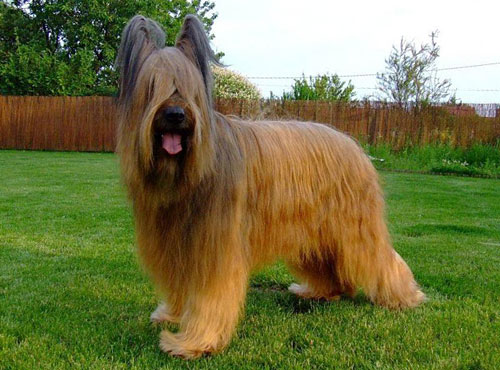
The Briard is the ideal partner for sporty people. He happily accompanies them when hiking, jogging and other outdoor activities. At the same time, this means that owners must offer their Berger de Brie plenty of exercise and exercise. If this does not happen, the dog is in real distress and can show behavioral problems. If you buy a Briard, you have to be sporty and active.
Since dogs of this breed are reluctant to be alone, they take up a lot of time. Because of their size, they also take up a lot of space. The apartment should therefore be big enough for a huge basket and the dog’s freedom of movement. With its weight and size, the Briard is not a lap dog. Nevertheless, he needs his daily cuddles. As a family dog, the Briard’s ideal place is in a home with children and lots of exercises.