The German boxer belongs to group 2 in the FCI standard no. 144. This means that he belongs to the pinschers and schnauzers, molossoids, and Swiss mountain dogs. Due to its muscular appearance and origin, it can be found in Section 2.1, the mastiff-like molossoid dogs.
German Boxer Dog Breed Information

Size: 53-63cm
Weight: Males: 30-34 kg, females: 23-27 kg
FCI Group: 2: Pinscher and Schnauzer – Molosser – Swiss Mountain Dogs and other breeds
Section: 2.1: Molossoid, mastiff-like dogs
Country of origin: Germany
Colors: Fawn, brindle, white, yellow-brindle
Life expectancy: 8-12 years
Suitable as: Companion, working, and family dog
Sports: Dog tracking
Personality: Playful, Intelligent, Kind, Devoted, Loyal, Energetic, Calm, Fearless, Confident, Cheerful, Brave, Bright
Leaving requirements: high
Drooling potential rather low
The thickness of hair is rather high
Maintenance effort: low
Coat Structure: Short, hard, shiny and close-lying
Child-friendly: rather yes
Family dog: yes
Social: medium
Origin and breed history
The ancestors of the Boxer are Brabant Bullenbeisser. These hunting dogs were bred in the Middle Ages specifically for hunting well-fortified game such as bears and wild boar. With the spread of firearms for hunting, dogs lost their jobs. Instead, they were used as guards and protection dogs. Later they helped in slaughterhouses with cattle drives and guarded the animals for slaughter. In the 18th century, the Brabant Bullenbeisser was deliberately crossed with English bulldogs, giving the breed the appearance it has today.
It is not clear where the breed got its name from. The following assumptions can be considered:
Explanations often refer to the name “Bierboxer”, which was given to the dogs in the Munich area.
The name comes from the English language and means translated as a fighter.
The animals were named after one of their first ancestors, a Berlin butcher’s dog named Boxel.
Boxers get their name from a special posture when playing with other dogs. They box with their front paws while shifting their weight onto their hind paws.
An agreement on the breed name Boxer followed with the founding of the first boxer club in Germany, the Boxer-Klub e. V. in Munich in 1895. The Boxer Club established the first breed standard in 1904 in Munich. With the international boxer federation, the standards were largely unified.
The ancestors of the German Boxer
The German Boxer breed has its origins – who is surprised by this naming – in Germany, of course. The ancestors of today’s Boxer were initially used successfully for hunting, preferably wild boar. The first “breeds” of these popular hunting dogs were in northern Germany, but also in parts of Poland and Belgium. The animals were selected and bred solely for their hunting qualities.
The (uniform) appearance played a far less important role. Only the wide mouth with an underbite, the short nose and the strong stature were desired and earned the dogs (depending on the area of application) names such as Saupacker, Bullenbeisser or Bärenhund.
The “Little Bull Biters” or “Brabant Bullenbeisser” that are widespread in Germany are now considered the direct ancestors of today’s German Boxer. Later, English Bulldogs were crossed with and changed and shaped the type and appearance of the former Bullenbeisser.
What’s more, the bulldog was the first to breed white. So there were pure white offspring, but also those with white markings.
The following breeds are added as ancestors of the German Boxer:
Tibetan Mastiff
Molosser
mastiffs
Hunting helper, fighting, and butcher dog
Stature and in particular the distinctive head shape made the ancestor of the German boxer ideal for hunting, which was a popular, albeit sometimes bloody, pastime at the European aristocratic courts. The wide mouth with underbite reliably helped to hold onto the prey and the upturned nose allowed the dog to continue breathing without any problems. This way he didn’t have to let go of the game to catch his breath, which could have meant the prey fleeing.
However, after the French Revolution, interest in the hunting helpers quickly ebbed away, as the principalities in Germany were dissolved and the royal hunt came to an end as a result. In addition, firearms had previously made the use of hunting dogs partially unnecessary. Nevertheless, the Brabant Bullenbeisser found other uses. He was used by private individuals as a guard and protection dog or was used in bloody show fights. The ancestor of the German boxer competed against bulls (when “bull biting”) or other dogs. Fortunately, these “sports” were banned in Germany in the mid-19th century.
But the strong four-legged friend has still not become unemployed. From then on, he was a sought-after helper in the slaughterhouses, where he helped herd cattle, held them down or pushed wild bulls back into their stalls. However, targeted breeding and selection, as in the case of hunting dog breeding, no longer took place. The Brabant Bullenbeisser was crossed with several other breeds, including the aforementioned English Bulldog, which was very popular at the time. Just as there was no uniform type, the naming of these dogs was no longer unambiguous. For some it remained the Bullenbeisser, in other parts dogs of this breed were only referred to as bulldogs.
How did the German boxer get his name?
There are various theories and clues as to why and since when the breed has been given this name of all things:
1. “Boxdoggen” were first mentioned in 1866 in a treatise by the Imperial Academy in Vienna.
2. In 1886, in his book “Brehms Tierleben”, the zoologist Alfred Brehm describes dogs named Bulldogs or Boxers, which he counts among the mastiffs and which are mainly kept in England. In his description, however, there is a differentiation from the Bullenbeisser.
3. The dog of a Berlin butcher is said to have given the breed its name. His name was “Boxl” or “Boxel”.
4. Bulldog breeder Friedrich Roberth describes and praises the “Boxer” in a newspaper article from 1894 and at the same time asks for the founding of a Boxer Club in Germany so that the breeding of these excellent animals can proceed according to plan.
5. The animal painter Ludwig Beckmann also mentions the “Boxer” in his book about dog breeds and wishes for pure breeding of these dogs.
6. Also in 1894, the cynologist Richard Strebel draws attention to the “Boxer” in a specialist journal (Hundesport und Jagd) and advocates proper breeding.
7. At the end of the 19th century, there were many Boxer dogs around Munich, often referred to somewhat derisively and condescendingly as “Bierboxer”.
8. Some believe the breed’s name comes from English, where boxer can also be translated as fighter. This is meant to describe the breed’s courage, strength and endurance.
9. A particularly nice explanation for the breed name comes from a peculiarity of the Boxer, which often shows up when playing with other dogs: the dogs shift their weight onto their hind legs and “box” their opponent with their front paws.
Munich: The cradle of the German boxer breed
Finally, in 1895, three enthusiastic men founded the “Boxer Club”: Elard König, Friedrich Roberth and Rudolf Hoepner. Their goal was to make the boxer a breed of dog with a uniform appearance and certain characteristics. Some time earlier, but in the same year, the “St. Bernhard Klub” at one of his exhibitions a test class for the boxer. However, only one dog was reported: “Mühlbauers Flocki”. Needless to say, he received first prize and at the same time became the first dog to be registered in the stud book.
A year later, a first standard was established and the Boxer Club held its first exhibition. With surprising success. If the club’s founding fathers approached the event with few expectations, they were far exceeded. There were dogs from club members and non-members, as well as paying visitors and interested parties. Of the dogs exhibited there, one stood out in particular: the yellow male “Flock Sankt Salvador”. His build corresponded to the boxer ideal of the time and the “flock figure” was a clear demarcation and departure from the bulldog type.
After various disagreements among the club members and chairmen, however, another club called “German Boxer Club” was founded in 1897, which represented other interests of its members and to which many switched. With completely different breeding goals in mind, however, it was impossible for both clubs to exist side by side and promote a uniform boxer breed. So both clubs dissolved and a new club was founded: “German Boxer Club, Munich”.
The standard, created in 1896, was first written down in 1902 and revised in 1905. Another adaptation did not occur until 1924 when the Boxer was recognized as a service dog. The boxers of that time, with a maximum shoulder height of 55 cm, were too small for a service dog, so the standard in terms of size was adjusted and still applies today: 57-63 cm for males and 53-59 for females. Shortly thereafter, it was also agreed that black, white and piebald are considered false colors.
Important dogs for breeding
1. The founders of boxer breeding are:
Male “Flock Sankt Salvador” (yellow, he shaped the desired “Flock type” with his appearance)
Male “Wotan” (brindle, typical head)
Bitch “Mirzel” (red and yellow)
Bitch “Meta von der Passage” (piebald, good offspring, her parents were both white)
2. Male “Rolf vom Vogelsberg” (owner Philip Stockmann) also became an important stud male. Not only did he survive being used as a war dog in World War I, but he also sired a few litters at the time and helped preserve the breed. The success of the famous kennel “Vom Dom” is also based on him and his offspring laid the foundation for boxer breeding in the United States.
3. Male “Humorous vom Dom” (owner Friederun Stockmann) was a champion and had a decisive influence on boxer breeding in Germany. Out of necessity, Stockmann sold it to America after the war and continued its triumphal march there. One of his descendants, “Bang Away of Sirrah Crest”, is considered THE boxer par excellence and has won numerous titles and awards.
A passionate breeder: Friederun Stockmann
Friederun Stockmann (born in Riga in 1891) was enthusiastic about the boxer breed as a child, but was never able to convince her parents to keep such a dog. She went to Munich at the age of 18 to study sculpture and met her future husband Philip Stockmann there. However, her interest in him was only piqued when he told her about his dog: a boxer named Pluto.
But owning a boxer wasn’t enough for her. Wanting to learn more about the breed, she studied the existing literature. She even managed to have Pluto entered in the studbook of the Munich Boxer Club as “Pluto from the Dome” despite deviations from the standard. The kennel name “Vom Dom” came about by chance, because Pluto lived for a while with Friederun’s mother-in-law in Mainz, who lived opposite the Mainz Cathedral.
Shortly after Pluto, the boxer Laska was added, who was considered a very promising young bitch, but never brought the breeding success that Stockmann imagined. After all, the two boxers took the hearts of Friederun’s parents by storm, and the boxers were an integral part of Stockmann’s life from then on.
With the male “Rolf v. Vogelsberg” finally turned the page. His offspring “Dampf vom Dom” was her first winner and was sold by her husband to the USA at the exhibition in Hamburg. Only 20 years later did she learn that Dampf had become the first boxer champion there. Rolf, on the other hand, served with his master Philip Stockmann in World War I and was the only one of his boxer dogs to survive being deployed at the front.
Other dogs from the line “Rolf v. Vogelsberg” became champions and the Stockmanns gained more and more recognition and fame with their boxer breed. Four of their breeding animals eventually formed the foundation for Boxer breeding on American soil:
Sigurd from the cathedral
Funny from the cathedral
Utz from the cathedral
Dorian of Marienhof
During the Second World War, hard times broke out again for the Stockmanns and their kennel. Since boxers were used for military purposes, Friederun received food stamps for her animals and was thus able to ensure the continued existence of her breeding. Out of necessity she sold more dogs to America and England and although many of her boxers lost their lives at the front, she was able to save a small stock. Her book “A Life with Boxers” and numerous drawings, photos and notes are her legacy. Not to mention all of today’s boxers that are a result of their breeding efforts.
Use of the German boxer in the war
Sadly, scores of German Boxers lost their lives during two world wars as they served as popular military dogs alongside the German Shepherd, among others. Their courage and loyalty made them ideal for this work, but also vulnerable, fearlessly following their soldiers wherever they went. The breed was used for the following tasks in the wars:
- news dog
- reporting dog
- guard dog
- expression dog
- Find and rescue wounded soldiers
- Transporting medicines and food
During World War I, a Munich officer first approached the Munich Boxer Club with a request for suitable dogs for his soldiers who patrolled the front and were regularly overpowered and murdered by hidden troops. The boxers should track down the hidden enemies and warn against further attacks. And indeed: After some boxers accompanied the soldiers on their tours, there were no more incidents.
During the war, however, there were hardly any entries in the stud book and hard times began for the club. Nevertheless, there were opportunities to maintain and advance the breed, for example at a war dog exhibition in 1916 and other events in the following year. Nevertheless, breeding only slowly recovered after the war years. Unfortunately, it was decided by the members of the meeting (probably due to a lack of suitable boxers) that dogs without proof of pedigree should also be included in the stud book for a year. A decision that was later regretted and threw back breeding.
During the Second World War, the Boxer was again in great demand as a service dog. So much so that breeders have been provided with food stamps for the dogs to feed and keep them healthy. On the other hand, the Reich specialist group “German Dogs” issued some special resolutions for the German Boxer. Black and white boxers, like pinto boxers, were to be killed immediately after birth because they were not considered suitable for military service. In addition, there was an appeal that every bitch of a working dog breed with a stable character should be mated to a licensed male in 1943.
In return, the National Association for Dogs would also help with feeding and taking care of the litters. The reasons given were the importance and benefits of the service dogs for the soldiers and their safety. Any service dog owner who failed to do this was considered a traitor. In contrast to the First World War, there were enough boxers in the Second World War and they were even of high quality. Regular exhibitions and licensing took place.
Docking ban
Unfortunately, cropped ears and the shortened tail were seen as the ideal of beauty for the German boxer and were even firmly anchored in his breed standard. It should underline the appearance of the breed and make the dog appear more elegant. In addition, docking the rod should prevent the risk of injury. On the other hand, the undesirable kinked tails that occur from time to time in breeding were eliminated by docking and could therefore be neglected in the breeding selection.
Today, however, it has been proven that cropping ears and/or tail not only causes the dog unnecessarily long-lasting pain, but also restricts its ability to communicate and express itself. What’s more: the rod is an aid to movement and supports the dog’s balance when jumping, running and in curves. Only dogs used for hunting purposes are considered exceptional cases. The tail can still be shortened on request.
Ear docking has been banned since 1987. Tails were banned eleven years later (1998). This may only be done with the hunting dogs mentioned above or out of medical necessity. The breed standard of the German boxer was adjusted after the enactment of these laws and the boxer may keep his natural lop ears and long tail.
For exceptional cases there is a confirmation from the veterinarian. Without such the boxer may not be shown at exhibitions. In order to deal with the problem of tail deformation, there has also been a regulation since 2008 that boxers with docked tails can no longer win champion titles at shows.
German boxers who have a famous owners:
Eko Fresh (rapper) – Butkus
Paul Breitner (soccer player) – Dino
Luke Perry (actor)
Jordan Knight (singer) – Shane
Udo Walz (celebrity hairdresser) – Oskar
Peter Alexander (singer/actor)
Jennifer Love Hewitt (actress)
Axel Schulz (boxer)
Jodie Foster (actress) – Lucy
Justin Timberlake (singer/actor) – Buckley and Brennan
Cameron Diaz (actress)
Hugh Jackman (actor) – JJ
Kim Kardashian-Bella
Cesar Millan (dog trainer)
Gisele Bundchen (model) – Hazel
Jessica Biel (actress) – Buckley and Brennan
Aishwarya Rai (actress) – Sunshine
Ryan Reynolds (actor)
Tony Curtis (actor)
Humphrey Bogart (actor) – Harvey
Sylvester Stallone (actor)
Robin Williams (actor)
Alec Baldwin (actor)
George Clooney (actor)
How expensive is a boxer?
The price of a boxer puppy depends on the quality of its parents. Animals without proof of breeding are available from around $800. Puppies from award-winning parents can achieve prices of $2,000 and more.
Nature and temperament of the boxer
Today the boxer is considered a loyal and child-friendly family dog. He is characterized by healthy self-confidence and friendly nature. Other characteristics of the breed are:
- spirited
- cheerful
- active
- awakened
- fond of children
- patiently
- confident
- brave
- faithful
- docile
- willing to work
- attentive
- intelligent
- dominant over other dogs
Due to the many positive characteristics, the breed was officially recognized as a service and utility dog as early as 1924. Boxers are playful into old age. Therefore, they need employment and plenty of outdoor exercises. If they are denied this, they get bored and look for work themselves. Shoes, furniture, and other items they find may suffer as a result.
While the dogs are loyal to their caregivers, they are initially suspicious of strangers. In times of need, the boxer protects and defends his pack, his family, and his territory with conviction. Despite their great courage and pronounced self-confidence, boxers are not belligerent. Owners should counteract the tendency to stubbornness early on with loving consistency.
What is a typical German Boxer?
The boxer is a very spirited and sporty dog with many good characteristics. He has tons of energy and this combined with his muscular body makes him a real powerhouse. You need owners who also like to be active and want to spend a lot of time with the boxer and give him a task.
In contrast to many other working dog breeds, the German Boxer lacks the “will-to-please”. If he doesn’t see the point in a task or an order, he just acts stubborn. Its temperament, paired with this distinctive stubbornness, requires a consistent but loving upbringing by its people, who should have a lot of patience.
The Boxer is not only intelligent and curious, but often very playful and silly even as a senior. He’d rather play the clown than be serious. However, when he sees his family or home threatened, he doesn’t take a joke. After all, the Boxer is very observant and confident and willing to protect whatever he is supposed to or wants to protect. After all, it was once a helper in hunting dangerous game and the Bullenbeisser was a brave and fearless dog by nature. So it’s no wonder that the character of the German Boxer is ideal for the protection dog test.
He may be a bit skeptical and cautious towards strangers anyway, for example when strangers approach the property. He is quite suitable as a guard dog and is good loud. However, he quickly makes friends and quickly drops his suspicions when he realizes that someone is not threatening. However, a Boxer is and remains sometimes a bit suspicious of other conspecifics and does not always behave in a friendly manner. However, this can be counteracted with good socialization.
Last but not least, the Boxer is known to have an affectionate and loyal nature. He doesn’t like being alone for long periods of time. He would much rather follow his master and mistress at every turn. He is also a great companion and buddy for children. He’s very patient and willing to do almost any nonsense his two-legged friends come up with.
What does a boxer look like?
The sporty and muscular dog may seem dangerous to some. It is not uncommon for inexperienced people to even think they have a fighting dog in front of them. This is especially true for brindle breeds, or if you see a specimen with cropped ears and/or a tail. Boxer friends can only smile and shake their heads. The boxer’s character is friendly, playful and even often a little silly. killing machine? Not a trace! Fortunately, docking is now forbidden in Germany and the natural floppy ears and long tail make the four-legged friend appear friendlier.
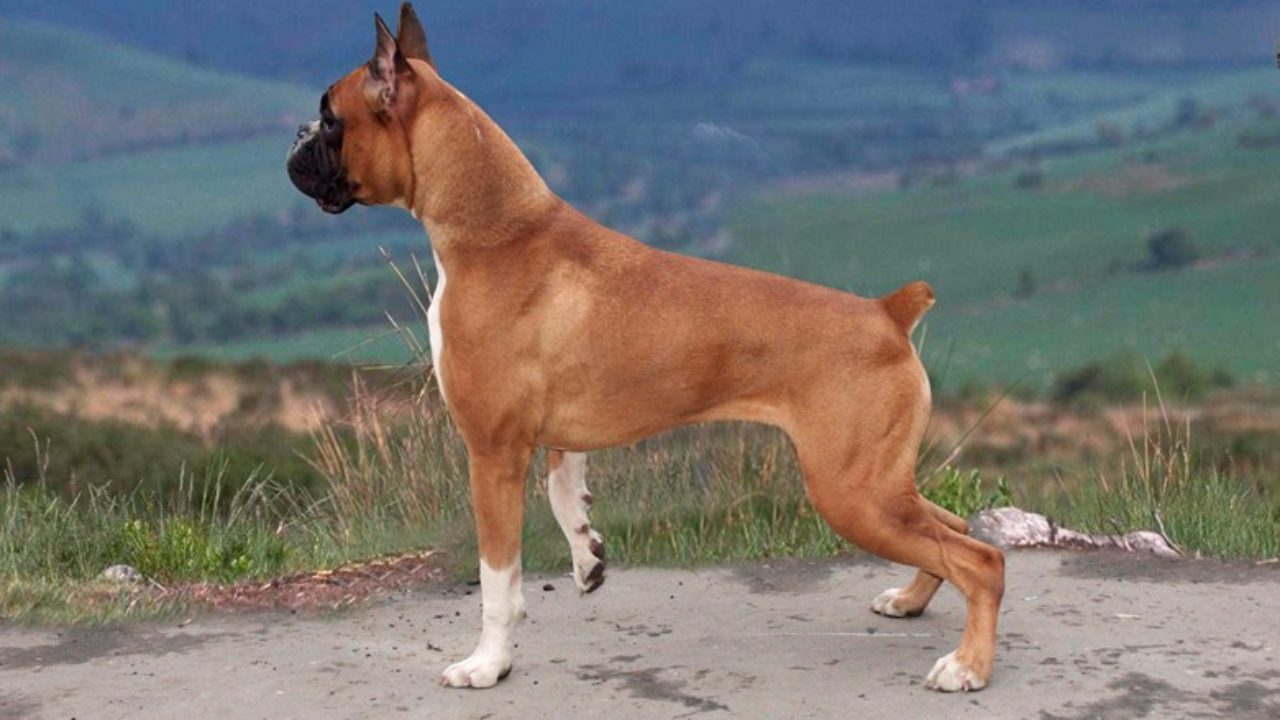
The German boxer is a strong dog with a square build. So it’s about as long as it is high. It has strong bones and the boxer-typical distinctive skull with turned-up nose, broad muzzle and underbite. His eyes are dark and the edges of the lids colored. According to the FCI breed standard, only the colors yellow and brindle are allowed. However, there are also healthy black, white and piebald German Boxers. Its coat is short, smooth, shiny and has no undercoat. White markings (max. 1/3 of the body surface) and a dark mask are allowed.
How big does a boxer get
The Boxer is considered a medium-sized dog. Male dogs are usually slightly larger and also heavier than boxer bitches. They reach a height at the withers of 57-63 cm. The women, on the other hand, “only” reach 53-59 cm. Sometimes it is claimed that there are different types or species of boxers, such as mini boxers and the like. However, if the dog is larger or smaller than the standard specifies, it only falls outside the set framework. However, he still remains a German boxer.
How heavy does a German boxer get?
Males should weigh around 30 kg, bitches slightly less at around 25 kg. The weight should always be seen in relation to the size. A tall boxer lady, for example, can weigh a little more, while a rather small male can also weigh less than 30 kilograms.
What is the German boxer called?
One theory says that the German boxer owes its name to the fact that it likes to nudge its opponent (regardless of whether it is a human or a dog) with its front paws during play. This looks as if he would fight or box. Whether this was actually the real reason for the naming can no longer be sufficiently understood. Abroad, the breed is often referred to simply as Boxer, sometimes also as German Boxer.
How long does a German Boxer live?
The life expectancy of the German Boxer is 10-12 years. In addition to genetic predisposition (which cannot be influenced), other factors also play an important role in determining whether the four-legged friend will have a happy and long life. Species-appropriate husbandry conditions, for example, healthy food, sufficient exercise and occupation as well as family connections and good veterinary care contribute a lot to a happy life span of the Boxer. Of course, life expectancy can be shortened by disease. Because within boxer breeding there are some breed-typical diseases that the four-legged friend could suffer from in the course of his life.
Is a German Boxer suitable as a family dog?
His playfulness and silliness make the German Boxer an ideal family pet. He loves his people and really wants to be there anytime, anywhere. That is why it is best kept by active people who are adventurous and active just like their four-legged friends. Because if there’s one thing the boxer wants, it’s action and movement. While leisurely walks and “hanging out” on the sofa are nice from time to time, they are not the standard activity program for the sporty dog.
Due to his attachment he does not like to be alone and keeping him in a kennel is strongly discouraged. The boxer also feels comfortable in an apartment if the workload is appropriate, but a garden would of course be ideal, since not only can they play and romp around here, but the dog also has a property to guard. Because this is actually in the boxer’s blood. He is somewhat reserved towards strangers and gives a loud voice when strangers approach. However, with people he knows or is allowed to get to know, he warms up quickly and quickly makes new friends.
Since the Boxer can be quite stubborn at times and his upbringing and training will take a lot of time and patience (especially when he reaches puberty), you should probably refrain from buying a Boxer if there are infants or small children in the household. So that your four-legged friend gets all the attention he needs to become a great and well-behaved member of your family, you should buy it long before you want children or you should wait until your offspring is a little older.
What do I have to consider with boxers and children in the same household?
The boxer retains his playfulness into old age. He’s sure to get involved in all the games and adventures his little two-legged friends come up with. And there is certainly nothing better for children than going through thick and thin with your furry friend. Often the boxer becomes a real confidante, comforter, co-conspirator and best friend.
The boxer breed is very fond of children and patient by nature and is therefore ideal for families with children. However, the prerequisite is that the four-legged friend was well socialized and brought up early on. He should be familiar with people of all ages, including babies crying, crawling, and toddlers scampering about. The more familiar these miniature people are to the boxer, the more relaxed he will react to them. Even more: The patience with HIS children is often very large and he puts up with a lot.
But beware: A boxer is and will always remain an animal and therefore does not always react as we expect or wish. Therefore, the dog should never be left alone with small children. Even the good-natured Boxer can run out of patience, and if his threatening gestures are not understood by the baby or toddler, he may correct them. That is why it is of course just as important to explain to your own offspring how to deal with the dog correctly. Don’t climb on him, pull his tail, hit him, or anything like that. It is best if you practice respectful interaction with the boxer and show your children the limits. If the dog is eating or looking up its blanket to sleep, it should not be disturbed. Older children and young people, on the other hand, can be given age-appropriate tasks and thus take on a bit of responsibility. Fill up the food bowl, brush, play or go for a walk? These will soon become the children’s favorite tasks.
It should also be mentioned that the boxer can be quite boisterous at times and may not always look before chasing a ball or when he’s really getting going during a game. Such a small child quickly ran over the pile and possibly suffered some injuries. Make sure the game and activity don’t get too wild and keep an eye on the whole action. It is also an advantage if the training for walking on the leash is carried out particularly intensively. At least if your offspring may or should also walk the dog later.
Is the German Boxer suitable as a therapy dog?
Some people mistakenly classify the Boxer as a fighting dog because of its distinctive and muscular appearance. This is especially true if the four-legged friend has a docked tail and cropped ears. Although this is forbidden in Germany, this appearance of the boxer is well known. This could of course lead to discomfort or even anxiety in some patients. Dogs with long fur and soft features are preferred by many. The German boxer is actually peaceful and friendly by nature and can be a real joker. Not a trace of aggression or hostility. His play instinct and enthusiasm are even an advantage when training to become a therapy dog. And that he is definitely a suitable candidate is underlined not only by all his positive character traits, but also by numerous breed representatives who work as therapy or visiting dogs.
Of course, the dog is not just let loose on the people in old people’s homes, nursing homes, hospitals, centers for the disabled, etc. A practical and theoretical training is pending, for which dog handlers and four-legged friends should meet certain requirements. For example, the boxer should have the following basic conditions:
- basic obedience
- resilience
- Walking on a leash (also with strangers)
- Be available at all times, even when distracted
- Be compatible with peers
- Crowds of people don’t bother him
- Noise from groups of people or sudden noises are tolerated
- He allows himself to be touched, held, and even harassed by strangers
- No potential for aggression
- A close bond with the handler
- Early embossing is an advantage depending on the area of application
essence festival - Even if it is a voluntary activity, working as a therapy dog is hard work for the German
- Boxer, which requires full concentration and is quite tiring and exhausting for the four-legged friend. In his free time, he should therefore be given a nice contrast program where he can switch off from time to time.
Are there differences in temperament between male and female dogs?
The German Boxer is bred to have certain traits and characteristics that are typical of its breed. However, certain conditions are attached to ensuring that these can also develop fully. After all, genes and predisposition are only half the battle. It remains to be seen what breeders and owners will make of the solid base in the end. Because with the wrong or missing upbringing, a lot can go wrong and even the most good-natured and friendliest boxer develops bad habits or even shows aggressive behavior.
In order for desirable personality traits to become established, a number of requirements must be met for puppies and young dogs:
Does the Boxer puppy come from a reputable breeder?
Has socialization and familiarization already started in the kennel?
Did the puppy have a family connection?
Does the boxer know conspecifics and possibly other pets?
Was the dog allowed to experience a lot and gather positive new impressions (noises, underground, people of all ages, city noise, traffic, etc.)?
Are his new owners novice dogs or more experienced?
What training does the dog get (dog school)?
How do their owners raise them (strict, consistent, with punishment, positive reinforcement)?
By doing nothing, no one gets a top trained dog with a stable temperament. It doesn’t matter whether you choose a male or a female.
You don’t automatically get certain character traits just because you end up choosing the female Boxer puppy or vice versa. Even if it is often claimed that the two sexes differ in essence. It is better to rely on the judgment and advice of the breeder. After all, he knows his puppies very well and knows who is the rowdy in the litter, who is the reserved one and who is the clumsy one. This usually has little to do with a male or female dog, but is more a question of disposition and type. There are also bitches who think they have to play the boss or even mark them.
Changes in temperament in boxers during heat
Of course, boxer males and boxer bitches differ in one respect: their heat. While the first heat (to be expected from about the 9th month) is still quite atypical in the bitch and is often not that pronounced, you will soon recognize a certain pattern if your boxer lady broods about 1-2 times a year comes into heat. How the bitch reacts and behaves during this time can be completely different. Some of them hardly notice the altered hormonal balance, others feel like they’ve changed. There are specimens who become totally cuddly and affectionate, while others prefer to withdraw. Mothering and protecting toys or other objects may also occur. Some bitches even become pseudopregnant and even lactate. However, this is not a cause for concern.
Even a male boxer can have a hard time turning a bitch’s head in the neighborhood when she’s in heat. Some refuse to eat, try to run away at a suitable moment and get to their loved ones or howl for hours (also at night). On walks, the trace of a bitch ready to mate can cause all sorts of distraction and the boxer sometimes forgets his good manners, ignores commands and goes pens.
Can neutering affect boxer behavior?
There is no medical need for castration in male dogs. It is often claimed that they become calmer afterwards or that bad habits and behavioral problems can be alleviated as a result. But this is by no means true for all candidates. Especially not when the dog is already fully sexually mature and fully grown. However, urges can be suppressed if the male dog is spayed before the onset of sexual maturity. After that, he usually behaves neutrally towards his female conspecifics and does not become “lovesick” with a bitch in heat in the neighborhood.
Castration in the Boxer bitch, on the other hand, can effectively prevent mammary tumors and also prevents various other diseases of the genital organs. However, the prerequisite for this would be that the intervention is carried out before or after the very first heat. After that, there is no significant difference in the risk of such diseases. Of course, regular bleeding during heat and false pregnancies also stop after the operation.
Important:
Castration is a surgical procedure and therefore always involves risks. Under no circumstances should males or females be castrated just because the master or mistress is too lazy to work on unwanted behavior or finds certain hygiene measures too strenuous or annoying during the heat. In addition, the early intervention is controversial because important hormones that are necessary for healthy development are lost.
Prejudice against the boxer
1. White boxers are deaf and sick
By law, thankfully, it is now illegal to kill white Boxer puppies from a litter. This was actually common not so long ago. Completely wrong. Because the white or piebald are no less healthy or sick than the brindle and yellow representatives of the breed. Unfortunately, the rumor still persists that white boxers:
- are albinos
- Often born blind or deaf
- are susceptible to disease
- show other anomalies
White boxers are inextricably linked to the history of the breed. Many progenitors and progenitors were white, as were the inbred English bulldogs. At the first breed shows, even more white boxers were exhibited than other colored boxers.
Many breeders also report that whites and piebalds are often stronger and healthier than the rest of the puppies. They now also receive a pedigree certificate, but with the note that they are not approved for breeding.
However, deafness occurs in a few white boxers. Namely, those with two blue eyes are a little more prone to anomalies or are sometimes just deaf. To demonize all colors except brindle and yellow is simply wrong.
2. Boxers have breathing problems
The boxer is one of the dog breeds with brachycephaly. This means that its skull is rounder than other dog breeds and its nose is shorter. This can lead to breathing problems and other impairments:
Less resilience in warm/hot temperatures
Breath sounds, such as snoring, whistling, or grunting
Shortness of breath when excited
lack of oxygen
Romping around with other conspecifics is too exhausting
Difficult feeding
However, the recessed boxer nose was actually bred precisely for the reason that the four-legged friend could continue to breathe easily when he was holding his prey with his catch and waiting for the hunter to arrive. Due to excessive breeding or incorrect ideals of beauty, some boxers are nevertheless impaired by their short snout and turned up nose and should be examined by a veterinarian and treated if necessary. Sometimes surgery can provide relief.
However, most specimens enjoy good ventilation and have little or no breathing problems. It should be mentioned, however, that there are quite different snout lengths in the Boxer breed. 1/3 and 2/3 lengths are often used. The shorter ones tend to make breathing noises a little more, such as snoring. If both parents are not white, the offspring often have longer snouts and the desired distinctive Boxer type is sometimes lost as a result. One reason, by the way, why attempts to breed the white out of the Boxer line were abandoned. The whites were and remain an integral part of Boxer breeding.
3. All boxers drool
Yes, that’s true, but not all boxers drool the same amount, and especially not all the time. Most often, drool strings form at the corners of the mouth when the dog is excited, playing or happy. Even when begging, eating and drinking, the foam flows out more or less strongly.
Many Boxer owners therefore always have a small towel with them so that they can wipe their snout in a jiffy if necessary. This is also advisable, especially after meals, because if the dog shakes itself, not only gooey drool but also food leftovers will fly through the apartment. The boxer also likes to clean his mouth on the owner’s trouser leg or wipe it dry on the sofa. Drinking water is best exchanged several times a day.
But don’t worry: most boxers don’t drip all day long. The amount of saliva can also vary greatly from dog to dog. While some only have spaghetti-long threads hanging out of their mouths in front of the feeding bowl, other representatives of the breed mucus far more often. A little (more) drool won’t deter a proud Boxer owner or Boxer friend though.
The appearance of the boxer
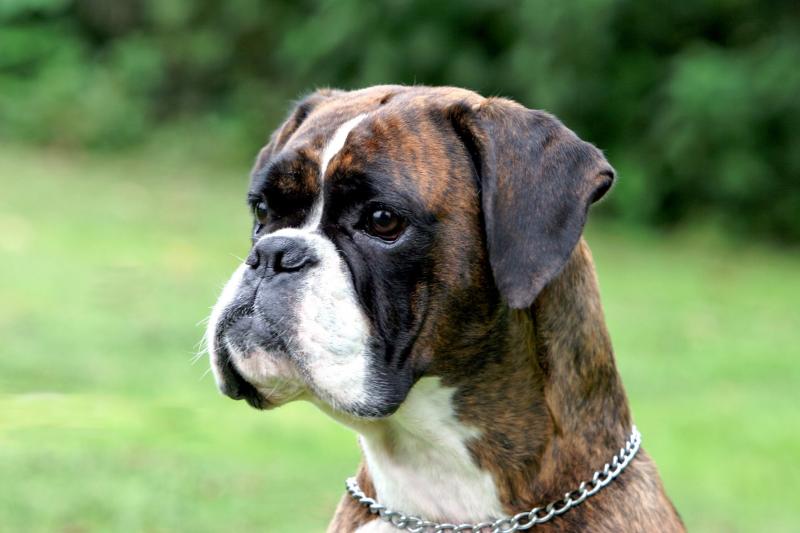
The most recognizable feature of the boxer at first glance is his entire face. It is dominated by a black mask from which large, dark brown eyes gaze lovingly and patiently. His nose is slightly set back due to the long lower jaw and the resulting underbite. The shape of the jaw is due to the original tasks of the ancestors. Bull biters need the underbite to reliably hold the hunted prey. Associated with this are his hanging flews, which give his face a somewhat sad expression. In this respect, the facial expression does not correspond to the nature of the boxer.
The shape of the head forms a harmonious overall picture with the physique. It is square with a wide muzzle and runs into a muscular neck. There is a clear step between the nose and forehead. High-set hanging ears round off the friendly face. Overall, the breed is characterized by a square and muscular physique. The chest is broad, muscular and deep. The legs are stocky and straight, with the rear also showing well-defined muscles. The tail is long, straight, and set high.
Female: 53 to 59 cm; 25 to 27 kg
Male: 57 to 64 cm; 30 to 32 kg
German boxers have a short, shiny, and rather hard coat that comes in the colors:
- Yellow amber
- Reddish-brown tabby
- Yellow tabby
- White
- White with brown spots
All color variants can be interrupted by white markings on the face, chest, or paws.
Upbringing and attitude of the boxer – this is important to note
The Boxer’s joy in learning and the attention they get from their people make training easier. The dogs are therefore also suitable for beginners in dog training. In order to awaken the positive characteristics, the acceptance of humans as pack leaders is necessary. Owners achieve this by treating their animals with a lot of love and attention. Calmness and composure are the right advisors when it comes to boxer posture. Under no circumstances should the dog be trained with a loud voice, threats, or even punishments. Dealing with the boxer in this way would encourage his stubbornness and stubbornness. However, it is precisely these qualities that should be weaned from him with consistency.
Training begins with the puppy in fine doses. The young dogs need a lot of rest between the learning and training periods. With increasing age, the activities should be increased. It is important to stop unwanted behavior consistently and directly. Positive behavior is reinforced by immediate praise, pats, and shows of happiness.
To learn commands, the dog first needs a quiet and undisturbed environment. The familiar environment in the garden or in the house is free of distractions and creates security. Later, the practice sessions will be moved to other locations. In this way, the dog learns that the commands apply anytime and anywhere. Visiting a dog school always makes sense with a puppy. On the one hand, its owner learns more about dog training, on the other hand, the dog learns social behavior in a group of conspecifics.
German boxer life expectancy, life span
How old does a German boxer get?
The average life expectancy of the German Boxer is 10-12 years. This lifespan is influenced, among other things, by the quality of the housing conditions, the feed and the medical care. Various diseases can also shorten the boxer’s life or significantly impair his quality of life. Above all, cancer and breed-specific and genetic diseases.
If you love your boxer, you will keep and feed the sporty four-legged friend as appropriately as possible and take his special needs into account. So that he not only has a healthy dog life, but also a beautiful one, you as the owner can do a lot to help.
If, on the other hand, the life expectancy of the boxer seems too low, but you don’t want to do without all the good qualities and characteristics of the breed, you might want to consider a boxer mix. But how old does a German boxer hybrid get? In any case, you have no guarantee that the larger gene pool will actually extend the expected lifespan. Mixed breeds do not automatically live longer than their purebred relatives. If you take a look at the mating partners and their respective life expectancies, you will at least get a first impression of how many springs your boxer mix could end up making.
Does a Dog’s Size Affect Its Life Expectancy?
If you look around the dog world, you will find that small breeds usually live longer than their larger and heavier counterparts. Maltese, Chihuahua or Shih Tzu, for example, live a lot longer compared to Boxers. It is not uncommon for the smaller candidates here to have a lifespan of 15 years or more. In the case of medium-sized and large dogs, on the other hand, the life expectancy drops somewhat and levels out at around 10-12 years.
Researchers see a connection between the rapid growth in the first year of life, the later onset of sexual maturity in large breeds and their lower life expectancy. Wear and tear and signs of aging or age-related diseases set in faster and cause problems, pain and a shorter life earlier.
However, when comparing different dog breeds and their expected lifespan, the size of the animal should always be considered in relation to its weight. Large but sporty and slim dogs therefore have an advantage over large but heavy breeds.
What role does cancer play in the life expectancy of the German boxer?
Unfortunately, the German boxer appears to be somewhat prone to cancer, particularly mast cell tumors of the skin and subcutaneous tissue. When it comes to a disease-related cause of death for the boxer, cancer actually ranks first. But neurological and genetic diseases can also shorten the lifespan of the German Boxer.
This makes it all the more important to always pay attention to skin changes during the care routine and to take the dog regularly to a veterinarian to have it checked and checked. If tumors are detected in time, they can be treated with surgery or chemotherapy. However, these treatments are not always successful.
How can I contribute to a happy dog life and positively influence the Boxer’s lifespan?
Nobody can predict when the last hour will come for your boxer. Despite good care and a perfect pedigree, genetic, chronic or other diseases can affect the Boxer or an accident can take the dog’s life away. 10-12 years is just a guideline. There are also boxers who unfortunately will not live to a decade, but also some candidates who might make it to 15 years. However, if you want to be sure that you have done everything for a healthy and long boxer life, we recommend the following tips. Anyone who heeds this makes an enormously important contribution to the well-being of the dog and a species-appropriate and wonderful boxer life. In the end, it’s the good memories that count, not how long your boxer has lived.
Tip 1 – Only buy the Boxer from a reputable breeder
A good breeder will only mate boxers that are healthy and have a stable temperament. His breeding animals have also passed a breeding approval test, where appearance, character and endurance were assessed by experts and their health had to be proven by reports. As a result, the future offspring should not only correspond to the breed standard, but above all be healthy and hopefully free of hereditary diseases when they see the light of day.
What’s more, the breeder has the puppies examined by a veterinarian and examined by the breed warden. The little boxers are also wormed and the breeder starts with the first vaccinations for a successful basic immunization against various serious infectious diseases. For the best possible start to boxer life and hopefully a long life expectancy.
Tip 2 – Good medical care
Some breed representatives only see a veterinarian for internal vaccinations or when worming or flea treatment is needed. But no matter why your boxer needs to be seen by the vet, always ask the doctor to do a quick check of the dog’s general condition if he doesn’t do this routinely anyway. The main focus should be on the dog’s mouth and changes or lumps on or under the skin.
Good oral hygiene in Boxers is extremely important and is unfortunately neglected by many owners. But bad teeth, tartar and inflammation in the mouth can cause serious damage in addition to loss of appetite and pain. It is possible for bacteria from the mouth to spread through the blood vessels in the body and affect other organs. For example, it has been shown that gum disease in dogs is linked to heart problems.
It is therefore better if you pull out the toothbrush every day and scrub the boxer’s teeth, or have the teeth cleaned professionally in the veterinary practice regularly (e.g. every year). Bad teeth should possibly be completely removed during this procedure. However, general anesthesia is required for cleaning, which is why preventive measures such as brushing teeth, dental care toys and chews should always be given preference. Diet also plays an important role. Because species-appropriate feed minimizes tartar formation and may never be a problem.
The older Boxer should also be examined and palpated for tumors as mast cell tumors in particular are more common in the breed. An analysis of the urine is also advisable in order to detect kidney diseases at an early stage. A change in diet can often help to get the problem under control.
Tip 3 – Holistic care of the German Boxer
There is more to grooming the German Boxer than just a shiny, beautiful coat. In the beauty routine, the dog should therefore always be cared for from head to paw. Check ears, eyes, mouth and teeth, skin, paws and claws regularly and watch for changes. If you notice scales, parasites, wounds, lumps, tartar, long claws or make other unpleasant observations, you should immediately visit the nearest veterinary practice. After all, such little ailments affect the quality of life of the dog very much. If left untreated, they can actually make him really sick and shorten the boxer’s lifespan. However, those who recognize changes quickly and act early have a good chance of quickly counteracting emerging diseases before they take on serious proportions.
By the way: Keeping the utensils and accessories in perfect condition is part of the overall care of the boxer. Cleanliness in the household is therefore a must. For example, food and water bowls should be rinsed with hot water daily or after each meal. Sleeping places, on the other hand, should be washed regularly (if possible in the machine) to remove dirt, germs and possible parasites. Care items, such as brushes, also need to be cleaned from time to time or should be replaced. This also applies to leashes or collars.
Tip 4 – Eat healthy
A balanced, varied and healthy diet not only tastes good to the boxer, but also provides him with important vitamins, proteins, fats and minerals that strengthen his immune system, ensure strong muscles and bones and keep him vital and fit. A few snacks in between are of course allowed, but should not get out of hand in order to avoid being overweight, which can make you ill. Rather feed small treats during training or subtract snacks from main meals.
By the way, when choosing the food, you should not only look at the price or rely on the nice advertising promises. Better take a look at the ingredients list. The shorter this is, the better the lining is usually. The main part should always be meat and contain little or no fillers.
Be aware that the boxer’s nutritional needs will change throughout his life. As a puppy, it needs a different food composition than its adult counterparts. In old age, on the other hand, it may be slightly smaller rations or calorie-reduced meals. Otherwise, the reduced urge to move can lead to an oversupply and the boxer will become fat. High-fiber feed also helps to get the sluggish digestion going a bit.
Tip 5 – Get enough exercise
The muscular boxer is a powerful bundle of energy that wants to be challenged. Originally bred as a working dog for hunting, even as a family dog he needs all sorts of other activities in addition to long walks to be happy. The boxer should not only be challenged physically. Give your four-legged friend a few tasks that will also put a little strain on his distinctive little head and mentally stimulate and keep him busy. It’s all about a good mix. Because a healthy body and fit mind are good foundations for a long and beautiful life.
However, too much exercise can be quite harmful in the first year of life. The entire musculoskeletal system is still developing and jumps, wild games, abrupt stops or quick turns must be avoided. The old boxer, on the other hand, needs to be persuaded to do a little physical activity every now and then. Feel free to adapt walks and other activities to the reduced urge to move, but make sure that your old boxer remains mobile. If you want to make it a little easier for your four-legged friend, you can consider a dog ramp for the car.
Tip 6 – Family connection and safety at home
The Boxer is absolutely not suitable for kennel keeping. While he can be home alone for a few hours a day, he shouldn’t be isolated in a kennel. He is known for his attachment and loyalty and therefore absolutely needs contact with his people. A garden, on the other hand, would be desirable, although not absolutely necessary. Keeping them in a large apartment is also conceivable if the four-legged friend gets enough exercise and is busy.
However, if you want to keep a Boxer, you should definitely make your home dog-proof. For example, electrical cords should be routed so that sharp puppy teeth cannot reach them. Poisonous medicines, cleaning agents and plants should also be kept out of reach and a garden should be fenced in so that it cannot escape.
Tip 7 – Safely on the go with the German Boxer
It is a rule that dogs must be adequately secured in the car so as not to endanger the occupants and other road users. Of course, the safety of your boxer is also important to you, which is why it should be stored in a transport box during journeys, which should ideally be at right angles to the direction of travel. Since the Boxer is quite large, you need a correspondingly large vehicle or a spacious trunk. With a station wagon, it is also possible to separate the trunk from the occupants with just a partition grille and to make the entire area available to the boxer. However, the risk of injury for the animal is greater than in the transport crate.
On the other hand, the boxer should always be on a leash on walks if he cannot be called absolutely reliably. The four-legged friend could get frightened and hop onto the road or maybe suddenly chase after an animal. So to avoid bad accidents, the leash is the safest option. Especially in cities, on busy roads or places with high traffic and crowds.
Tip 8 – Castration to prevent cancer
This procedure is not really medically necessary for either male or female boxers. However, if two dogs of different sexes live in the same household, one of the animals is often castrated to prevent unwanted offspring. It is also sometimes claimed that neutering can increase the life expectancy of the dog somewhat, but this thesis is controversial.
However, it is true that early castration in bitches can reduce the risk of diseases of the ovaries and uterus as well as various types of cancer (e.g. mammary tumors). However, there is only a significant difference to non-neutered Boxer bitches if the procedure takes place before or after the first heat. Castration at a later point in time hardly reduces the risk and should therefore only be undertaken if the bitch suffers from repeated and severe false pregnancy.
Tip 9 – Vaccinations
It’s so easy to protect your Boxer from nasty infectious diseases. A complete basic immunization in puppy age and regular booster vaccinations reliably help to keep the dog healthy. A small prick protects him from diseases that can take a violent course, especially for puppies or old dogs, and sometimes have a fatal outcome.
If you don’t want to pump your Boxer up with a multitude of vaccinations every year, it should be said that veterinarians have now moved away from the annual vaccination routine. “As little as possible. As much as necessary.“, is now the motto. According to the manufacturer, most vaccines only need to be refreshed every 3-5 years and still offer sufficient protection.
How do I know that my German Boxer is aging?
Some dogs have less desire to exercise or are more quickly exhausted. Tailor your walks and activities to the old boxer’s needs, and better take it slow.
The fur slowly turns gray and loses its shine. The first gray hairs are the first to become visible, especially on the face.
The four-legged friend is less adaptable. Older dogs often love their routine and don’t like any deviations (e.g. holidays to a foreign country)
Your boxer will require longer periods of rest to recover from activity.
Some dogs get a little stiff in the joints or other musculoskeletal problems. A dog ramp for the car can make everyday life easier and protect the Boxer’s joints.
Vision may deteriorate and/or the boxer’s hearing may be impaired.
Incontinence can occur with age. Therefore, go out more often for small rounds with the boxer.
Age ailments appear.
Can a boxer be dangerous?
Boxers don’t have an aggressive nature. If their pack or family is threatened, they fervently defend and protect their surroundings.
Boxers need space and exercise
For boxers, range of motion and entertainment is important. They are ideal companions for sports such as cycling, skating, or jogging. Keeping them in a house with a garden that the dog can guard is ideal. The dogs don’t feel comfortable in a flat in a big city. Since contact with people is very important, the animals should not be left alone for long. Boxers feel like people’s partners and therefore like to have someone around them all the time.
Since they are fond of children, Boxers are happy to have children in the house who romp and play with them. Nevertheless, even a boxer should not be alone with small children. Small children, in particular, do not yet know how to approach a dog properly. They may unknowingly inflict pain on you, causing the dog to snap at you. Older children must also first learn how to handle the dog properly.
Anyone who chooses a boxer should have plenty of time for him. The dog needs at least two hours of daily exercise. In order to be able to live out one’s temperament, simply going for a walk is not enough. Balls or frisbees should be constant companions on walks. Keeping them in a kennel or possibly on a chain does not correspond to animal welfare and is unimaginable for boxers.
Boxer diet
As agile and active dogs, boxers need food that is rich in fat and protein with lots of meat. Whether the dog should be given dry food, wet food or raw meat depends on its state of health and age. Allergies to certain food components or a sensitive digestive system can restrict the choice of food. When purchasing a puppy, the first thing you should do is stick to the breeder’s feeding habits. Veterinarians also provide important information about the right food for a Boxer. Healthy dogs tolerate:
- Dried animal food
- Canned wet food
- BARF (raw meat and offal)
- Home-cooked food
In order to bring a little variety into the diet, a combination of different types of food is also possible. For example, dry and wet food can be mixed. In between, dogs love raw or cooked meat with vegetables and few carbohydrates. Some dog owners swear by “Barf”, feeding them only raw meat. Pet shops, slaughterhouses, and specialty shops offer special feed made from slaughterhouse waste. But not all dogs tolerate this form of nutrition.
Some dog food manufacturers offer both dry and wet foods specifically designed to cater to boxers’ needs. In between, dog snacks are allowed in moderation. They make dog training easier and help to clean teeth. The pet trade offers special chewing bones made of cowhide, dried meat, and many other variants.
Bones are only suitable as snacks to a limited extent. Dogs must not eat cooked poultry bones, as these tubular bones can splinter and cause serious injuries. However, this also applies to some extent to the bones of other animals. Therefore, bones should only be fed raw. Since raw pork is not suitable as dog food due to the possible virus and bacteria content, pig bones are also excluded.
Dogs enjoy the occasional gift of beef or lamb bones. However, the amount should be kept small. Bones contain many minerals, not all of which are healthy for dogs. In addition, eating large amounts leads to hard stools and constipation. Both cause the dog unnecessary pain. Dogs love marrow bones and can spend hours entertaining them. However, these popular bones in particular carry a high risk. They can become so lodged in the fangs and between the teeth that the vet has to remove them under general anesthesia.
It is important that the dog always has sufficient amounts of fresh drinking water available. Dogs that live in the house and garden like to have different drinking places inside and outside.
Like all large dogs, Boxers are prone to gastric torsion. It is therefore advisable to feed them in small portions several times a day. After feeding, the dog should rest a little.
Health – life expectancy & common diseases
A healthy boxer has a life expectancy of 12 to 13 years. Among other things, health depends on breeding. Therefore, when choosing a puppy, it is important to pay attention to its origin. In the past, many breeders attached great importance to the external appearance of the dog. This led, for example, to the extremely shortened snout and a short and round head. Affected animals suffer from severe shortness of breath due to this brachycephaly (short and round head). Responsible breeders choose parents with longer snouts to solve this problem in the long term.
Like all large dogs, Boxers are at risk of hip dysplasia. Due to this misalignment of the hip joint, the dogs suffer from pain when running and walking. Occasionally boxers are prone to spondylosis, a degenerative change in the spine. Other breed-specific diseases are:
- Heart diseases
- Tendency to the stomach and intestinal problems and flatulence
- Susceptibility to osteochondrosis dessecans (OCD, cartilage detachment in the shoulder joint)
- Cancer
Before deciding on a puppy, it makes sense to take a look at the breeding line. The risk of disease is very low if it did not occur in the ancestors.
Boxers have a strong appetite. Due to their muscular physique and their joy of movement, however, they do not tend to be overweight.
The boxer’s short coat offers little protection from heat and cold. Boxers are therefore sensitive to extreme temperatures. On warm summer days, they prefer a cool, shady place. On these days, the exercise program should be a little more economical. In winter, the boxer freezes easily. A dog coat can then make walks more comfortable for him.
How old do boxers get?
Well-bred boxers can live to be 12 to 13 years old. Overbreeding with inbreeding shortens life expectancy significantly.
Care of the boxer
The advantage of the short-haired coat is that the Boxer is easy to care for. It is sufficient to occasionally brush the coat with a soft comb to remove dirt.
With the changing of the seasons, boxers change their fur in spring and fall. During this time they shed more. If bald spots form, there may be hormonal causes or parasite infestation. Boxers are also susceptible to seasonal flank alopecia. This occurs in the winter months after the moult. Bald spots form symmetrically in the area of the flanks. The fur grows back in the spring. The cause of this hair loss has not yet been clearly clarified. It is assumed that there is a connection with the length of daylight or with hereditary dispositions. Since the dog does not suffer from the hair loss and the fur grows back, no medical treatment is required. However, possible other causes should be ruled out beforehand.
How much hair do boxers shed?
Boxers only shed during the spring and fall moult. The rest of the time they lose very little hair.
Boxers – Activities and Training
As an active and active dog, the boxer needs a balanced training program. Dogs love playing with balls, frisbees, and other dog toys, as well as tugging games. They look forward to long hikes and bike tours. When cycling, however, the needs of the dog must be taken into account. From time to time he also needs time to sniff and to do his necessities.
Boxers enjoy various dog sports such as:
- dog dancing
- obedience
- agility
- mantrailing
- intelligence games
Boxers are enthusiastic about training to become rescue or therapy dogs because they like both the movement and the cognitive challenges.
Good to know: special features of boxers
Boxers are very popular because of their friendly nature, interesting facial expressions, and self-confidence. Since ear and tail cropping has been banned, the Boxer’s appearance has returned to reflect its friendly disposition.
Many celebrities, such as Justin Timberlake, Kim Kardashian, or Cameron Diaz, have therefore opted for a boxer.
Is a boxer a family dog?
The boxer is the ultimate family dog.
Disadvantages of the boxer
The Boxer’s greatest disadvantage, drooling, has been largely contained through breeding in recent years. Disadvantages in the behavior of the boxer only arise from incorrect posture and training. When boxers are bored or lonely, they develop undesirable behavior and can destroy the facility. Dogs that are raised under stress can become completely closed to their human. Therefore, sensitive training and regular occupation with the dog are important prerequisites for living together.
Does the boxer suit me?
The Boxer is the ideal dog for families with children. He is the right dog for the family with a house and garden, in which someone always has time for him. Due to its urge to move, sporty people are good partners for the dog.
Why do boxers drool?
Large dogs, especially Molossers, tend to drool a lot. Large amounts of saliva accumulate in their cheeks, which they cannot always swallow. This causes the saliva to swell and run out of the mouth.