Chartreux, Carthusian, or Maltese cat – many names, one breed. The Carthusian cat is one of the most popular breeds of cats in Europe, yet there is a lot of confusion around them. And that’s not only because of the different names for the breed but also because of its changeful history!
Everyone knows the gentle cats with blue-gray fur and yellow eyes. No wonder, after all, the Chartreux has not only been known and loved since it appeared in the well-known Sheba cat food advertising! In the vernacular, the cats are often referred to as “Carthusian”. A name that causes confusion, the term stands for various blue-gray colors of well-known cat breeds, from the long-haired, blue Angora cats to British Shorthair with blue-gray fur and finally cats belonging to the “Chartreux” breed.
Chartreux Cat Breed

The origin of the Chartreux cat is believed to be in present-day Syria – from there they came to France via trade routes. Allegedly, the monks of the order of the Grande Chartreuse near Grenoble should have bred Léger Karträuser cats since the Middle Ages. Even if the Chartreux looks noble and majestic and you can easily imagine it in weathered monastery walls, this is not true. The monks devoted themselves less to breeding cats, but more to the production of a herbal liqueur called “Elixir de Vegetal de Chartreuse”. However, it cannot be ruled out that they were involved in the creation of the Carthusian wool known in France in the 16th century. As already indicated, a few centuries ago Carthusian cats were valued as a supplier of wool and fur.
In fact, the foundations of the Chartreux breeding were laid on the Breton islands. There the Léger siblings began the targeted breeding of gray-blue beauties under the kennel name “de Guerveur” who lived semi-wild on the island. During the Second World War, the number of potential breeding cats dwindled, so the Chartreux was crossed with the British Shorthair among others. Nowadays this is no longer allowed according to the breeding standard but explains why the breeds are closely related. So it is no wonder that the blue color of both breeds was combined under the common name Chartreux cat by the international breed association FIFe in the early 1970s. In Germany and Austria, this was translated as “Carthusian”. The crossing of Persian cats also changed the original Chartreux type. What remained was her blue-gray fur.
At the same time, the few Chartreux of the old type continued to be bred in France and the Benelux countries and thus also made their way to Germany. The original characteristics of the breed have been preserved to this day. In 1977 the Chartreux was recognized by the FIFe as an independent breed with its own standard. Only the Chartreux are allowed to call themselves “Carthusians”. Nevertheless, the blue representatives of the breed “British Shorthair” are still sometimes referred to as Carthusian – confusion is guaranteed here! According to the breed standard, however, Carthusian cats must belong to the “Chartreux” breed.
If you are interested in a Carthusian cat, you should only trust a professional breeder!
Appearance
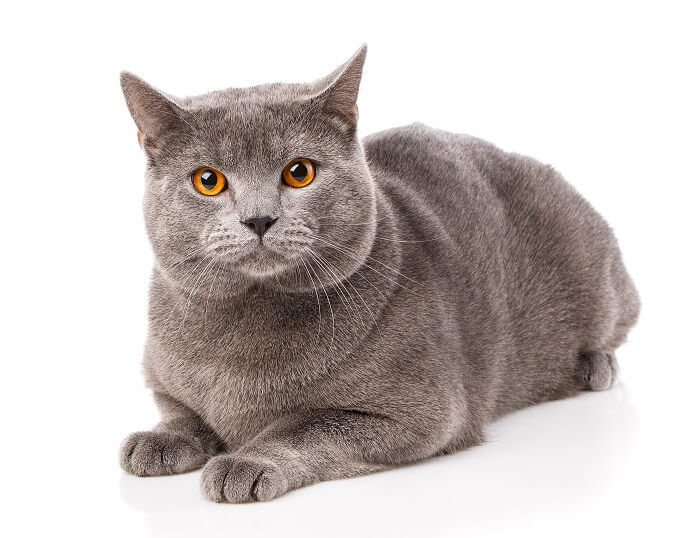
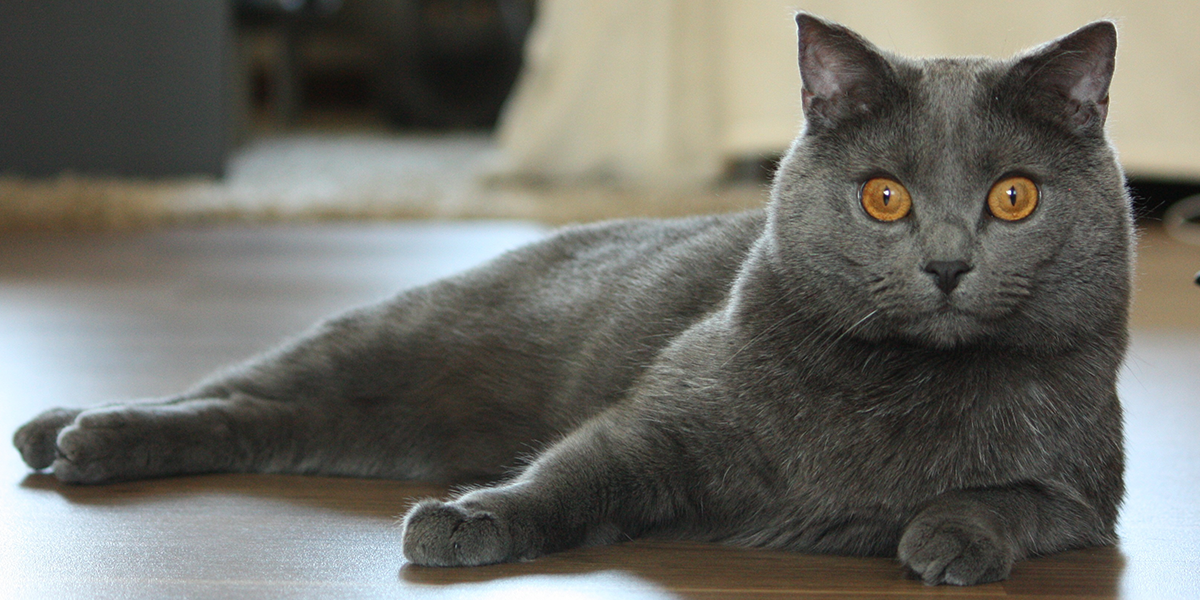
The semi-wild cats of the Breton islands shaped the appearance of the Chartreux. It is strong and muscular with a well-defined, angular muzzle and a trapezoidal skull: it should be broad at the base and narrow at the forehead. The cheeks are particularly pronounced, they frame the face like a hood, especially in tomcats. This makes for marked differences in the appearance of male and female cats! The erect ears are set high and quite close together. The chest is strong, the legs of medium length and muscular. They are carried by large, broad paws. The intensely colored yellow eyes of the Chartreux are particularly striking. The color can vary from dark yellow to copper. Their fur is also characteristic: blue-gray in color, short and particularly dense, it is one of the breed’s trademarks. The thick undercoat gives the fur a slightly woolly appearance.
The origin of the blue-gray color is interesting: In Chartreux and Russian blue, the black pigment eumelanin is diluted to blue by a so-called “thinner”. This predisposition is inherited as an autosomal recessive trait. In other cat breeds, this gene ensures that red is diluted to cream and brown to lilac. Despite the similar color, the appearance of the Carthusian cat is said to be clearly different from Russian blue and British blue. Crosses between Carthusian monks and these two races are undesirable.
Carthusian Cat Temperament
The Chartreux cat is considered a particularly intelligent and people-friendly breed. In France, she is often referred to as a dog-cat because she loves fetching in addition to extensive cuddling sessions. The Carthusian unconditionally joins people, quickly feels at home in a new environment, and is considered to love harmony! This makes the Carthusian breed a particularly problem-free, uncomplicated breed – their often “smiling” face is a perfect expression of their character. The so-called “Carthusian smile” is also reflected in their voice: In contrast to the rather noisy oriental cat breeds, the Carthusian cat’s meowing is also rather calm and quiet.
Chartreux cats tend to be calm animals, they are considered sociable and not very aggressive. They are therefore suitable for keeping in the apartment, but also enjoy being outdoors in the garden or having a secure run. Their short, dense fur does not tend to knot and is easy to clean – an advantage especially for outdoor cats who love to roam around in the bushes and undergrowth!
If they are kept alone in the house, the Chartreux should be given sufficient stimuli so that they can let off steam in the apartment and be mentally busy. This includes climbing and scratching opportunities, resting places, and potential hiding places. Many ceiling-high scratching posts offer all of this in a small space, but you can still let your imagination run wild! A bookshelf can be converted into a cat climbing wall, heated loungers and non-slip cushions on the windowsill invite you to relax and watch.
Diseases
Responsible breeding is the first step to a healthy, balanced cat. This means that the Chartreux is not particularly susceptible to certain hereditary diseases. The exception: FNI, or “neonatal isoerythrolysis in cats”. Due to the frequency of blood group B in Carthusian cats, if a cat with blood group B is mated with a tom with blood group A or AB, there is a risk of feline neonatal isoerythrolysis in the kittens. In plain language, this means: The blood groups of the mother cat with blood group B and kittens with blood group A are incompatible after birth. With their first milk, the kittens absorb antibodies against blood group A – this travels to excrete the red blood pigment through the urine and anemia. Acute feline neonatal isoerythrolysis is fatal for kittens. With 44 percent, the Chartreux has the largest preposition for FNI.
In general, mating incompatible blood groups can be avoided. It is essential that the vet determine the blood group beforehand. Fortunately, there are a number of different commercial blood tests available to do this! Professional breeders who care about the well-being of their cats, therefore, rely on a previous blood group test to avoid an FNI in their kittens.
Care and Attitude
Apart from the preposition for feline neonatal isoerythrolysis, the Chartreux is considered uncomplicated and robust. This is also reflected in optimal care and maintenance. Carthusian cats can be kept indoors and outdoors due to their rather calm character. They get along with other cats, children, and even dogs. Too much stress should not be expected of the friendly, harmony-addicted animals. On the other hand, in individual cases, they are even suitable as single cats, as long as there is enough address to “their” human.
A species-appropriate attitude is the best prerequisite for a long, healthy cat life. This includes a species-appropriate diet with plenty of healthy meat that provides high-quality protein, and regular care by the veterinarian. Don’t forget to look into your mouth here! Because the cat’s teeth are not protected against tooth decay either.
Cats that enjoy being outdoors should be given vermin prophylaxis and vaccinated as needed at regular veterinary check-ups. A basic immunization against rabies, cat flu, and cat epidemic is useful for cats with free-range. If you receive your cat when you are a kitten, a vaccination against leukosis may also be appropriate. In older cats, however, this makes less sense, as they have often already come into contact with the pathogen. The vaccination recommendations for veterinarians are constantly updated – people now refrain from annual vaccinations and only vaccinate every two or three years. A clear marking with a microchip facilitates repatriation in the event of an emergency. Just don’t forget to register your cat with one of the pet registries for free after it has been tagged.
Apart from that, a cat-friendly environment is essential so that your Chartreux feels completely comfortable. All cats should be able to enjoy numerous scratching, hiding, resting, and playing opportunities. This is particularly important for animals that are exclusively in the home. As a human-centered cats, the Carthusian cats particularly enjoy playing and cuddling with their human family. And with its famous Carthusian smile and velvety fur, the Chartreux convinces every cat lover to continue scratching it for a few more minutes.
Cat Breed

Did the Chartreux convince you with its well-known “Carthusian smile”, its soft fur, and its uncomplicated temperament? Now it’s time to look for a new, four-legged family member! As with other cat breeds, anyone interested in a Chartreux should only trust a professional breeder. Even if classified ads that offer “pedigree cats without papers at a low price” are irritating and you don’t actually need any breeding papers, but only want to offer an amateur cat home for life, going to the breeder has many advantages.
Professional breeders, for example, value the targeted mating of their animals. Inbreeding is avoided, hereditary diseases are minimized and the appearance of the Chartreux is optimized according to the breeding standard. Responsible cat breeders do not allow their dams to be mated continuously. They allow them a certain time to relax. Because rearing a cat litter is a lot of work for mother cats and breeders! This gives his animals enough time to grow up and learn everything they need to know about cats from mothers and siblings before they can move into their new home at the earliest twelve weeks. At this point in time, they are ideally vaccinated, fed appropriately, and presented to a veterinarian several times. The breeder can present these health documents as well as those of the parent animals as well as the entries in the studbook. Because ideally, he is also a member of one of the large breeding associations or the interest group of breeders and lovers of the Carthusian monks, Chartreux d’Europe.
Breeding is an expensive hobby, unfortunately, this is also reflected in the prices. Anyone who values a species-appropriate diet for their animals does not shy away from going to the vet and takes full care of their kittens for at least twelve weeks must charge around $1,000 per cat to cover their costs. But with that, you also get a real Chartreux that will enchant you with its smile and enrich your everyday life!
We wish you and your Chartreux a wonderful time!