





This playful, fledgling breed of cats from Great Britain emerged from the accidental crossing of a chinchilla Persian cat with a Burmese cat. Myths entwine around the origins of which one is cuter and more heartwarming than the other. Just like the Burmilla cat itself. The beauty with the silver shimmering fur is basically also suitable for keeping in an apartment with limited space. However, the Burmilla cat also appreciates having one or two adventures outside – and is very happy to be part of a family.
Burmilla Cat Breed
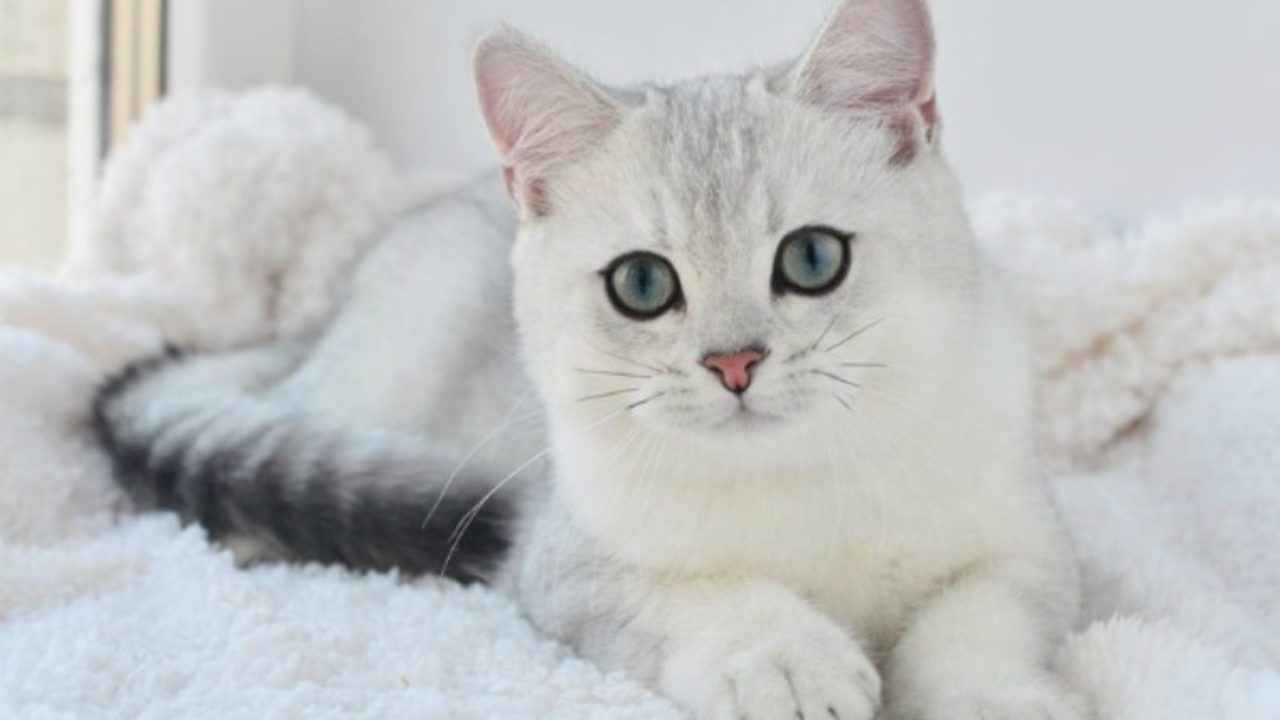
The name Burmilla gives an indication of the two breeds involved in the creation: the Burmese and the chinchilla Persian cat. The emergence of the Burmilla cat in 1981 sounds like a love story or like a cat romance or a kitty fairy tale. Once upon a time, there was a chinchilla Persian cat named “Sanquist” and a purple Burma cat named “Faberge”. By mistake or out of sympathy by a domestic worker because the animal was locked in the study of the English baroness Miranda von Kirchberg – there are different traditions – Sanquist came to Faberge at that time. According to tradition, the baroness herself kept both races. According to another tradition, one of the Baroness Burma cats escaped mating with the chinchilla Persian cat on a neighboring property.
We will probably not find out how it really was. An incontrovertible fact, however, is that the first Burmilla kittens were born accordingly later. The little kittens of this accidental breed were very strong, impressive personalities with shimmering silver fur. This would later become one of the trademarks of this distinctive beauty. At the beginning of 1984, the “Burmilla Cat Club” was founded. With that began the slow but steady rise of the breed. After the coincidental emergence of the Burmilla, its own association took on breeding. It was recognized by the “FiFe” (“Fédération Internationale Féline”) in 1996.
Appearance
The Burmilla cat is built to be as similar as possible to its Burmese ancestors. In terms of stature, she is rather small to medium-sized. Her physique is as strong and muscular as it is elegant, and she can weigh between 3 and 6 kg. Your chest is quite broad. Her legs are slender and her paws are delicate. Their back legs are slightly longer than the front legs. The characteristic external features of the Burmilla cat are the sparkling silver fur and the distinctive “makeup” that frames and accentuates their nose, lips, and expressive eyes. The dazzling beauty around the eyes looks as if someone had generously applied a kohl pencil.
The basic color of the fur is pure silver-white with tipping in the colors “shaded” or “shell”. Black, blue, chocolate, lilac, cinnamon, fawn-silver-red, creme-silver, and fawn-tortie-silver are officially recognized as coat colors. The Burmilla cat is available in two different fur lengths – with half-length and with long fur. At the “GCCF” (“Governing Council of the Cat Fancy”) – one of the oldest European umbrella organizations for cat associations – the half-length coat is called “Tiffanie”. The Burmilla’s fur has a nice soft texture. The recessive gene that is responsible for the long hair was taken over from the Chinchilla Persian cat. These cats have half-length fur that follows the lines of the body. It’s soft and silky. The tail of this Burmilla is long and feathered. The gene responsible for the short fur version is dominant. So if there is a gene for short fur and one for long fur, the gene for short fur always prevails. A Burmilla cat with short fur always develops from this.
The head of the Burmilla cat is rounded with a strong jaw. More precisely, the tip of the head is slightly rounded, at the level of the eyes and the jaw the head is wide, and it tapers to a short blunt wedge. The nose and the tip of the chin are ideally in line. The eyes of this breed of cats can be any shade of green. In the youth of the cat of this breed, the eyes are mostly greenish-gold to yellowish, with the green fading as the cat gets older. The entire appearance is somewhat comparable to that of the Burmese, but with a “cuter” expression that corresponds even more to the child scheme.
Temperament
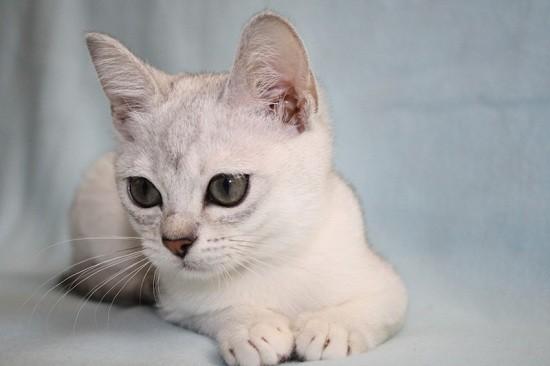
The Burmilla cat is very people-oriented and literally develops an unconditional love for its owner. When she lives with a family, she creates a very intense bond not just with one person but with all family members. The same is true within their feline family. With a great need for communication and a pleasant kind of attachment, she always seeks the closeness of her human roommates. At the same time, she brings the other side of the typical cat characteristics with her. The Burmilla is independent and very demanding at the same time, despite all its devotion – characteristics that also characterize the Burmese cat.
Characteristics such as the need to communicate and the affection of the Burmese cat mix with the Burmilla cat with the calm and relaxed nature of the Persian cat. This roommate kitty is the perfect mix: sociable, playful, loving – Burmilla. In addition, she has a remarkable feeling for the people around her, so she feels when “her” person is not doing so well. For all their seismographic sensitivity and calm, gentle nature, cats of this breed love to have fun. The Burmilla cat maintains its playfulness into old age. She gets along well with both other animals and children. Keeping them together with other cats suits their nature the most – especially if their owner is out of the house all day for work.
The Burmilla cat doesn’t like to spend time alone. If you are toying with the idea of bringing such a wonderful creature home, you should have enough time to spend time with your roommate kitty. You, too, will be able to have a lot of fun and relax. The cat breed with the silky silver coat has an intelligent and very inquisitive nature. Because of her strong intelligence, she finds it easy to learn tricks. It doesn’t take up too much space to run around and romp around. A climbing wall (you can even make this yourself), a scratching board, or a scratching post with climbing options – or ideally several – for sharpening claws and stretching muscles should definitely be available. So it corresponds to a species-appropriate attitude, and your feline fur being is guaranteed to feel really comfortable with you.
Burmilla Diet
You can maintain the characteristic shimmering silver shine of the fur by giving your beloved roommate kitty high-quality cat food to eat. On the other hand, if the feed is of poor quality and difficult to digest, this can lead to a lack of vitamins and minerals. This in turn causes a lack of shine and an overall impression of the coat that appears less well-groomed.
Since cats are carnivores by nature, it makes sense to offer your fur nose food with high meat content. Furthermore, factors such as age or state of health influence the amount and type of feed. For example, older cats need special senior food. Diet food should be given to your cat if it is too fat. Regardless of whether you choose dry or wet food, the decisive factor is the quality. Make sure you only feed high-quality cat food. Other feeding methods are BARF (biologically appropriate raw feeding) and self-cooking, but you should find out about the respective method beforehand. Deficiency symptoms can thus be avoided. You can get advice from veterinarians or other competent persons.
Health & Care

The fur of the Burmilla cat is quite easy to care for. But she enjoys it when her human roommate grooms her fur with a cat brush. This also prevents the fur from becoming matted, because the fat content is distributed over the entire fur due to the brushing. For this reason, you should take time to groom your feline friend once a week. The cat’s fur is not only visually and haptically appealing, but also fulfills important functions. It transmits sensory information to the cat and protects it from heat and cold, wind and rain. Vitamin D is also produced through the fur.
Obesity in a cat can also lead to the fact that it does not reach all parts of the body when grooming its body due to its fullness – and the coat is consequently less well-groomed and shiny. The same applies if, due to old age, the cat can no longer easily reach all parts of the body because it has arthritis or its physical flexibility is simply limited. Bathing the cat too often can also damage the coat. Dull fur can also indicate more serious diseases such as diabetes, parasite infestation, allergies, an autoimmune disease, or the like.
In any case, Burmilla cats can experience allergies more often than other cats. The triggers can be very diverse. The most common are flea bites and environmental allergens such as pollen, house dust mites, and mold spores. A pollen allergy manifests itself accordingly only during the respective pollen flight times. Cats can also have an allergic reaction to certain foods. For example, on feed that contains wheat, beef, or fish. Additives such as colorings and preservatives can sometimes trigger allergies in cats and should be avoided as far as possible. Even fragrances and dyes in cleaning products can lead to allergy symptoms in your feline fur creature.
To find out which substances the cat is allergic to, the veterinarian can perform an allergy test. If there is an allergy to certain ingredients in the food, it is quite easy to find out for yourself by trying food that does not contain any of the foods that are suspected of causing an allergy in the cat. Regarding the therapy of a possible allergy, your trusted veterinarian knows which one should be used here. Homeopathy has also basically proven itself in cats. As a potential new owner, you should use the pedigree to ensure that no serious kidney problems have occurred in the past. Because that would increase the likelihood that this would also be the case with your roommate kitty.
Choosing Burmilla Breeders

There are currently few breeders for the Burmilla cat. When it comes to choosing the right breeder, the same criteria apply to the Burmilla as to other cat breeds. If a supposed breeder offers to sell cats without papers, you should definitely refrain from buying them. Get an impression of the respective cat breed. How do the cats affect you? Are you open-minded and balanced or scared? How do you look? Do you have any external abnormalities such as sticky and puffy eyes? The latter must not occur under any circumstances. A serious breeder is also characterized by the fact that he belongs to an association or club affiliated with the “FiFe”. He can also provide you with the cat’s pedigree and will willingly give you a copy.
Reliable tests now exist to identify genetic defects. In the future, these may even be absolutely necessary. With all the diligence and care of the breeders, it can of course still happen that not all kittens in a litter are healthy. A trustworthy breeder is interested in their welfare even after they have given up their kittens and will be available to answer any questions even after the cats are with you.
We wish you a wonderful coexistence with the flatmate kitties in need of communication in silky silver coats.















