





“Holy Burma” – the name of the Birman cat creates a lot of confusion. The cat breed is called “Burma” in English – but it should not be confused with the Burma cat! In fact, the Birman came from a French breeding program in the 1920s. Find out more about the breed that is the perfect combination of the Persian and Siamese here!
Appearance

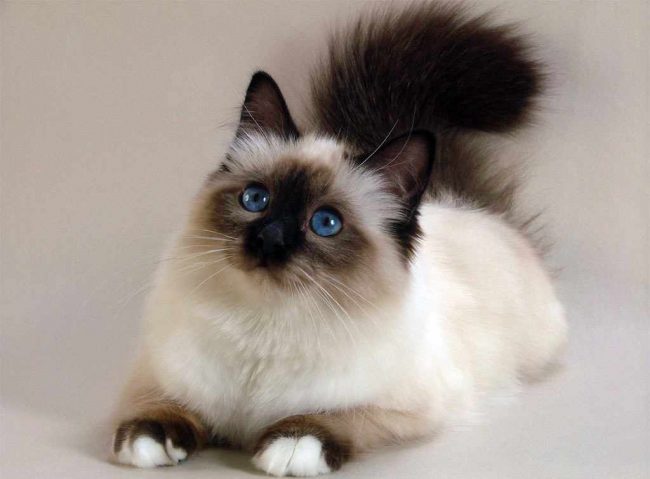
The Birman owes its appearance to a cross between Siamese and Persian cats in France in the 1920s. It is therefore not surprising that Birman cats are outstanding animals in terms of character and appearance. The Burmese body is somewhat elongated and the legs are short. The big blue eyes of the Birman are particularly noticeable. The fur on the face is short, on the rest of the body, it is medium to long.
Holy Burma Weight
An adult Sacred Birman cat should ideally weigh between 3 and 4kg, male representatives of the breed should weigh between 4 and 7kg. The weight of a Sacred Birman kitten after birth is around 100g. In the first week of life, the value usually doubles. Cats and hangovers usually gain a similar amount of weight by 10 weeks. After that, hangovers gain weight faster and more than cats. Regularly check the weight of your fur nose and see if the kitten is losing weight. This could be an indication of health problems such as parasite infestation. If you lose weight, you should see a veterinarian immediately.
Birman Cat Colors
Their half-length fur is predominantly white and only darkly colored at the body tips such as the snout, legs, tail, and ears. This color drawing is called the “point”. According to the genetic basis, the basic color of the cat can only be seen on the cold parts of the body, the so-called “points”. The rest of the body is mostly white.
This coloring is one of the most important breed standards for the breed. However, not every point cat with white paws and half-length fur is a Birman! The Birman’s body must be elongated, yet muscular and of medium weight. It is carried by short, stocky legs. The tail is bushy. Her head is strong, she has a pronounced chin. Her deep blue, round eyes are particularly outstanding! The fur of the Birman is half-length and silky. In contrast to the Persians, Birman cats have little undercoats.
What Colors of the Birman Cat are There?

As a pointed cat, all point colors are approved for breeding in Burma. According to the genetic basis, every coat color can also appear as a point color. Black and red are seen particularly frequently. There are also the dilutions “blue” and “creme” as well as “chocolate” and “cinnamon” and their dilution “lilac” and “fawn”.
The colors of Holy Burma are designated as follows, depending on the basic color:
- Seal-point: Burma in seal-point have a black basic color
- Blue-point: Black basic color, diluted to “blue”
- Chocolate-point: In the case of Holy Burma in chocolate-point, the base color is brown
- Cinnamon-point: Red base color, only visible in the point tips
- Fawn-point: The basic color in “cinnamon” is diluted to “fawn”
- Lilac-point: The dilution of brown is called “Lilac” (it is of course only visible here in the point tips)
- Red-point: Burma red-point have a red base color
- Creme-point: “Creme” is the name given to red (Burma creme-point have cream-colored points)
The point tips can even have stripes! These are listed as “tabby” in the color code. Examples are Birma Seal-tortie-point, Blue-tortie-point, or Chocolate-tortie-point. In addition, according to the breed standard, a red piebald is allowed – this is known as a “tortie”. There are even Birman cats in lilac-tortie-tabby-point.
The cause of the discoloration of the body fur is now known. It is a mutation that causes the enzyme tyrosinase to malfunction. This disrupts the production of the pigment melanin and thus leads to “partial albinism”. Burma also has pure white paws, so-called “spores”. This peculiarity was genetically cleared up in 2009. A mutation in the Hardy-Zuckerman 4 feline sarcoma viral oncogene homolog (KIT) gene is responsible for the characteristics of the gloves. But enough of the genetic characteristics of the Birman cat!
Birman Cat Temperament
What cat lovers already suspected in the appearance of these special animals are confirmed in the character of Holy Burma. The friendly cats, who are affectionate and good-natured and who enjoy spending time with “their” human, is, according to breed history, a cross between Siamese and Persian cats. Birman cats are very friendly to people. They are often sold as the perfect animals for families with children. Cats and children make a good team – if both of them know the rules of the game. You should therefore prepare your child before the cat moves in so that cats are not cuddly toys. A properly treated cat, who can also enjoy its space, will be happy to cuddle with your child. If you approach your cat and child with a little patience and instinct, they will both become best friends!
Many cat owners report that the animals also trust strangers, like to be lifted and petted, and like to get into strange cars. You can tag your cat with a microchip and have it registered with a pet registry so that it can find you again quickly if the worst comes to the worst! Your trusted veterinarian can implant the microchip quickly and painlessly in the animal’s shoulder area, there are no health risks.
Burmese Cats Attitude

The sociability of the Burmese extends to other animals and especially cats. Birman cats, like all other cats, should ideally be kept in pairs. Especially when you have little time to spend with your feline family member! As particularly gentle animals with a medium urge to move, they are also suitable for keeping in the house, provided that there are enough stimuli in the apartment. A scratching post and sufficient hiding places and viewing options are a must, as are regular play units between cat and human.
Health and Care
The Birman is considered to be robust and healthy. Their semi-long fur has a little undercoat and therefore seldom tends to become matted. It is often enough to brush your Holy Burma thoroughly once or twice a week. Get your cat used to brushes and combs at an early age. This will make grooming your fur a lot easier!
A disease that can only be combated by excluding sick animals from breeding is hypomyelination. This genetic defect also occurs more frequently in Birman cats. Affected animals are prone to severe tremors and spastic attacks due to a disruption of cell communication. This disease can often be recognized as early as the third week. Sick kittens appear spastic or uncoordinated, they shiver abnormally and develop tremors. Often the symptoms are associated with hearing loss or a short life expectancy. In exceptional cases, however, these problems can stabilize during growth and are therefore often not taken seriously. A fatal mistake! Hypomyelination can be inherited – even if the breeding animals themselves no longer show any symptoms.
Birman Cat Diet
A healthy diet is the best prophylaxis against diseases and the best guarantee for a long and healthy cat life. The basis of cat nutrition should be high-quality wet food with a high percentage of meat and lots of animal protein. Scientific studies have confirmed that cats prefer foods with a composition similar to that of the mouse. The cat’s average prey animal usually consists of 50 to 60 percent protein, 20 to 30 percent fat, and three to eight percent carbohydrates from the contents of the animal’s gastrointestinal tract. According to legal regulations, the list of ingredients on the packaging label is sorted by quantity. So it’s not surprising that meat should be at the top of the list of contents. In addition, the cats should always have enough fresh water at their disposal.
Species-appropriate cat food helps keep your cat healthy. Unfortunately, it does not protect against hereditary diseases. Many breeders and keepers of the Holy Burma report increased eye infections and a tendency to squint. There are also dermoid cysts, especially on the ovaries and testicles, but also in the head area.
Birman Cat Breed
There are different reports about the origin of the Birman cat. One thing is certain: the ancestors of the breed, officially known as “Holy Burma”, are Siamese cats and Persians. How it came to this mating is uncertain. Some sources tell of an industrialist who brought a pair of Siamese cats from the Orient around 1919. The tomcat does not consider the crossing – the descendants of the female are said to have been crossed with Persian cats. Other stories suggest that the ancestors of Sacred Burma were temple cats from Burma. The recognition as a breed, however, is clearly understandable, it took place in France in 1925. Since 1964 the breed has also been recognized in the FIFe.
The breeding of Holy Burma finally came to Germany. The first official Holy Burma in Germany was the tomcat “Timour de Madalapour”, of which a picture appeared in 1933. The second world war brought the breeding here to a standstill. After the war, however, targeted breeding programs were continued; in 1955 the Burma population had recovered. In Europe and the USA, the classic colors Seal-Point and Blue-Point were used for breeding. In England, the breeders broke new ground and brought Burma in the colors Chocolate-Point and Lilac-Point into the gene pool.
In the meantime, other, newer color variations of the Birman cat have been added. Red-Point and the Thinning Creme-Point are just a few examples. Now there is even Sacred Burma in tabby and tortie. As with all Birman cats, these drawings are of course only shown in the “points”, the tips of the body.
How to Find the Right Breeder

The occurrence of hereditary diseases shows again and again how important breeding selection and sensible mating are. Breeders who care about their animals’ welfare invest in genetic testing. They do not hesitate to exclude sick animals from breeding. For you as a cat lover, this means the following. Only trust professional breeders who can provide you with health records or the results of genetic tests.
These breeders do not only have the pure “reproduction” of their animals in mind. They invest in good health care for their animals, high-quality feed, and good socialization. This also includes never allowing kittens to move into their new home before they are twelve weeks old! This “conditioning phase” is essential for the physical and mental health of the cat. After all, in the first few weeks of life, she learns the essentials for a long, balanced cat life. A good breeder, therefore, gives his dams time to recover after the strenuous pregnancy and childbirth and often does not raise more than one litter per year. A serious breeder is a member of one of the breeding associations and acts in accordance with the Animal Welfare Act.
All of this is of course reflected in the price. The actual pedigree doesn’t make up the price you put on the table for a pedigree cat. Rather, it is the experience of the breeder and the care and cares that he gives his animals. Therefore do not trust advertisements that offer “Birman cats without papers at a low price”. In most cases, it is a matter of breeders who have less the health of their animals in mind, but above all their profit.
It’s understandable if you don’t want to or can’t pay between 500 and 1000 dollars for a cat. Cats from animal welfare are an alternative. In animal shelters, many animals of all ages and races are waiting for a good new home – and maybe you will find your dream cat here!















